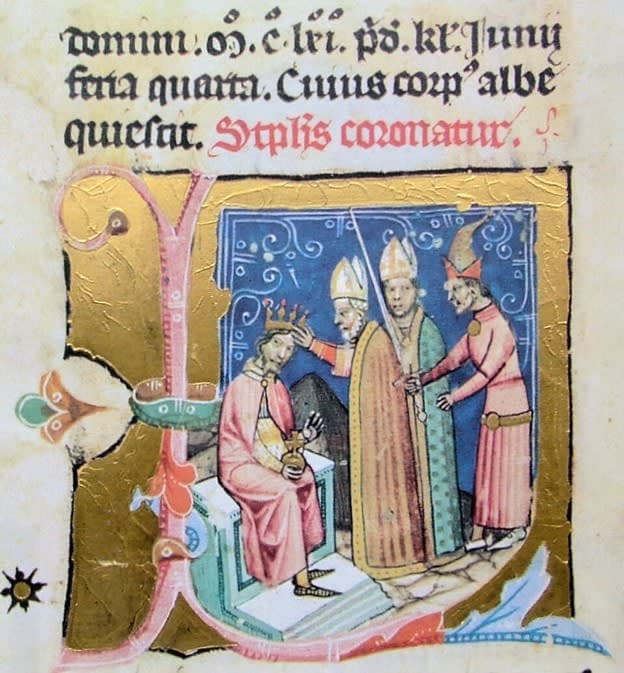

The life of Stephen III, the eldest son of King Géza II and his wife Euphrosyne of Kiev, daughter of the renowned Prince Mstislav I Vladimirovich the Great, seemed destined for glory from the very beginning.
Even his baptism became an event of European significance: the newborn Hungarian prince's godfather was none other than King Louis VII of France, whose route to the Crusade passed through Hungarian territory.
However, this boy, in whose veins flowed the blood of powerful European and Rus' rulers, was destined for a life filled with hardship and a tragically early death.

Stephen ascended the Hungarian throne while still a young teenager, immediately following the death of his father.
He inherited a difficult legacy: the kingdom had attracted the watchful and predatory attention of the powerful Byzantine Empire.
Throughout his brief reign, the young monarch was forced to wage a desperate and exhausting struggle against the schemes of his bitterest enemy — the energetic, extraordinarily cunning, and treacherous Byzantine emperor Manuel I Komnenos.
The basileus cherished a single great ambition: the complete subjugation of Hungary and its transformation into an obedient vassal of Constantinople.

The first, nominal reign of the young Stephen III lasted no more than two months.
Emperor Manuel, unwilling to see an independent sovereign on the Hungarian throne, decided to play the dynastic card and install Stephen's uncle, Ladislaus II, as king of Hungary.
This claimant was prepared to make any concessions and fully agreed to bring the country under Byzantine influence.
Faced with overwhelming military superiority and internal betrayal, the legitimate King Stephen, his mother Queen Euphrosyne, and his two younger brothers were forced to flee and seek refuge behind the walls of the heavily fortified city of Pozsony.

The reign of Ladislaus II proved short-lived: the usurper died suddenly on January 14, 1163.
However, there was no respite.
The supporters of the deceased ruler immediately proclaimed his younger brother the new king, who would enter history as Stephen IV.
Like his predecessor, he relied on Byzantine military power and unconditionally supported the empire of the Romans.
Such servile submission to a foreign power provoked first quiet resentment and then open outrage among the proud Hungarian nobility.
The barons attempted to overthrow the usurper on their own, but their rebellion failed.

Realizing that the kingdom's internal resources were insufficient to reclaim the crown, the young Stephen III demonstrated diplomatic skill far beyond his years.
He appealed for military support to another great European power — Holy Roman Emperor Frederick I Barbarossa.
This alliance bore fruit.
With the support of the formidable army of the German emperor, Stephen managed to return triumphantly in June 1163, arrest his treacherous uncle, and reclaim his legitimate throne.
At that moment, the Church intervened in the fate of the captured usurper.
At the urgent request of the influential Archbishop Lucas of Esztergom, Stephen III showed mercy and restored freedom to his uncle and namesake.
This act of generosity proved costly for the kingdom.
The liberated Stephen IV immediately fled to Byzantium, giving Emperor Manuel another opportunity to continue his anti-Hungarian political intrigues.

By the end of that same year, 1163, Byzantine armies once again invaded Hungary, intending to restore their puppet claimant to the throne.
But the increasingly mature Stephen III offered fierce resistance.
Confronted by the determined opposition of the Hungarians, the cunning Manuel Komnenos decided to radically change his strategy.
He recognized that supporting Stephen IV was completely futile and officially withdrew his backing.
Instead, the Byzantine emperor offered Stephen III peace and full recognition as the legitimate king, but imposed two extremely harsh conditions.
First, Hungary was required to permanently surrender the region of Szerémség (Syrmia) to Byzantium, a territory that the usurper Stephen IV had previously attempted to hand over to the empire.
Second, the Hungarian king's younger brother, the fourteen-year-old Prince Béla, was to be sent to Constantinople as an honored hostage.
With a heavy heart, Stephen accepted these conditions for the sake of saving his country.
Szerémség passed into imperial possession, and young Béla left his homeland.
Yet the long-awaited peace never came. The treaty proved to be merely another Byzantine deception.
In the second half of 1164, the treacherous Komnenos launched a new war, using the protection of the so-called "inheritance of Béla" as his formal justification.
The situation was complicated by the fact that the late Géza II had bequeathed the crown of Croatia and Dalmatia to his son Béla.
The Byzantine emperor, now acting as the young prince's "guardian," sent troops into these territories.
Stephen III made repeated, desperate attempts to recover the lost lands by force of arms, but fortune turned against him.
As a result of years of warfare, by 1167 both Croatia and Dalmatia had been definitively separated from the Kingdom of Hungary.
Trapped in a seemingly endless struggle against the Byzantine Empire, Stephen III desperately searched for powerful allies, directing his attention toward the Bohemians, Germans, and the principalities of Rus'.
In 1167, fortune finally seemed to smile upon him.
A strategic alliance between Rus' and Hungary was concluded, sealed by the king's marriage to the daughter of the powerful Galician prince Yaroslav Vladimirkovich Osmomysl.
However, the ever-watchful Manuel Komnenos was not idle.
Using his seemingly inexhaustible financial and diplomatic resources, he managed to destroy this alliance.
The emperor persuaded Osmomysl to switch sides, generously promising him military assistance in Galicia's continuing struggle for complete independence from Kiev.
Betrayed by his ally, Stephen III was forced to send his Rus' wife back to her father.
The following year, in 1168, he attempted to strengthen his western borders by marrying Agnes of Austria, daughter of the Austrian duke Henry II.
Yet even in his family life, the monarch was pursued by cruel misfortune.
Agnes, who would later die around 1183, bore him two sons, but neither was destined to continue the dynasty.
The first boy lived for less than a year, while the second died only a few days after his birth, following Stephen's own death.

The final act of this historical drama unfolded in early 1172.
At that time, Stephen III was honorably receiving a distinguished guest in his kingdom — his godfather, King Louis VII of France, who was making a pilgrimage to the Holy Land.
The young Hungarian monarch seized upon this meeting as a desperately needed opportunity, regarding the French king as the ideal ally for a decisive strike against Byzantium.
But these grand plans were never destined to become reality.
In the midst of the negotiations, Stephen suddenly fell ill with an unknown disease and died unexpectedly on March 4, before even reaching his twenty-fifth birthday.

The young king's death was so sudden and so disturbingly convenient for Emperor Manuel that the theory of deliberate poisoning remains one of the principal explanations discussed by historians.
Byzantium's motives seemed obvious.
First, Stephen's death immediately destroyed the emerging and potentially dangerous Franco-Hungarian alliance.
Second, Stephen's wife, Agnes, was pregnant with an heir at the time. The birth of a legitimate son would have permanently blocked the Byzantine candidate's path to the throne, although, as we know, the infant would soon die.
Third, Manuel already had an ideal candidate for the Hungarian crown — one who was fully prepared and completely loyal to him.
That candidate was the deceased king's younger brother, Béla.
During more than eight years spent amid the luxury of the Byzantine court, he had mastered the Greek language, absorbed imperial customs, and even adopted a new Orthodox Christian name — Alexios.
Unlike the previous puppet usurpers, Béla was an entirely legitimate heir to the throne in the event of his elder brother's death without surviving sons.
Nevertheless, Manuel was not accustomed to leaving anything to chance.
As a precaution, Béla-Alexios was accompanied on his journey home by an elite Byzantine army.
However, no display of military force was necessary.
Neither his grieving mother Euphrosyne nor his younger brother Géza offered the returning prince any serious resistance.
Béla's unquestionable legitimacy achieved what military force might otherwise have struggled to accomplish: bloodshed was avoided.
Thus, a new monarch ascended the Hungarian throne under the name Béla III, turning yet another page in the turbulent history of the Kingdom of Hungary.


