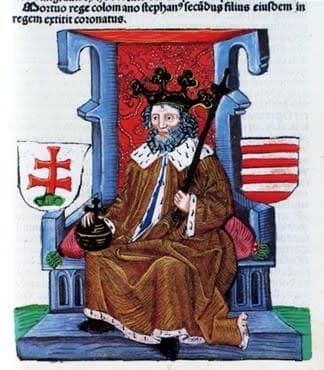

The life of Stephen II was inseparably connected with the fierce struggle for the Hungarian throne from his very first breath.
Around 1101, Queen Busilla, also known in history as Felicia, the noble daughter of Count Roger of Sicily and wife of King Coloman the Learned, gave the monarch two heirs at once — twin boys.
They were named Ladislaus and Stephen.
However, the joy of the royal court was short-lived. One of the brothers, Ladislaus, died — according to some chronicles, in infancy, shortly after birth, while other sources claim that he tragically failed to reach adulthood, dying in 1112.

Young Stephen remained the only surviving son and the greatest hope of the aging Coloman.
Storm clouds were gathering over the throne. The boy's own uncle, the rebellious Prince Álmos, repeatedly launched bloody uprisings in an attempt to wrest the crown from his brother.
Determined to permanently eliminate any claims by Álmos and secure the legitimacy of his direct line, Coloman took an unprecedented step. As early as 1105, when Stephen was still a small child, he was solemnly crowned as the legitimate heir to the throne.
But even this failed to stop the restless Álmos.
After a series of betrayals and renewed attempts to overthrow the government, King Coloman's patience finally ran out.
Around 1115, he issued a horrifying order: Álmos and his young son Béla were seized and blinded.
Coloman hoped that his mutilated relatives would disappear from the political scene forever.
However, this brutal punishment merely became the prelude to further troubles. Even after losing his sight, Álmos continued plotting intrigues.

Understanding how fragile royal authority had become, the young prince's supporters acted with lightning speed.
On February 3, 1116, only days after Coloman the Learned had breathed his last, Lőrinc, Archbishop of Esztergom, hastily proclaimed the young prince the new ruler of Hungary — King Stephen II.
The beginning of the young monarch's independent reign turned into a genuine military catastrophe.
Barely having ascended the throne, Stephen led his army on a campaign against the Bohemians in the spring of 1116.
On the banks of the Olšava River, a major battle unfolded, ending in a devastating and humiliating defeat for the Hungarian forces.
The scale of the tragedy was so enormous that the famous chronicler Cosmas of Prague left a chilling account in his Chronicle of the Bohemians, recording that in this slaughter, "even more Hungarians perished than at the Lech River."
This was a reference to the legendary and most devastating Hungarian defeat of the tenth century.
Portrait of Cosmas of Prague from the Leipzig manuscript.

The Republic of Venice immediately and coldly exploited this catastrophic weakness.
The Venetians, who had long coveted Hungary's possessions along the Adriatic Sea, launched a large-scale military campaign.
This exhausting war, interrupted by occasional periods of peace, raged for nine years, from 1116 to 1125.
Already weakened by battles on other fronts, Hungary ultimately failed to maintain its positions, and the Venetians ruthlessly seized the strategically important region of Dalmatia from the kingdom.
Defeats in the west and south did nothing to temper Stephen II's warlike nature.
In 1121, he turned his attention eastward, deciding to intervene openly in the bloody dynastic conflicts tearing apart the principalities of Rus'.
He led his troops to support Prince Yaroslav Sviatopolchich, who had entered into a desperate struggle against the powerful Vladimir Monomakh.

The climax of this campaign came in 1123, during the difficult siege of the city of Vladimir-Volynsky.
During the assault, Hungary's ally, Prince Yaroslav Sviatopolchich, was killed.
Despite the death of the very man for whose sake the war had seemingly begun, Stephen II, consumed by the desire for battle, demanded that the siege continue and that the city be captured at any cost.
But then something extraordinary happened.
The Hungarian nobility, exhausted by meaningless losses on foreign soil, launched an open rebellion against their sovereign.
The king's closest advisers, barons, and military commanders issued an ultimatum demanding an immediate return to Hungary.
They openly declared to Stephen that if he refused to lift the siege, they would depose him from the throne without hesitation.
This episode vividly exposed the weakness of royal authority. Grinding his teeth in frustration, Stephen was forced to obey his own vassals and lead the army home.
The monarch's internal weakness once again emboldened his old enemies.
In 1126, the blind Duke Álmos, relying on an extensive network of supporters among the dissatisfied Magyar aristocracy, launched his final desperate attempt to seize the Hungarian throne.
The conspiracy was uncovered, the rebellion suppressed, and Álmos, having suffered yet another failure, was forced to flee to Constantinople under the protection of the Byzantine emperor.
The presence of a legitimate claimant to the Hungarian throne at the court of the Byzantine basileus made a full-scale war between the two powers inevitable.
Preparing for an extremely difficult confrontation in the south, Stephen II was forced to secure his rear as quickly as possible.
Demonstrating diplomatic cunning, he finally concluded peace treaties with his old enemies — the Bohemians and, at the same time, the Germans.
The great Hungarian–Byzantine War raged from 1127 to 1129.
Even the death of Duke Álmos, who apparently died of natural causes in exile in 1127, could no longer stop the machinery of bloodshed that had already been set in motion.
Stephen II personally commanded his armies, and initially fortune favored the Hungarians. They achieved significant successes while invading Byzantine territory.
However, the military machine of Constantinople eventually reversed the course of the campaign.
The Hungarians were defeated in the decisive battles, and the peace treaty that followed merely confirmed the prewar status quo.
It brought Stephen nothing but thousands of dead soldiers and an exhausted royal treasury.
Continuous warfare pushed the country to the breaking point.
In the late 1120s, another extremely dangerous internal rebellion erupted.
The powerful ispáns Ivan and Bors not only took up arms against the king but went so far as to elect their own rival king.
Stephen had to expend enormous effort and shed considerable blood to suppress this large-scale uprising.
By the end of his life, having barely managed to hold his disintegrating kingdom together, Stephen II appears to have experienced bitter remorse for the sins of his father.
Having no children, he faced a serious succession crisis.
Initially, the king officially designated Saul as his successor — his nephew and the son of his own sister Sophia.
However, exhausted by years of conflict and wishing to reconcile the divided dynasty, Stephen chose to forgive his blind cousin Béla, the son of the late Duke Álmos, who had been hiding in monasteries.
Stephen brought him back to the royal court and personally took care of his future, arranging a prestigious marriage for the mutilated prince.
He betrothed Béla to Helena, daughter of the powerful Serbian župan Uroš I.
Historians do not rule out the possibility that, on his deathbed, Stephen II managed to change his will and transfer the right to the crown to Béla himself.
The king's own fate proved tragic.
Despite his extraordinarily warlike, uncompromising temperament and his constant desire to be in the thick of battle, Stephen II was a physically weak man.
He suffered almost continuously from severe illnesses.
The life of this restless ruler ended ingloriously and painfully.
He died at the age of only thirty from a severe form of bloody diarrhea (dysentery), leaving behind a country exhausted by wars — a kingdom that would soon once again descend into the turmoil of a struggle for power.


