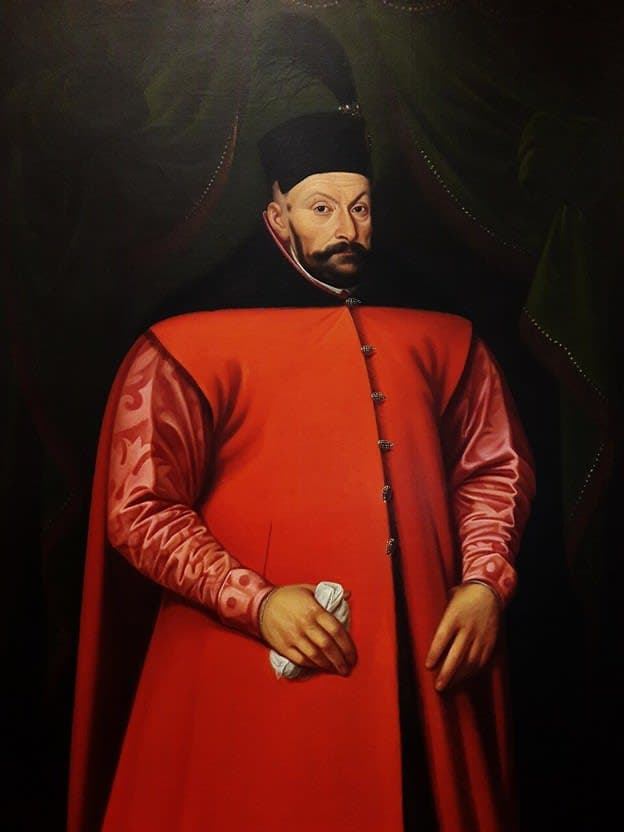
Stephen Báthory was a figure of exceptional historical significance, whose accession to the throne marked the beginning of one of the most dynamic and victorious periods in the history of the Polish-Lithuanian Commonwealth.
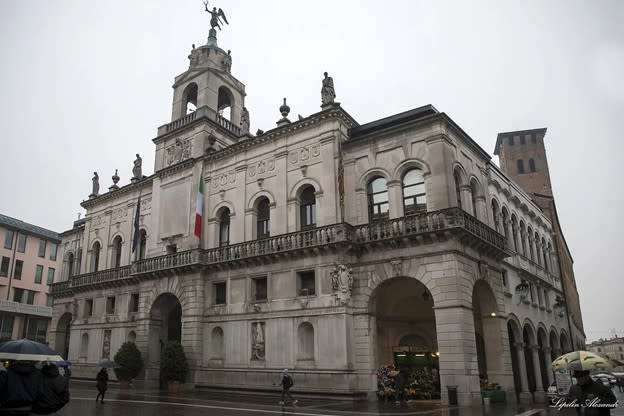
His life began in Transylvania, where he was born into the family of Prince Stephen IV Báthory and Catherine Telegdi. Having received an excellent education at the University of Padua, he absorbed the spirit of the European Renaissance and acquired a profound knowledge of Latin, which would later become his primary language of communication with his subjects.
In 1571, after emerging victorious from a brief but decisive civil war, he established himself as Prince of Transylvania, unaware of the great mission that awaited him in the north.
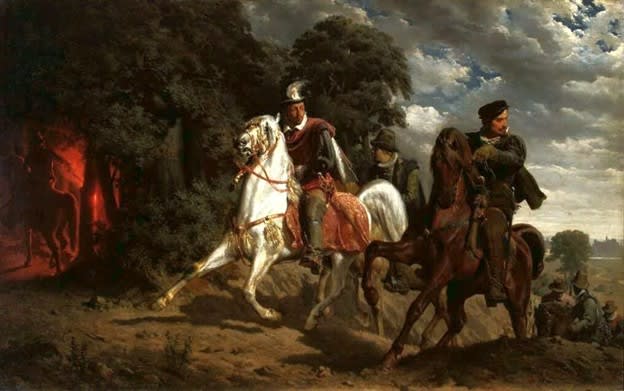
A decisive turning point came in June 1574, when King Henry of Valois secretly fled Poland for France, leaving the Commonwealth in a state of uncertainty that would last for two years.
The Polish-Lithuanian Commonwealth became an arena for the competing interests of Europe's great powers.
The Orthodox nobility, led by Krzysztof Grajewski, saw salvation in an alliance with the Tsardom of Russia and proposed offering the Polish crown to Ivan IV the Terrible.
The senators and the highest aristocracy favored the candidacy of Holy Roman Emperor Maximilian II or his son Ernest.
However, the Ottoman Sultan Selim II strongly opposed the Habsburgs and proposed his own vassal, Stephen Báthory, as a candidate for the Polish throne.
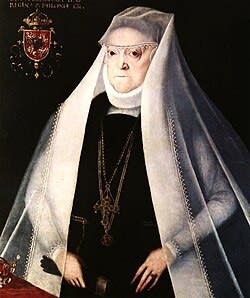
Amid this political division, when the Primate had already proclaimed Maximilian king, the middle and lesser nobility, led by Jan Zamoyski, carried out a political maneuver. They proclaimed Anna Jagiellon, the sister of the late Sigismund Augustus, Queen of Poland, on the condition that Báthory would become her husband and the effective ruler of the state.
To consolidate their success, the armed nobility occupied Kraków, while the unexpected death of Maximilian II in 1576 finally eliminated the threat of civil war.
In 1575, Stephen married Anna Jagiellon, and in 1576, he was officially recognized as Grand Duke of Lithuania.
Although the king knew almost none of the languages spoken by his subjects and communicated almost exclusively in Latin, his political determination was understood by everyone.
He immediately declared his intention to rule as a sovereign monarch rather than a puppet in the hands of the nobility, famously stating:
"I intend to be a sovereign ruler, and I will not tolerate anyone telling me what to do."
He demonstrated his determination through action, suppressing opposition and executing those responsible for unrest, including the Lithuanian nobleman Grzegorz Ościk and Samuel Zborowski.
Báthory's domestic policy was aimed at the comprehensive modernization of the state.
In 1578, he acquired rights to the throne of the Kingdom of Livonia for his dynasty.
Understanding that the strength of a monarch depended on both the military and education, he introduced a series of fundamental reforms.
In 1579, Báthory reorganized the monetary system, establishing the Polish grosz as the principal unit of payment.
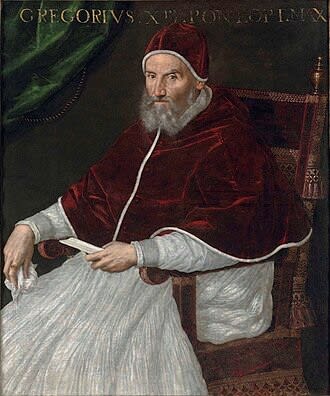
That same year, he granted a royal privilege to the Jesuit College in Vilnius, transforming it into the Vilnius Academy and University. This decision was confirmed by a papal bull issued by Pope Gregory XIII on October 30, 1579.
The king actively supported the Jesuits, regarding their schools as institutions capable of training educated officials and administrators for his reforms.
He founded Jesuit colleges in Lublin, Polotsk, Riga, and other cities.
Báthory's military genius was demonstrated through the creation of a new structure for the armed forces.
He moved away from the cumbersome traditional noble militia in favor of professional mercenaries, particularly Hungarians and Germans, as well as the Wybraniecka Infantry, recruited from peasants living on royal estates.
He paid particular attention to the Zaporozhian Cossacks. In 1578, Báthory provided them with a formal organizational structure, granted them lands, and recognized their right to elect a hetman, effectively becoming their first official patron.
At the same time, he did not hesitate to act harshly when strategic interests and stability along the Ottoman frontier were at stake.
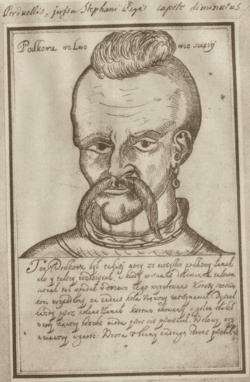
To avoid provoking the Sultan, he ordered the execution of the Moldavian ruler Ivan Pidkova in Lviv.
The greatest foreign policy challenge of Báthory's reign was the Livonian War against the Russian state.
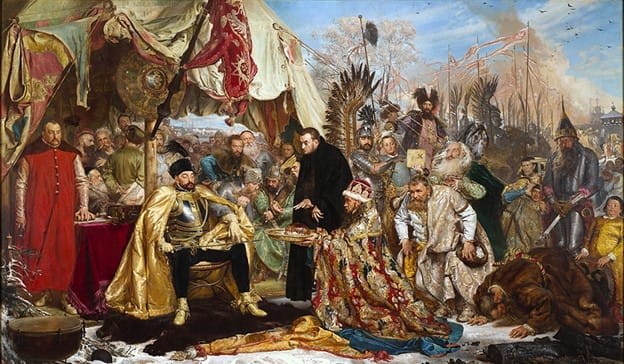
Between 1579 and 1582, Báthory conducted a series of brilliant military campaigns that reversed the earlier conquests of Ivan the Terrible.
His forces captured the fortress of Sokol, Velikiye Luki, and Polotsk.
Although the heroic defense of Pskov by Russian troops halted the king's advance, the Truce of Jam Zapolski was concluded in 1582, under which the Polish-Lithuanian Commonwealth regained control of Livonia.
During the final years of his life, the king developed plans for an even larger war against Moscow and even contemplated a military campaign against the Ottoman Empire.
He discussed these ambitions with Pope Sixtus V and King Philip II of Spain.
Báthory chose Grodno as his royal residence, where he reconstructed the Old Castle, transforming it into a magnificent palace.
The cause of his death was uremia, possibly resulting from a hereditary kidney disease or the physical hardships of his demanding lifestyle.
His death was followed by what is considered the first documented medical autopsy in the history of Eastern Europe.
In his final moments, the monarch demonstrated courage, humbly entrusting his soul to God and calling upon his subjects to preserve peace.
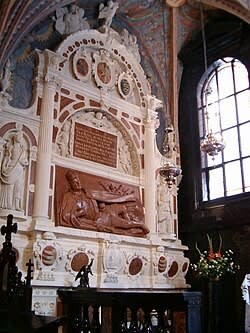
His remains rest in Wawel Cathedral in Kraków, beneath a magnificent funerary monument.


