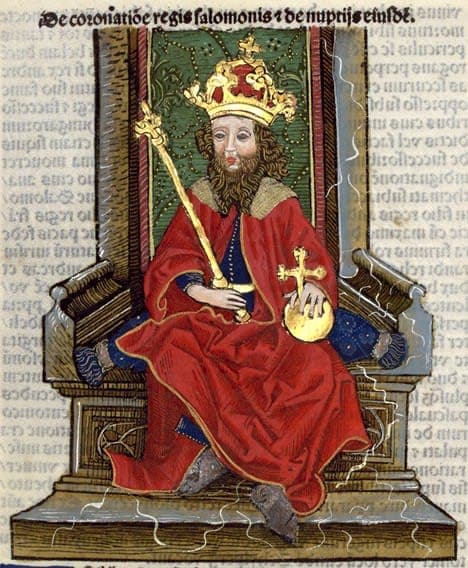

The shadow of a heavy crown fell upon Solomon when he was still a small child. His father, King Andrew I of Hungary, who ruled from 1046 to 1060, had initially sworn to pass the throne to his loyal ally and younger brother, Béla. However, the birth of his long-awaited son overturned all previous promises.
Driven by paternal love and political calculation, Andrew changed his succession plans and forcibly compelled Béla to renounce his legitimate rights to the throne. To secure power permanently for his own line, the king acted swiftly: when Solomon was only five years old, he was officially proclaimed heir to the throne, crowned in advance, and betrothed to Princess Judith, daughter of the powerful German emperor Henry III the Black. The princess was four years older than her Hungarian fiancé.

This decision proved fateful.
Deprived of his rights, Béla refused to accept his fate. Taking advantage of a large-scale uprising by Hungarian pagans who opposed the imposed Christian faith, he called upon the Polish army of his nephew by marriage, Duke Bolesław II the Bold, for assistance.
In 1060, a brutal civil war erupted between the brothers. King Andrew I suffered a crushing defeat and died of severe wounds in the town of Zirc in 1061.
The young Solomon, together with his mother, Queen Anastasia Yaroslavna, was forced to flee to Germany, seeking protection at the imperial court.

However, Béla I's triumph proved short-lived.
Less than three years later, in 1063, he died under rather mysterious circumstances. According to legend, a massive wooden throne collapsed beneath the king.
The death of the usurper and Solomon's strong dynastic connections with Germany gave the young prince an opportunity for revenge.
Relying on the heavily armored German cavalry provided by Emperor Henry IV, the young exile triumphantly returned to Hungary in December 1063 and reclaimed his father's crown.
The sons of the deceased Béla I — Géza, Ladislaus, and Lampert — realistically assessed the balance of power and chose not to launch another war against their cousin.
Instead, they agreed to a peaceful settlement, recognizing Solomon as their legitimate king and accepting the position of rulers of the extensive Principality of Nitra in the north of the country.
The symbol of this fragile reconciliation was a historic ceremony: on April 11, 1064, in the city of Pécs, Géza himself solemnly placed the crown upon Solomon's head.

It seemed that Hungary had finally found peace.
Having ended the exhausting civil conflict and united with his cousins, Solomon was able to direct the full strength of the kingdom toward defending its eastern borders, where waves of Pecheneg nomads launched repeated incursions.
These years became a period of shared military glory.
In 1068, the united Hungarian army caught up with a large Pecheneg force returning from a plundering raid with rich spoils.
In the famous Battle of Kerlés, fought in Transylvania, in what is now Romania's Bistrița-Năsăud County, Solomon demonstrated extraordinary personal courage. Sword in hand, he personally led his warriors in a fierce charge.
The king was wounded in the thick of the fighting, but the Hungarians achieved a brilliant victory.
This was not the only occasion on which they demonstrated their unity.
In 1067, Solomon, Géza, and Ladislaus fought shoulder to shoulder in a successful campaign against the Carantanians and Venetians, defending the political interests of the Slavonian ban Dmitar Zvonimir.
Their alliance was strengthened by family ties: Dmitar was married to Helen the Beautiful, the sister of Géza and Ladislaus.

Yet, despite the blood they had shed together, the seeds of distrust between Solomon and his cousins had already begun to grow.
True peace had never existed between them.
Minor disputes repeatedly escalated into open conflicts, which could be resolved only with great difficulty through the authoritative mediation of the senior clergy.
Sooner or later, the accumulated hostility was bound to erupt.
The decisive confrontation between the king and Géza, Prince of Nitra, took place on February 26, 1074, on the Kemej Plain, north of present-day Karcag.
Fortune initially favored Solomon. He completely defeated his cousin's army, and Géza barely managed to escape from the battlefield.
However, the sons of Béla had prepared for this confrontation in advance.
Upon learning of his brother's defeat, Ladislaus acted with lightning speed.
He brought not only his own troops but also a substantial Polish army sent by their mutual cousin, Duke Bolesław the Bold.
Moreover, a large contingent under the Bohemian prince Otto I the Fair, ruler of northern Moravia, joined the rebels. Otto was married to Euphemia, the sister of Géza and Ladislaus.
On March 14, 1074, in the fateful Battle of Mogyoród, northeast of Budapest, the combined forces of the cousins utterly crushed the royal army.
Solomon lost his kingdom and was forced to flee, while Géza I was proclaimed the new king of Hungary.
From that moment onward, Solomon began a long and desperate struggle to regain his slipping power.
After the catastrophe at Mogyoród, he managed to retain only a northwestern fragment of the kingdom — the counties of Sopron, Moson, and Pozsony.
Making Pozsony, present-day Bratislava, his seemingly impregnable capital, the deposed king defended himself with desperation and courage.
The chronicles claim that Solomon, an exceptional fighter, repeatedly challenged Géza's finest warriors to single combat and invariably emerged victorious.
During this period, he placed enormous hopes in his brother-in-law, the German emperor Henry IV.
However, the empire itself had become entangled in internal conflicts. Henry's exhausting struggle with Pope Gregory VII prevented him from providing substantial assistance to his relative.
The long-awaited imperial campaign against Hungary in August 1074 ended ingloriously near the city of Vác. Alarming news of an uprising in Saxony forced the Germans to turn their regiments back.
Worse still, Solomon's wife Judith abandoned him, preferring to return to the safety of Germany with her brother.

Realizing the complete hopelessness of his political and military position, Solomon surrendered.
In 1081, he officially capitulated in exchange for forgiveness.
By that time, another of his cousins, Ladislaus I, had already ascended the Hungarian throne following the death of Géza I on April 25, 1077.
Returning to the royal court as a pardoned relative, Solomon nevertheless remained unable to reconcile himself to his fate.
In 1083, he attempted to organize a secret conspiracy against King Ladislaus, but his plans were discovered, and the former monarch found himself imprisoned in a damp dungeon.
His life was saved only by a historic celebration.
On August 19 of that same year, on the occasion of the great celebrations surrounding the canonization of Stephen of the Árpád dynasty, Hungary's first king and the ruler who had brought Christianity to the country, Ladislaus I granted the prisoner a second pardon and restored his freedom.
Once released, Solomon realized that he could no longer rely on anyone in the Christian world.
The emperor once again refused to help him, while his own wife Judith did not even wish to see him.
It was then that Solomon, blinded by his thirst for power, committed an act that would permanently stain his name in Hungarian history.
He traveled eastward into the lands of present-day Moldova, where he joined the sworn enemies of his homeland — the Pecheneg horde led by Khan Kutesk.
Disregarding all Christian and moral laws, Solomon married the daughter of the Pecheneg khan, even though his wife Judith was still alive and their marriage had never been dissolved.
Promising to allow the nomads to plunder Transylvania in exchange for military support, Solomon invaded Hungary from the east in 1085, leading a fierce steppe horde behind him.
But King Ladislaus I was prepared for the attack.
Near Kisvárda, in northeastern present-day Hungary, he confronted Kutesk's forces and completely defeated them.
Solomon was once again forced to flee for his life.
Having lost his last hope of reclaiming the Hungarian crown, the exile gathered around himself a band of equally desperate wandering Hungarian knights and permanently bound his fate to the nomads.
He joined a new Pecheneg khan, Chelgu, and participated in the nomads' large-scale campaign against the Byzantine Empire.
This journey would prove to be his last.
In March 1087, at the Battle of Chariopolis, the Pechenegs encountered the Byzantine army and suffered a crushing defeat.
Khan Chelgu fell on the battlefield, while Solomon and his heavily armored cavalry found themselves trapped among the ruins of an old fortress, completely surrounded by Byzantine forces.
The following morning, refusing to surrender, Solomon launched a desperate attempt to break through the encirclement.
However, in the fierce fighting that followed, he was killed by the Byzantines, and his loyal detachment was slaughtered to the last man.


