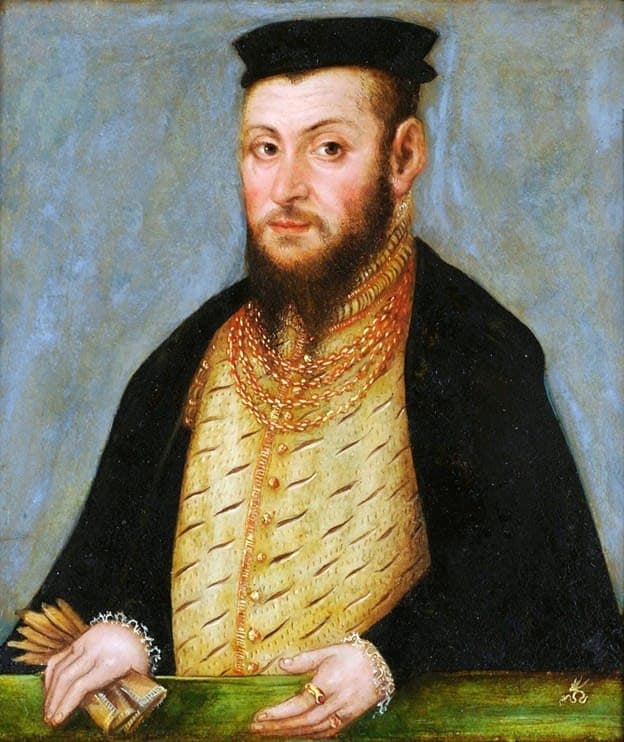

The future monarch was the son of Sigismund I the Old and the charismatic Italian noblewoman Bona Sforza. He was elected Grand Duke of Lithuania as early as 1529, and in 1530, at an extraordinarily young age, he was crowned King of Poland while his father was still alive.
His upbringing, conducted under the constant and authoritarian supervision of his mother, left an indelible mark on his personality. Contemporaries described him as somewhat dreamy, indecisive, and gentle—qualities that Bona deliberately encouraged in the hope of maintaining her influence over her son.

Wishing to separate Sigismund Augustus from his wife, Elizabeth of Austria, whom he had married in 1543, Bona insisted that he depart for the Grand Duchy of Lithuania.
From 1544 onward, he effectively began governing the Lithuanian territories independently.
Elizabeth's death in 1545, which many contemporaries associated with the intrigues of the queen mother, set the stage for a new drama that would become the central theme of his personal life.

Sigismund Augustus's second marriage became a genuine political challenge.
In 1547, he secretly married Barbara Radziwiłł, the widow of Gasztołd, who belonged to a powerful but non-royal Lithuanian noble family.
When Sigismund Augustus officially ascended the throne following his father's death in 1548, this marriage provoked a storm of indignation at the Sejm of Piotrków.
The nobility and magnates demanded that the marriage be annulled, regarding it as a misalliance and an insult to royal dignity.
Even Primate Dzierzgowski offered the king absolution for breaking his marriage vows if he agreed to abandon Barbara.

However, it was at this moment that the king revealed his hidden determination.
Defying his mother's wishes and the pressure of the Sejm, he solemnly crowned Barbara as Queen of Poland in Kraków in 1550.
Their happiness was short-lived. Just one year later, Barbara died, once again giving rise to rumors that Bona Sforza had poisoned her.
Seeking to ensure the continuation of the dynasty, the king entered into a third marriage in 1553 with Catherine of Austria, the sister of his first wife.
However, this union proved childless and unhappy, eventually resulting in a de facto separation and prolonged attempts to obtain a divorce.
Despite the turmoil in his personal life, Sigismund Augustus proved to be an energetic reformer.
In 1557, he initiated a large-scale agrarian reform known as the Volok Reform (Włóka Reform), beginning with the grand-ducal estates of Lithuania.
This reform, which was later extended to privately owned lands, intensified agricultural production and significantly increased state treasury revenues.
It was followed in 1559 by a reform of state forests.
The king's domestic policy was aimed at strengthening the state, a process that the nobility referred to as the "reform of the Commonwealth" (naprawa Rzeczypospolitej).
At the Sejms of 1562–1563, the king secured the recovery of crown lands that had been unlawfully held by magnates.
Decisions adopted at the Warsaw Sejm of 1563–1564 and the Piotrków Sejm of 1567 divided royal estates into two categories: those reserved for maintaining the royal court, known as table estates, and those granted to the nobility.
From the latter, one-quarter of the revenue, known as the kwarta, was allocated to maintaining a permanent military force known as the Quarter Army (wojsko kwarciane).
Sigismund Augustus also demonstrated considerable political foresight in religious affairs.
At the height of the Reformation, he neither sided with religious radicals nor permitted widespread religious persecution.
In 1563, he signed a privilege granting equal rights to Orthodox Christians, Catholics, and Protestants, marking an important step toward preserving domestic peace.
At the same time, he laid the foundations of the Polish navy and carried out judicial and administrative reforms in 1565–1566.
The greatest achievement of Sigismund II was the creation of a unified state.
Initially skeptical of closer political integration, he changed his position under the pressure of external threats and the need to consolidate resources.
Resistance from the Lithuanian nobility was overcome through a decisive measure: the king transferred extensive southern territories from the Grand Duchy of Lithuania to the Kingdom of Poland, including the Kyiv region, Volhynia, and Podlachia.
In 1569, the Union of Lublin was signed, uniting the Kingdom of Poland and the Grand Duchy of Lithuania into a single federative state—the Polish-Lithuanian Commonwealth.
This political entity, with a common Sejm, monarch, and foreign policy, became one of the most powerful states in Europe at the time.

In foreign policy, the king sought to maintain a balance of power, preserving peaceful relations with the Habsburgs and the Ottoman Empire.
However, confrontation with the expanding Tsardom of Russia under Ivan the Terrible proved unavoidable.
The principal cause of the conflict was Livonia. In 1561, Livonia came under Lithuanian control, triggering the Livonian War (1561–1570).
The war was difficult and exhausting. In 1563, Lithuanian forces lost the strategically important city of Polotsk.
Only after the Union of Lublin, when Polish resources became available for the war effort and Ottoman-Tatar forces launched a campaign against Astrakhan, was Moscow compelled to seek peace.
In 1570, a three-year truce was signed. Under its terms, Russia retained control of Polotsk and several fortresses, including Sitno, Yezeryshche, and Usvyaty.
Nevertheless, Ivan IV's expansion toward the Baltic Sea was temporarily halted.


The final years of the king's life were overshadowed by the realization that the Jagiellonian dynasty was approaching its end.
Having lost hope of producing a legitimate heir, Sigismund Augustus led an increasingly disorderly personal life, surrounding himself with alchemists and sorceresses.
In 1571, his mistress Barbara Giżanka gave birth to an illegitimate daughter named Barbara, but this could not resolve the dynastic crisis.
Sigismund II Augustus died in July 1572 in Knyszyn.
In his final testament, he called upon his subjects to preserve peace and harmony, anticipating the political chaos that could follow during the interregnum.
He passed away as an outstanding patron of the arts and culture, under whose reign the Renaissance in Poland and Lithuania reached its height.
His death marked the end of an entire era, yet the Polish-Lithuanian Commonwealth he had helped create survived for more than two centuries, remaining a lasting monument to his political determination and vision.


