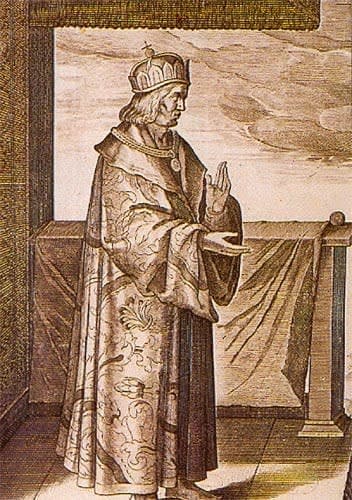

Among all the rulers of early medieval Hungary, few figures are as mysterious and controversial as Samuel Aba. In eleventh-century German chronicles, his name appears in short, unfamiliar forms — Obo, Ovo, or simply Aba. The silver coins minted during his reign bear the concise inscription "Sámuel rex" ("King Samuel"). It was only thanks to the meticulous records of the anonymous chronicler known as Anonymus that historians were able to connect these names, establishing that the powerful nobleman Aba and King Samuel were one and the same person.

Samuel's origins are shrouded in a dense fog of legends and contradictions, with roots stretching deep into the vast steppes of Eurasia. According to Anonymus's chronicle Gesta Hungarorum (The Deeds of the Hungarians), Samuel's family descended from two Cuman chieftains, Ed and Edemen, to whom Grand Prince Árpád of the Hungarians had granted "extensive lands in the Mátra Mountains."
However, fourteenth-century Hungarian chronicles, particularly the works of Simon of Kéza, offer an even more extraordinary genealogy. They identify Ed and Edemen as the sons of Csaba, whose father was none other than the Scourge of God himself — Attila, leader of the Huns — while their mother was supposedly a noblewoman from Khwarazm.

Whatever the truth may be, all the chroniclers agree on one point: the Aba family had eastern, non-Hungarian roots.
The modern historian Gyula Kristó and several of his colleagues believe that Samuel's ancestors came from the Kavars (Kabars), a formidable Khazar tribe that joined the Hungarians during their conquest of the Carpathian Basin.
Moreover, the biblical name "Samuel" itself led Kristó to propose a bold hypothesis: the future king of Hungary may have been born into a family that practiced Judaism, a religion associated with the Khazar elite.
Other researchers suggest that Samuel's relatives may have been Christians of the Eastern tradition — Nestorians.
Regardless of who his ancestors were, Samuel belonged to the highest ranks of the aristocracy.
Around 1009, his status was reinforced by a dynastic marriage of unprecedented importance: an unnamed sister of Stephen I the Saint was married to a member of the Aba family.
Historians still engage in heated debates over who exactly married the princess — Samuel himself or his father. If Samuel was the bridegroom, he must have been born no later than 990.
It was following this marriage that Samuel, having converted from either Judaism or steppe paganism, received Catholic baptism.
Around the same time, the Catholic Diocese of Eger was established in the Mátra region, the ancestral homeland of the Aba family.
Samuel became a generous patron of the new faith. Hungarian chronicles record that he founded an abbey in the village of Abasár. Archaeological evidence supports this account: the earliest layers at the nearby monastery of Feldebrő date precisely to the first half of the eleventh century.

During the reign of Stephen I, Samuel Aba became one of the pillars of the young Hungarian state and a loyal companion of the king in his efforts to unify the country.
According to historian Pál Engel, the power of the Aba family was so great that a newly constructed fortress, Abaújvár ("Aba's New Castle"), was named in Samuel's honor.
Samuel became the first ispán (royal governor) and the virtually absolute ruler of the extensive Abaúj region.
His influence at court was enormous. Samuel entered the exclusive inner circle of the royal council and received the title of Hungary's first palatine, effectively becoming the second most powerful man in the kingdom after the monarch himself.
But when the great Stephen I died on August 15, 1038, fate dealt Samuel a devastating blow.
As he approached death, the king disregarded his loyal palatine and brother-in-law as a potential successor, instead bequeathing the throne to his Venetian nephew, Peter Orseolo.
No historical source provides a clear answer as to why Stephen made this decision.

The new monarch, Peter, immediately surrounded himself with Italian and German mercenaries, arrogantly excluding the established Hungarian nobility from the government — above all, Samuel Aba himself.
This decision proved fatal for Peter.
In 1041, the aristocracy's patience finally ran out. A rebellion erupted, Peter was driven from the country in disgrace, and the triumphant barons elected Samuel Aba as the new king of Hungary.
Upon ascending the throne, Samuel acted swiftly and ruthlessly. With a single stroke of the pen, he abolished all the laws introduced by Peter, while the supporters of the deposed Venetian were subjected to elaborate torture and public executions.
However, Samuel's reign soon took an unexpected turn, shocking the very aristocrats who had elected him.
The former steppe lord suddenly began relying on the lower classes.
Hungarian chronicles criticized the new king with undisguised irritation for his extraordinary generosity toward the peasantry.
Samuel took an unprecedented step: he abolished several burdensome taxes imposed on ordinary people, becoming a genuine "people's king."
Meanwhile, storm clouds were gathering along Hungary's western borders.
The exiled Peter Orseolo had fled to the court of Holy Roman Emperor Henry III, begging him to restore his crown.
Samuel initially attempted to resolve the conflict peacefully. He dispatched an impressive embassy to Strasbourg, offering the emperor friendship and peaceful relations between their countries.
But Henry responded arrogantly, declaring that he was placing Peter under his protection.

Samuel's response was immediate.
Rather than waiting for an invasion, he launched his own attack against the empire's Austrian frontiers on February 15, 1042.
Dividing his army, he personally commanded the southern force, which marched victoriously through enemy territory and set the prosperous city of Tulln ablaze.
The northern Hungarian army, however, suffered a setback and was defeated by the Austrian margrave Adalbert.
Nevertheless, Samuel returned to Buda in triumph.
Adalbert depicted in the Babenberg family tree.

The empire retaliated in 1043.
A massive army under Henry III invaded Hungary. Under pressure from the numerically superior imperial forces, Samuel was compelled to accept a harsh peace treaty.
He renounced all Hungarian territories west of the Leitha and Morava rivers and also agreed to pay an enormous tribute to the empire.
To raise the necessary sum, Samuel imposed unprecedented taxes on Church property and even began directly confiscating episcopal estates.
This decision alienated even his closest supporters. The aristocracy and clergy came to despise the populist monarch.
The famous Hungarian Illuminated Chronicle describes this period with unmistakable aristocratic indignation:
"King Aba became arrogant and began to oppress the Hungarians cruelly. He believed that everything should be held in common between master and servant, and he regarded the violation of an oath as a mere trifle. Despising the nobles of the kingdom, he associated with peasants and commoners. The Hungarian noblemen were unwilling to tolerate this and conspired to kill him. However, one of them informed the king of the conspiracy, after which the king imprisoned many of them. He also arranged for them to be put to death without trial."
The suppression of the conspirators was bloody and merciless.
The situation was made even worse by the fact that, on the king's orders, the executions took place during Lent.
The senior clergy were horrified.
Bishop Gerard of Hungary (Gellért), renowned for his uncompromising character, openly challenged the monarch and categorically refused to perform the traditional coronation ceremony at Easter.
The country was torn apart by division.

The final act of this historical drama unfolded in the summer of 1044.
Emperor Henry III, taking advantage of the internal turmoil in Hungary, once again crossed the kingdom's borders, bringing the deposed Peter Orseolo with him.
The fate of the kingdom was decided on July 5, 1044, in the great Battle of Ménfő, near the city of Győr.
Samuel Aba assembled an enormous army, but his overconfidence led to catastrophe.
The German chronicler Hermann of Reichenau left a detailed description of this imperial triumph:

"When King Aba violated the terms of the treaty, King Henry invaded Hungarian territory with a very small army. Aba, who had assembled a very large army, regarded his opponent with such contempt that he allowed him to enter the province, although he could easily have prevented the enemy's advance.
Henry, however, trusting in divine assistance, quickly crossed the Raab River with part of his forces and entered into battle.
In the very first attack, he put numerous Hungarian units to flight, while losing very few of his own men.
He himself fought bravely and, on July 5, won a glorious victory.
King Aba miraculously escaped by fleeing, while the Hungarians surrendered in great numbers...
Shortly afterward, Aba was captured by King Peter and paid for his crimes with his head."
While German sources, such as Hermann of Reichenau, claim that the captured Samuel was executed by Peter Orseolo himself, fourteenth-century Hungarian chronicles present a different, more tragic account.
According to these accounts, the defeated Samuel managed to escape from the battlefield and fled eastward toward the safety of the Tisza River.
However, there, cornered and with nowhere left to run, he was captured and mercilessly killed by local inhabitants who had turned against their fallen ruler.
Initially, the king's mutilated body was hastily buried in a nearby unnamed church.
Only years later were his remains transferred to the ancestral monastery of the Aba family in the village of Abasár.


