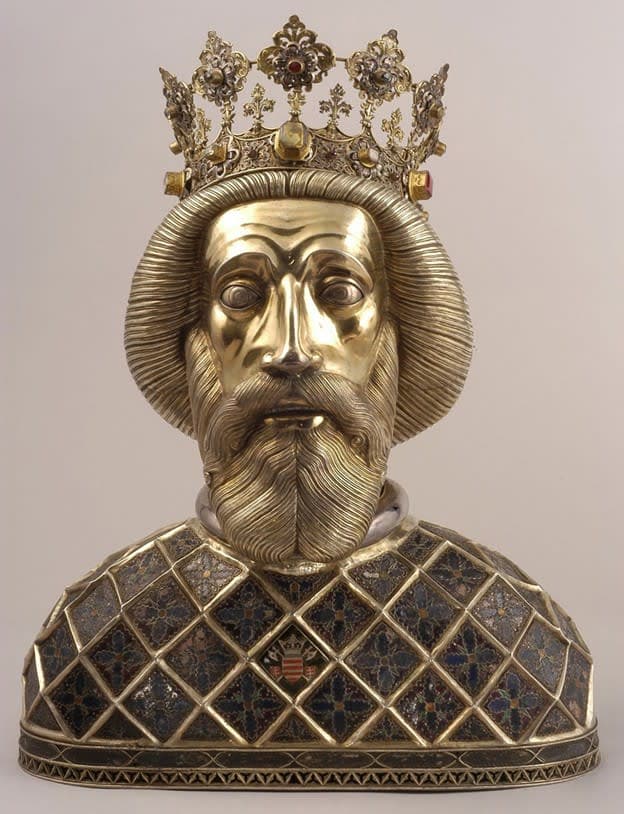

The story of one of Hungary's most revered monarchs began far beyond its borders, in the shadow of political intrigue and exile.
The future King Ladislaus I was born in 1046 on Polish soil. His family had been forced to flee there after the boy's grandfather, Prince Basil (Vazul), failed in a daring conspiracy against King Stephen the Saint.
The newborn prince's father was Béla I, while his mother was Rixa (Adelaide), daughter of the Polish king Mieszko II.
It was his mother who, wishing to emphasize her Slavic roots, gave her second son the Slavic name Ladislav. In Hungarian pronunciation, it became the distinctive name "László" — a name that had previously been entirely unfamiliar to the local aristocracy, but which would become one of the most popular in Hungarian history thanks to the future glory of this child.

The Hungarian royal family's life in exile came to an end in 1060, when Béla I triumphantly defeated the forces of the reigning King Andrew I and ascended the Hungarian throne himself.
The new monarch's family, including his eldest son Géza and the young Ladislaus, could finally return to their ancestral homeland.
However, peaceful life did not last long.
Following Béla I's death in 1063, Hungary once again descended into the chaos of a fratricidal civil war.
Two powerful factions clashed over the throne. On one side stood Solomon, son of the defeated Andrew I, supported by the formidable military power of the Holy Roman Empire. On the other were the brothers Géza and Ladislaus, who enjoyed strong support from Poland.

After a year of bloodshed, the opposing sides managed to reach an agreement in 1064.
Géza and Ladislaus recognized Solomon's supreme authority, while Solomon, in return, confirmed the sons of Béla in their right to govern the northern and eastern territories of the kingdom — an extensive region known as the Tercia Pars Regni ("Third Part of the Kingdom"), which their father had once ruled.
The fragile peace lasted ten years, but the underlying conflicts were too deep.
In 1074, the flames of war erupted once again.
The decisive confrontation took place at the Battle of Mogyoród, where Solomon's forces suffered a crushing defeat.
The Hungarian crown passed to the elder brother, Géza I.
Throughout Géza's brief reign from 1074 to 1077, Ladislaus remained the monarch's loyal supporter and principal adviser in the ongoing struggle against the deposed Solomon.
When Géza died unexpectedly in 1077, Ladislaus himself was proclaimed the new king of Hungary.

Ladislaus began his reign with a brilliant diplomatic maneuver.
In 1078, he married Adelaide, daughter of the Swabian ruler Rudolf.
This marriage was motivated not only by personal feelings but also by cold political calculation. Ladislaus sought to deprive Solomon once and for all of any hope of receiving German military assistance.
Realizing that his geopolitical support had collapsed and that further resistance was entirely futile, Solomon soon definitively recognized Ladislaus as the legitimate sovereign.
Having secured full authority, Ladislaus I proved himself a strict but wise statesman.
His domestic policy was characterized by an unprecedented strengthening of royal power.
With an iron hand, he suppressed the feudal conflicts that had torn the country apart for decades.
Under the protection of the newly established peace, Hungary's economy began to flourish rapidly.
Ladislaus issued a series of crucial laws that became the foundation of law and order. He introduced the principle of strict protection of private property and established unprecedentedly severe, uncompromising punishments for all forms of theft and robbery.
The king devoted no less attention to the spiritual foundations of his state.
Ladislaus became a true pillar of Catholicism in Hungary, generously financing the establishment of new dioceses and the construction of monasteries.
On the broader European stage, he actively intervened in the famous Investiture Controversy.
The Hungarian monarch firmly sided with the papacy, providing direct support to his father-in-law, Rudolf of Swabia, in his bitter confrontation with Emperor Henry IV — the principal and most uncompromising enemy of Pope Gregory VII.

This loyalty to Rome bore fruit.
In 1083, on the initiative of Pope Gregory VII, Hungary's first king, Stephen I, and his son, Prince Emeric, were solemnly canonized.
This event greatly elevated the moral authority of the Árpád dynasty and King Ladislaus personally in the eyes of the entire Christian world.
Ladislaus I was not only a perceptive politician but also an outstanding military commander.
In 1085, he proved his abilities on the battlefield by utterly defeating the Pecheneg hordes that had dared to invade his kingdom.
From 1089 onward, the direction of Ladislaus's foreign policy shifted toward the southwest.
King Dmitar Zvonimir of Croatia had died.
His widow, Queen Helen, was the sister of Ladislaus I, and she began an active political campaign to transfer the Croatian crown to her Hungarian brother.
The Croatian aristocracy, terrified of losing its national sovereignty, hastily placed the elderly Stephen II on the throne.
However, fate intervened once again: in 1091, both Stephen II and Queen Helen died.
The ancient Croatian Trpimirović dynasty came to an end forever.
Without wasting a moment, Ladislaus asserted his legitimate claim to the Croatian throne, basing it on his family relationship with Dmitar Zvonimir.
Hungarian armies crossed the borders of the weakened kingdom and swiftly conquered Slavonia, followed by much of Croatia.

This triumph provoked outrage in Constantinople.
Byzantium, unwilling to tolerate Hungary's growing power, resorted to a treacherous strategy and incited the Cumans to attack Ladislaus's territories.
In 1091, the nomads swept into the eastern regions of Hungary, spreading death and destruction.
Ladislaus immediately turned his army around and pursued the invaders in a forced march.
On the banks of the Temes River, he inflicted a crushing defeat upon the Cumans, forever inscribing this battle into the annals of military history.
Having punished the Cumans, he continued his offensive in the Balkans, directing his wrath against the Byzantine Empire itself.
Hungarian forces triumphantly captured the strategically important region of Syrmia and the city of Belgrade, wresting them from Constantinople's control.
Maintaining his momentum, Ladislaus launched another successful military campaign in 1092, this time in the northeast, against Prince Vasylko Rostyslavych of Terebovlia.
Meanwhile, Ladislaus attempted to consolidate his control over Croatia by appointing his nephew Álmos as its king.
However, the proud Croatian nobility refused to accept the loss of independence.
In 1093, they rose in rebellion and elected the powerful nobleman Petar Svačić as their ruler. He launched a bloody war against the Hungarian garrisons and managed to recapture part of the territory.

The final years of the great king's reign were overshadowed by serious concerns about the future of his kingdom.
Ladislaus had no sons to inherit his throne.
His only daughter, Piroska, who received the name Irene at baptism, was married to Byzantine Emperor John II and was subsequently canonized by the Orthodox Church.
In the absence of a direct male heir, two of his nephews, the sons of his late brother Géza I — Coloman and Álmos — were preparing to fight for the Hungarian throne.
By the end of his life, Ladislaus I had achieved such extraordinary fame throughout Europe that the continent's spiritual leaders regarded him as the ideal commander of the planned First Crusade.
Ladislaus agreed to undertake this great mission, but he was never destined to raise the cross above Jerusalem.
On July 29, 1095, while staying in the Principality of Nitra and actively preparing for a new war against the Bohemian prince Bretislaus II, King Ladislaus I died.
The great monarch's body was laid to rest in the Benedictine Abbey of Somogyvár, located north of Kaposvár.
Just as he had anticipated, immediately after his death, the country descended into turmoil.
A fierce struggle for the crown erupted between his nephews Álmos and Coloman, from which Coloman ultimately emerged victorious.
Yet death marked only the beginning of Ladislaus's eternal glory.
Even during his lifetime, he had been surrounded by the reverent admiration of his people. After his death, he became the object of a widespread popular religious cult.
People began praying to him as a saint long before the Catholic Church formally canonized him in 1192.
The anniversary of his death, July 29, became a national day of remembrance.
The king's image quickly became surrounded by dozens of extraordinary legends and traditions.
For future generations of Hungarians, Saint Ladislaus I would forever remain the unattainable ideal of a ruler — a flawless Christian knight-king whose courage protected his country and whose faith strengthened the spirit of his people.
Today, some of the relics of this legendary sovereign are carefully preserved in the cathedral of Győr, serving as a reminder of the golden age of the early Hungarian kingdom.



