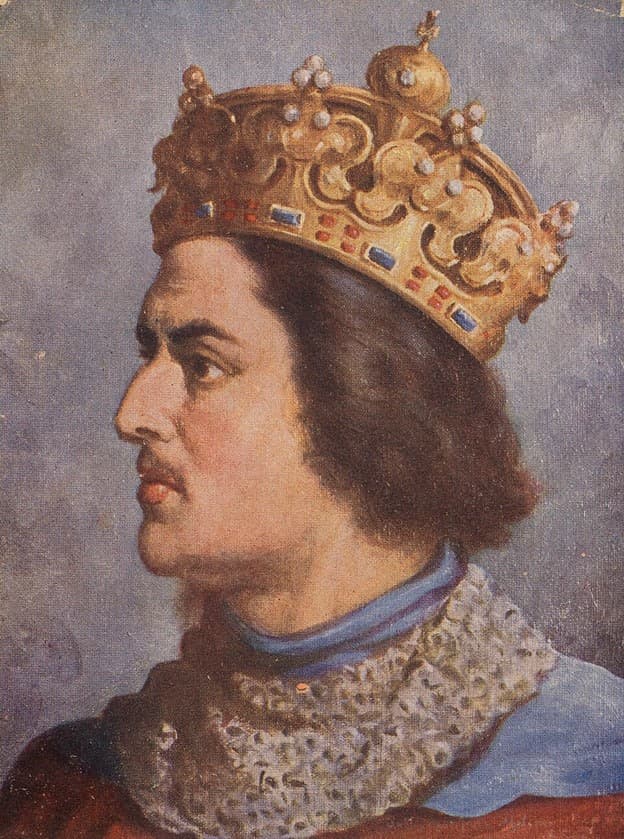

Przemysł II was born on October 14, 1257, several months after the death of his father, Duke Przemysł I of Poznań. As the only son and the last representative of the Greater Poland branch of the Piast dynasty, the infant prince carried the expectations of an entire dynastic line. His mother was Elisabeth of Wrocław, daughter of the legendary Henry the Pious, who had fallen at the Battle of Legnica, giving the young prince an unquestionably prestigious lineage.

Guardianship of the young prince passed to his uncle, Bolesław the Pious. Under his strict but capable supervision, Przemysł learned the fundamentals of government and, according to historians, received a solid education that included knowledge of Latin.
His uncle did not delay introducing him to the realities of military and political life. As early as 1272, the sixteen-year-old prince formally led a campaign against the Margraviate of Brandenburg. The expedition ended in triumph: the recovery of the towns of Drezdenko and Strzelce became the first major success of Przemysł’s political career.

Upon reaching adulthood, Przemysł demanded a territory of his own, and his uncle granted him the Duchy of Poznań. To strengthen political alliances, a marriage was arranged with Ludgarda of Mecklenburg.
Real power, however, came to him in April 1279, when the death of Bolesław the Pious allowed Przemysł to unite all of Greater Poland under his rule.
The path toward greatness was far from smooth. In 1281, Przemysł personally experienced the political ruthlessness of his principal rival, Henry IV Probus. At the assembly of Sądowel, instead of diplomatic negotiations, Przemysł found himself taken prisoner.
To regain his freedom, he was forced to make a painful concession and surrender the strategically important Wieluń region.

The prince’s personal life was also marked by tragedy. In December 1283, his wife Ludgarda died suddenly. Dark rumors circulated that Przemysł, frustrated by the lack of an heir, may have been involved in her death.
Despite the gossip, the prince soon married again, this time to the Swedish princess Richeza, hoping to secure the continuation of his dynasty.
Realizing that the Piasts could not survive politically in isolation, Przemysł became a master of alliance-building. One of the most important events of his career was the agreement concluded at Kępno in 1282 with Mestwin II of Pomerelia.
This mutual succession pact became one of the foundations for the future reunification of Poland. In the following years, the alliance against Brandenburg was further strengthened through meetings at Słupsk in 1287 and Nakło in 1291.
When Leszek the Black died in 1288, Przemysł entered the struggle for the throne of Kraków. It became a complicated contest of shifting alliances. At first, he supported the Kuyavian princes against Henry Probus, yet ironically it was Henry himself who, in his testament of 1290, left Kraków to Przemysł.

After becoming High Duke in June 1290, Przemysł demonstrated remarkable political flexibility. Realizing that the military strength of King Wenceslaus II of Bohemia was too great to confront directly, he withdrew from Kraków.
He did so, however, as a man already thinking like a future king: he secretly removed from Wawel the royal regalia traditionally associated with Bolesław the Bold. In effect, he exchanged control of Lesser Poland for a greater opportunity — the chance to become king of a reunited Poland.
The death of Mestwin II on December 25, 1294, made Przemysł ruler of Eastern Pomerania. This dramatically increased his power. Access to the Baltic Sea and the region’s considerable economic resources transformed him into one of the strongest rulers in the Polish lands.
The culmination came on June 26, 1295.
In Gniezno Cathedral, at the spiritual heart of Polish Christianity, Przemysł II was crowned King of Poland. Although his actual territories consisted primarily of Greater Poland and Pomerelia, the title had enormous symbolic and political importance.
He restored the dignity of the Polish crown after decades without a native king. Despite protests from Wenceslaus II, Przemysł’s royal status gained recognition abroad.
The royal triumph lasted less than a year.
The winter of 1296 was tense. Early in the morning of February 8, near Rogoźno, the king’s entourage, resting after a feast, was attacked in a carefully planned ambush. The attackers initially intended to abduct the monarch, but Przemysł and his men resisted fiercely.
Severely wounded and bleeding heavily, the king soon became a burden to his kidnappers. Realizing that pursuit was closing in, the attackers abandoned him near the road.
When hunters later found Przemysł, he was already dead.
The conspiracy was most likely connected with Brandenburg, while members of the local noble families of Nałęcz and Zaremba have also traditionally been suspected of assisting the attackers because of their hostility toward the strengthening of royal authority.

With the death of Przemysł II, the Greater Poland branch of the Piast dynasty came to an end. He left no sons, and his territories once again became the object of dynastic struggle.
Yet his brief reign had already achieved something of lasting importance: it revived the very idea of the Kingdom of Poland.
That idea would later be taken up and brought closer to completion by Władysław the Short.
The king was dead, but the kingdom had been reborn.


