
The formative period of the Arsacid dynasty is sparsely illuminated by ancient authors, whose writings are often imbued with Greek or Roman condescension toward the “barbarians.” In this haze of uncertainty, the figure of King Phriapatius, the third (or fourth, according to some versions) ruler of the state, stands apart, provoking intense debate among modern scholars.
The roots of these disputes go back to the very founder of the dynasty — Arsaces I. Who was he? Ancient sources, contradicting one another, variously described him as a bold bandit, a Bactrian fleeing the wrath of Diodotus, a descendant of the Seleucid satrap Andragoras, or even of the Persian king Artaxerxes II (a version favored by the Arsacids themselves). Today historians largely agree that Arsaces I was the leader of the nomadic Iranian tribe of the Parni from the Dahae confederation, who, after seizing Parthia, adopted Zoroastrianism and the culture of the settled peoples.
But if the origin of the founder has been more or less clarified, the genealogy of Phriapatius remains a battlefield of hypotheses. How exactly was he related to Arsaces II?
Be that as it may, Phriapatius ascended the throne carrying on his shoulders the heavy legacy of his predecessors.
The exact date when Arsaces II departed this world and yielded the throne to Phriapatius is lost to time. Traditional scholarship names 191 BCE, yet Nicholas Overtoom, in his article for Encyclopaedia Iranica (2023), argues for shifting this date to around 185 BCE.
The inheritance that fell to the new king was unenviable. The powerful Seleucid monarch Antiochus III had dealt Parthia a crushing blow during his eastern campaign. In the 180s BCE Parthian territories shrank like shagreen leather, and the status of its kings was reduced to that of unequal allies (effectively vassals) of the Seleucids. The Parni were marginalized, their military strength undermined. It seemed that the star of the Arsacids had set forever.


Yet Phriapatius proved to be precisely the ruler needed at this critical moment. Not a conqueror, but a builder. Strabo noted that the future greatness of Parthia was rooted in their way of life, but historians (in particular Overtoom) rightly emphasize the role of individual leadership: it was the strong guidance of the early kings, such as Phriapatius, that enabled the country to survive. He became the first Parthian monarch to adopt the grand epicleses (titles) “Divine” and “Great,” which were not mere vanity but a political manifesto of renewal.
The reign of Phriapatius, lasting, according to Justin, 15 years (approximately until 176 or 170 BCE), was not marked by spectacular battles, yet this very quiet became the guarantee of future triumph.
Taking advantage of the weakening successors of Antiochus III, Phriapatius acted cautiously but steadily. He did not issue an open challenge to the Seleucids, avoiding suicidal wars, but managed by peaceful means to restore control over the sacred city of Hecatompylos and neighboring lands. It was a time of “gathering strength.” His principal achievement was the restoration of the combat effectiveness of the Parthian army, devastated by the Greeks, and the strengthening of the dynasty’s prestige.

Storm clouds were gathering in the east: the aggressive Greco-Bactrian king Demetrius I Aniketos was advancing into Iran and India. Phriapatius, understanding that Parthia still lacked the strength for direct confrontation with Bactria, concentrated on consolidating positions along the shores of the Caspian Sea. He was preparing a bridgehead. It was precisely thanks to his reforms and accumulated resources that his son, Mithridates I, would later be able to launch great conquests and transform Parthia into a world empire.

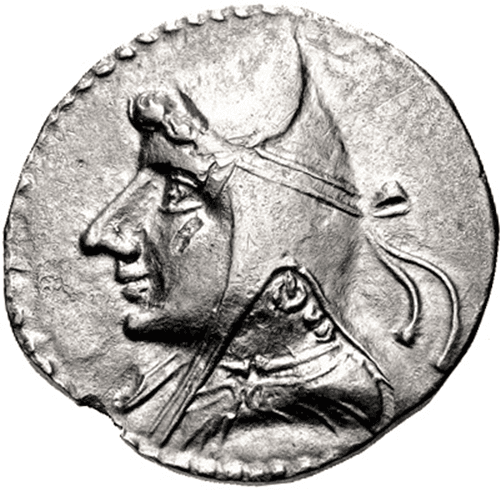
Tangible evidence of Phriapatius’s reign is provided by his coins. Struck in silver, bronze, and copper, they visually repeated the style of Arsaces I and II: on the obverse — the profile of the king in a soft bashlyk (a symbol of Iranian origin, in contrast to the Greek diadem), on the reverse — an archer. However, the legend on the coins, inscribed in Greek, read “Basileus” (King) and “Great.” According to Kh. Rezakhani, the restoration of these titles and the resumption of minting (interrupted under Antiochus III) symbolized the recovery of sovereignty over Parthia and Hyrcania.
Phriapatius passed away leaving the state far stronger than he had received it. He was not a conqueror of lands, but a conqueror of time, granting Parthia the necessary years of peace to prepare for future conquests.


