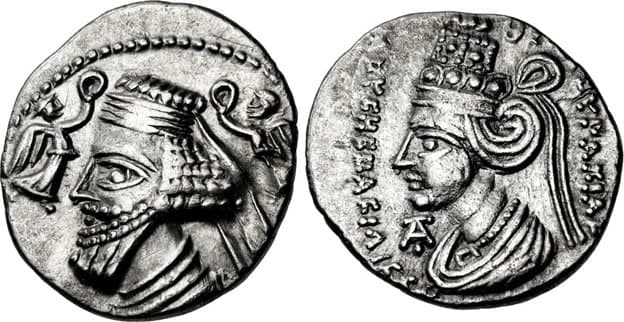

The reign of Phraates V, who entered history under the diminutive name Phraataces (“Little Phraates”), began with a crime. In 2 BCE he and his mother, the Italian slave Musa, poisoned his father to seize power. But a crown won by poison proved heavy.

No sooner had the young king ascended the throne than he faced a geopolitical crisis. In Armenia — the perennial apple of discord between Rome and Parthia — a revolt erupted. Around 1 BCE the local nobility and the pro-Parthian faction overthrew the Roman client king Artavasdes. Tigranes IV and his sister-wife Erato, openly sympathetic to Parthia, returned to the throne.

For the aging Emperor Augustus this was a slap in the face. Rome could not afford to lose prestige in the East. Lacking reliable generals, Augustus sent his beloved grandson and heir, Gaius Caesar, to restore order. The legions marched toward the Euphrates.

Learning of the approaching Roman host, Phraataces attempted a preemptive move. He sent an embassy to Augustus demanding the return of his half-brothers (legitimate sons of Phraates IV), who were held in Rome as hostages. It was a bold step, but Rome responded in kind.
Augustus’s reply was deliberately insulting: he addressed the letter simply to “Phraataces,” omitting the title “king,” and harshly demanded that he withdraw from Armenia. The hot-tempered young Parthian answered in the same tone, but political reality was against him. His ally, Tigranes of Armenia, was killed in a clash with northern tribes, and Queen Erato abdicated. Phraataces was left alone against the might of Rome. Realizing that a new war could cost him his throne, he agreed to negotiations.
The culmination of this confrontation was a historic meeting on an island in the middle of the Euphrates (1 CE). The scene was worthy of epic: on both banks of the great river stood the armies of the two superpowers, armor gleaming, while at the center, on neutral ground, met the heir of Rome and the king of Parthia.
The Roman officer Velleius Paterculus, a young tribune present there, later described Phraataces as “a youth of outstanding rank.” Negotiations proceeded in two stages: first the monarchs dined on the Roman bank, then on the Parthian. Over feasts and toasts the fate of Armenia was decided.
Phraataces, displaying eastern cunning, made concessions to preserve the most important thing — his own power.
Parthia officially renounced all claims to Armenia.
Phraataces’s four brothers remained in Rome (which, in fact, benefited the king himself).
In return, Rome recognized Phraataces as the legitimate ruler of Parthia.
Having secured his borders, Phraataces committed an act that shocked the ancient world and may have caused his downfall. In 2 CE he officially married his own mother, Queen Musa.
For Greeks and Romans this was monstrous incest, the height of barbarity. However, historians believe that not only depravity but also religious policy lay behind it. At that time Zoroastrianism was undergoing changes, and the custom of khvaetvadatha (close-kin marriage), previously practiced mainly by priestly magi, began spreading among the nobility as a supreme form of piety. Perhaps Phraataces, the son of a slave, sought in this way to strengthen his legitimacy in the eyes of orthodox Parthians. Coins of the period proudly bore the profiles of both — the king-son and the queen-mother.
Peace with Rome proved fragile. Gaius Caesar, encouraged by success, marched into Armenia to install a new puppet — Ariobarzanes (son of the king of Media). But the pro-Parthian faction did not yield.
A rebellion broke out. The center of resistance was the fortress of Artagira, defended by the brave satrap Addon (likely secretly supported by Phraataces). The siege dragged on. On September 9, 3 CE, a drama unfolded: Addon agreed to negotiations, promising to show Gaius a cache of Parthian treasures. But instead of gold he drew a dagger. During the meeting the Roman prince was wounded. The Romans, enraged, stormed the city, but the wound proved fatal. Gaius Caesar, Augustus’s hope, died the following year. Though Roman poets celebrated victory and Augustus boasted of subduing Armenia, the death of his heir was a terrible price for ambition.
The reign of the “little king” was brilliant but brief. His marriage to his mother, despite possible religious motives, disgusted most subjects. Concessions to Rome on the Euphrates were interpreted as weakness. The Parthian nobility, which had never loved the son of an Italian slave, formed a conspiracy.
In 4 CE the cup of patience overflowed. Phraataces was overthrown. According to one version he was killed in the palace; according to another he managed to flee to Roman Syria, where he soon died, forgotten by all.


