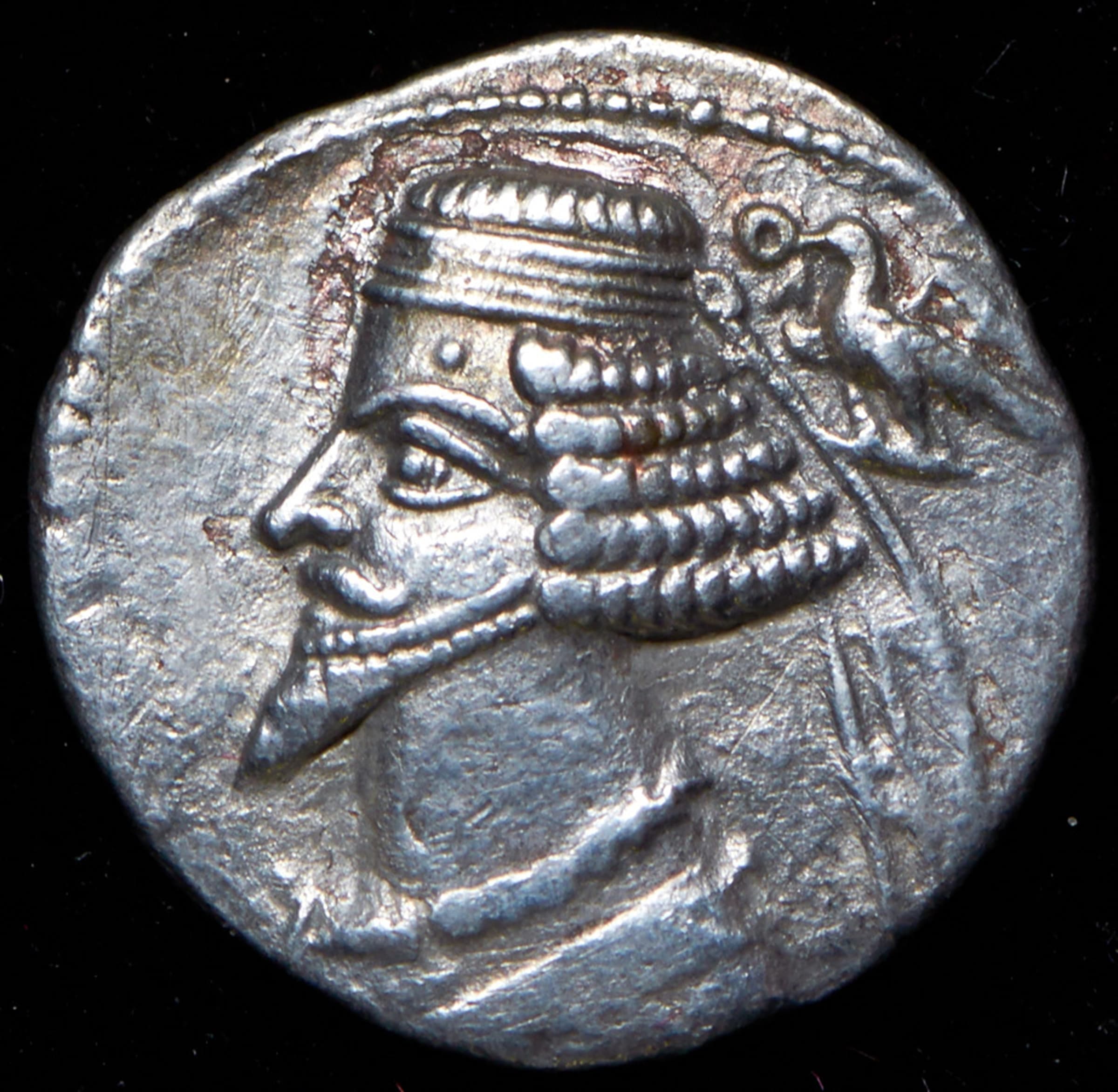

The accession of Phraates IV to the throne in 37 BCE became a bloody dawn for Parthia. Having gained power, he decided that the best way to keep it was to eliminate all potential rivals. Phraates did not hesitate to kill all his brothers (and the prolific Orodes II had many), and soon began exterminating the Parthian aristocracy as well.
The terror was so intense that nobles fled the country en masse. Among them was Monaeses — a celebrated general and the wealthiest man in the empire. He found refuge with Mark Antony, the Roman triumvir governing the East. Antony, dreaming of the glory of Alexander the Great, welcomed the fugitive with open arms, granted him three cities (Larissa, Arethusa, and Hierapolis), and promised him the Parthian throne. This was a direct challenge to Phraates.

Realizing the danger, Phraates IV entered into secret negotiations with Monaeses, persuading him to return home and guaranteeing his safety. Antony did not detain the defector so as not to provoke the Parthians, but the machinery of war had already been set in motion.
In 36 BCE Mark Antony assembled a colossal army for an invasion of Parthia. Under his banners stood about 100,000 men: 60,000 Roman legionaries (up to 18 legions), 10,000 fierce Celtic and Iberian cavalry, and 30,000 allied troops. His principal ally was the Armenian king Artavasdes II, who provided 13,000 soldiers.
The plan was grand: not to repeat Crassus’s mistake in the deserts of Mesopotamia but to strike from the north through Armenia and Media Atropatene. But Antony, hurrying toward glory, committed a fatal error. He divided his army. With cavalry and the best infantry he rushed ahead toward the capital of Atropatene — Phraaspa — while the slow baggage train with heavy siege engines (300 wagons) and two legions of guard under Oppius Statianus lagged far behind.
Phraates IV proved himself a brilliant tactician. Learning of the Roman division, he ignored Antony’s vanguard and hurled the full force of his cavalry against the defenseless baggage column.
The legions of Oppius Statianus were surrounded and slaughtered to the last man. But the decisive blow was the destruction of the siege machines. Massive rams and towers, without which the strong walls of Phraaspa could not be taken, were burned. In this battle even the Pontic king Polemon was captured. The Armenian king Artavasdes, seeing the disaster and realizing the campaign was doomed, withdrew his troops (Antony would later make him a scapegoat). When Antony reached the site, he found only corpses.
Without siege equipment, the siege of Phraaspa became a farce. The Romans built earthen ramparts, but Parthians launched daring sorties to destroy them. Winter approached, supplies dwindled, and Parthian archers harassed the legions incessantly. Antony was forced to retreat.
The Roman retreat became one of the most heroic and tragic episodes of ancient history. Phraates IV expected Antony to march across open plains where cataphracts could annihilate him. But the Romans were saved by a Mardian guide (possibly a survivor of Crassus’s army), who led them through the hills.
The march to the river Araxes lasted 27 days — a living hell. Parthians (about 40,000 horsemen) attacked constantly. On the third day, when the Romans reached open ground, they were surrounded. Antony barely saved the army by personally leading a counterattack. On another occasion a detachment of Flavius Gallus (3,000 men) was destroyed after pursuing too far.
The Romans survived only through iron discipline and the testudo (“tortoise”) formation. When Parthians showered them with arrows, legionaries locked shields overhead to form an impenetrable shell. Thinking the enemy was surrendering, Parthians closed for hand-to-hand combat, only to meet short Roman gladii.


Reaching the Armenian frontier, Antony had lost 35,000 men — a third of his great army. Phraates IV celebrated a triumph. He even overstruck captured Roman coins bearing the profiles of Antony and Cleopatra with his own symbols — the ultimate humiliation of the enemy.

After victory over Rome, Phraates’ arrogance exceeded all bounds. He quarreled with his ally, the king of Media, over the division of Roman spoils (a dispute Antony later exploited by winning the Median over to his side). At home, the king’s cruelty provoked a rebellion led by the commander Tiridates II.

Phraates was deposed but did not surrender. He fled east to the Saka (Scythians), gathered a new nomadic army, and regained his throne. Tiridates II fled to Syria to the Romans, taking with him Phraates’ young son as a hostage.
Octavian Augustus, who had come to power in Rome, was a pragmatist. Instead of a new bloody war he chose diplomacy. In 20 BCE he demanded the return of the standards lost by Crassus and Antony, as well as Roman prisoners.

Phraates IV, fearing another war and Roman support for pretenders, agreed. On May 12, 20 BCE, the Roman eagles were ceremonially handed over to Tiberius. For Rome this was a colossal propaganda victory (immortalized on the cuirass of the statue of Augustus of Prima Porta); for Phraates it was a way to buy peace on the western frontier.
Along with peace Augustus sent Phraates a gift more dangerous than legions — an Italian slave named Musa. Beautiful and intelligent, the Italian quickly captivated the aging king. From concubine she became queen and bore him a son, Phraataces (Phraates V).
Musa began a subtle intrigue. She persuaded her husband to send all his older sons (four legitimate heirs) to Rome, ostensibly for their safety and upbringing. Phraates, blinded by love and eager to prevent dynastic strife, agreed. The princes departed, clearing the path to the throne for Musa’s son.
In 2 BCE the denouement came. Musa, unwilling to wait for her husband’s natural death, poisoned Phraates IV. Thus ended the life of the king who had destroyed Antony’s armada, survived civil wars, yet fell to the hand of a woman sent by his enemy. Phraataces ascended the throne, and Musa became his co-ruler, concluding one of the most dramatic chapters of Parthian history.


