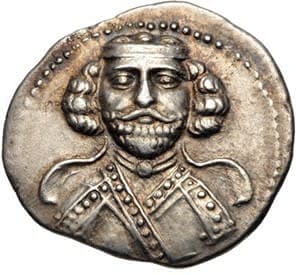

Phraates III, who adopted the throne name “Theos” (God), received power from his father (Sanatruces), who had managed to put an end to a long period of anarchy in Parthia. However, the calm was deceptive. Phraates ascended the throne at a turning point in the history of the ancient world. In the West, the star of Rome was rising, its legions under the command of Lucullus crushing long-standing rivals — Mithridates VI of Pontus and Tigranes II the Great.

In 69 BCE, when Lucullus invaded Armenia, Parthia found itself in the role of a “third force” upon which the outcome of the great war depended. Realizing the critical nature of the situation, Mithridates of Pontus and Tigranes of Armenia decided at any cost to draw Phraates into an anti-Roman coalition.

The historian Sallust preserved for us the contents of Mithridates’ letter to Phraates. Although the authenticity of the document is disputed, it accurately conveys the essence of the moment. The Pontic king appealed to the Parthian’s reason, pointing to the insatiable greed of the Romans, who would not stop at Armenia. He proposed a bold plan: while the allies pinned down Lucullus in the mountains, Parthian cavalry should strike Mesopotamia, cutting the Romans off from supplies. As a reward, Phraates was to receive Adiabene, Northern Mesopotamia, and the very “Seventy Valleys” once ceded and later taken back by Tigranes.

But Rome was not idle. Learning of the negotiations, Lucullus sent his envoys with direct threats and promises of rewards for neutrality. Phraates III found himself in an extremely difficult position. He understood that open war with Rome was dangerous, yet the strengthening of Armenia was also against his interests.
The king chose a policy of “double game.” He gave vague promises to both sides while waiting. His primary goal was to recover territories seized by Armenia using others’ hands. Even when the Roman legate Sextilius arrived ostensibly for negotiations (but in reality for espionage), Phraates did not succumb to provocation.
Fortune favored his caution. Lucullus defeated Tigranes at Tigranocerta and was already preparing a campaign against Parthia, considering it an easy target. But the Roman legions, exhausted by endless war, mutinied. Gaius Sornatius failed to lead the troops out of Pontus, and Lucullus was forced to abandon the invasion. Parthia was saved not by arms but by the enemy’s fatigue.
In 66 BCE the balance of power changed. Gnaeus Pompey Magnus — a far more pragmatic and cunning commander — replaced Lucullus. He immediately proposed a military alliance to Phraates III against Armenia. The Parthian king agreed, hoping Rome would help him recover lost territories.

The instrument of this alliance became a family schism within Tigranes’ house. His son, Tigranes the Younger, rebelled against his father and fled to the Parthians. Phraates III received the fugitive with open arms, gave him his daughter in marriage, and, breaking neutrality, invaded Armenia. The allies laid siege to Artaxata, but the siege dragged on. Phraates, leaving part of his forces with his son-in-law, returned home. This proved to be a mistake: the old Tigranes defeated his son, who was forced to flee to Pompey, becoming a guide for the Romans.

The fall of Tigranes the Elder and his capitulation to Pompey revealed the true face of Roman diplomacy. Acting as arbiter, Pompey redrew the map of the East not in favor of allies but in favor of Rome.
Tigranes the Elder retained Armenia.
Tigranes the Younger (Phraates’ son-in-law) received Sophene and Gordyene but was soon arrested by Pompey for insolence and refusal to surrender the treasury.
The disputed lands (Gordyene and Sophene) were given not to Parthia but to Cappadocia — a Roman vassal.
In 65 BCE, while Pompey campaigned in the Caucasus, his legate Aulus Gabinius boldly crossed the Euphrates and advanced to the Tigris. Phraates III, enraged by the arrest of his son-in-law and the violation of agreements, reoccupied Gordyene. He sent envoys to Pompey demanding recognition of the Euphrates as the frontier and the return of Tigranes the Younger.
Pompey’s reply was full of arrogance. He demanded the return of Gordyene and addressed Phraates merely as “king,” deliberately denying him the title “King of Kings,” which he preferred to reserve for the humiliated Tigranes. The Roman commander Afranius drove the Parthians out of the disputed region by force (according to Plutarch, defeating them and pursuing them to Arbela).
By 64 BCE both Phraates and Tigranes realized a grim truth: their mutual hostility benefited only Rome. Pompey, unwilling to repeat Lucullus’s mistakes and be drawn into another war, made concessions. Through mediation by Roman officials, a compromise was reached: Phraates III retained Adiabene. Tigranes held Gordyene and Nisibis, as well as the title “King of Kings.”
Phraates III found himself in a geopolitical trap. Rome controlled Asia Minor, annexed Syria, subjugated Judea, and dominated the kings of the Caucasus. Parthia was surrounded by Roman satellites and provinces. The Euphrates became the boundary not merely between two states but between two civilizations.
Despite foreign-policy setbacks, Phraates III attempted to maintain imperial prestige. On his drachms, minted at Mithradatkert and Rhagae, he is depicted wearing a Hellenistic diadem (and sometimes a tiara with stag horns, like his father’s), accompanied by grand titles: “Great King Arsaces, Manifest God, Benefactor, Friend of the Greeks.”
His end, however, was tragic. Around 58–57 BCE Phraates III Theos fell not by the hand of a Roman legionary but by the daggers of his own sons. His sons, Orodes and Mithridates, murdered their father only to begin a brutal struggle for power that plunged Parthia once again into civil war, before it would eventually strike back at Rome at Carrhae.


