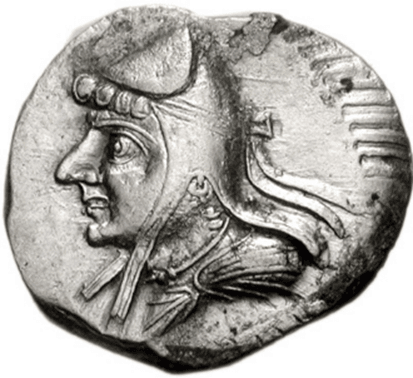

The accession of Phraates I, the eldest son of King Phriapatius, is shrouded in the same haze of uncertainty as the entire early history of the Arsacids. Ancient sources are sparse in detail, and modern researchers are forced to assemble the mosaic of events from fragments. Traditional chronology, based on the works of the Roman historian Justin, assigns Phraates’s father 15 years of rule — approximately from 191 to 176 BCE. However, contemporary scholars increasingly shift these dates forward, placing his reign in the period 185–170 BCE.
But was the transfer of power to Phraates direct? In the twentieth century, an archaeological find — an ostracon — gave rise to a bold hypothesis. The Iranian historian Gholam Reza Assar and his colleague N. Overtoom suggested that between Phriapatius and Phraates there existed another ruler — Arsaces IV, a grandson of Arsaces II. This “phantom king” may have ruled for a short period, from 170 to 168 BCE, but was deliberately omitted by Justin from his epitome. Not all scholars, however, agree with rewriting history: the Polish historian Marek Olbrycht considers this figure “pure speculation.” In any case, by the mid-160s BCE the burden of power had fallen upon the shoulders of Phraates I.
Phraates I inherited the state at a turning point in world history. The once-mighty Seleucid Empire, which had dominated Iran for more than a century, had begun to waver. The defeat of Antiochus III by the Romans at the Battle of Magnesia (190 BCE) and the humiliating Peace of Apamea undermined the authority of the Greek dynasty. Western territories were curtailed, the treasury was empty, and the kings’ attention was fixed on the Mediterranean.
Phraates, possessing strategic insight, understood that the time to act had come. In 165 BCE he broke the fragile equilibrium and launched a military campaign whose goal was not merely territorial expansion but the economic security of Parthia.
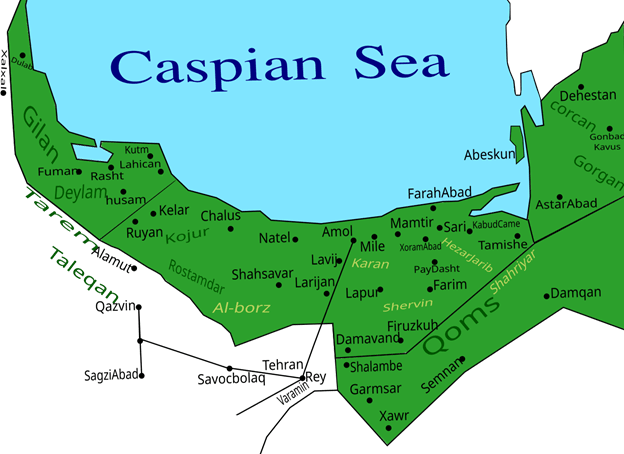
Phraates turned his gaze to the Elburz Mountains, inhabited by the warlike and powerful tribe of the Mardi. These highlanders controlled strategically important passes at the junction of Hyrcania and Media, threatening the trade routes linking eastern and western Iran. For Parthia, which sought to control commerce, the independence of the Mardi was a thorn in its side.
The campaign of Phraates I was swift and harsh. After defeating the Mardi, he did not limit himself to collecting tribute but employed the practice of mass deportations, demonstrating statecraft. The defeated Mardi were resettled in Charax to guard the Caspian Gates — a key passage into Iran. Another tribe, the Tapuri, the king resettled on the shores of the Caspian Sea, in a region that in their honor received the name Tabaristan.

Historian A. S. Balakhvantsev notes that here lay the genius of Phraates: he not only eliminated the threat of raids but also transformed former enemies into defenders of the empire, overcoming the age-old conflict between the nomadic Parthians and the settled population. These conquests opened the gates for future expansion into Media.
The audacity of Phraates I did not go unnoticed in Antioch. His actions constituted a “flagrant violation of the status quo.” King Antiochus IV Epiphanes, despite problems in Judea, understood that the loss of the Iranian plateau would mean the end of the empire. Parthian aggression now directly threatened Media — the heart of Seleucid possessions in the East.

Antiochus IV decided to repeat the great “Anabasis” of his father. Gathering half of his entire army, he marched east. The beginning was formidable: he once again brought Armenia into submission and prepared to strike Parthia. But war required gold. In a desperate attempt to replenish the treasury, Antiochus resorted to sacrilege — the plundering of a temple in Elymais. This proved to be a fatal mistake. Fierce resistance from the local population thwarted the king’s plans, and soon afterward, in 164 BCE, news arrived of his death. Some claimed he died of a mysterious illness; others (judging by an inscription at Armavir) that he was killed by rebels in the city of Tabae.
The death of Antiochus IV became a gift of fate for Parthia. The regent Lysias, occupied with internal strife and the defense of the minor heir Antiochus V, could not continue the campaign. The storm hanging over Parthia dissipated.
Phraates I died soon after his principal enemy, in 165 or 164 BCE. On his deathbed he performed an act that historian N. Overtoom calls a manifestation of the highest political responsibility. According to Justin, Phraates had sons of his own (likely still children). However, the king understood that the threat from the West had only been postponed, not eliminated. Parthia needed not a child-king, but a warrior and strategist.
Phraates transferred the diadem to his brother — Mithridates I. This decision determined the fate of Asia. It was Mithridates who would transform Parthia into a world power. (There is, however, a more cynical version: Mithridates may have seized power by force, eliminating his nephews, but there is no evidence for this.)


