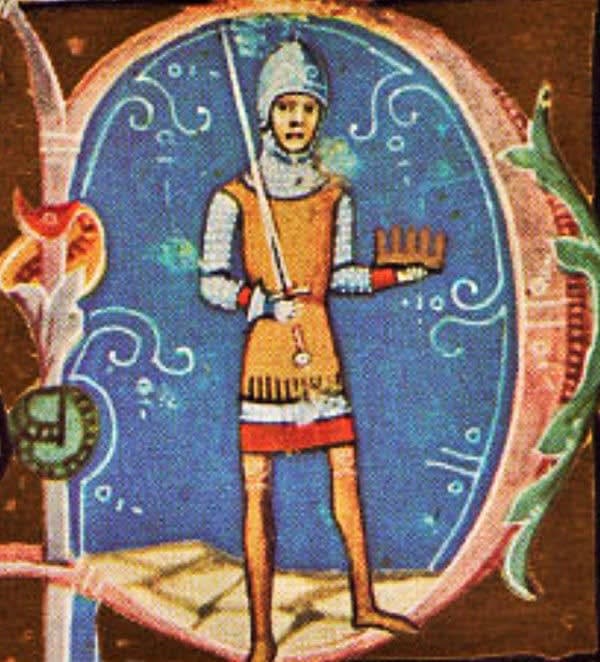

The life of a man destined to become one of the most controversial figures in Hungarian history began far from the Carpathian steppes. Peter was born in Venice (historian Gyula Kristó dates his birth to 1010 or 1011) and was the only son of the ruling Venetian Doge Ottone Orseolo. His mother was Grimelda, the younger sister of Stephen I the Saint, the first king of Hungary. Thus, the blood of pragmatic Italian patricians and the fierce Hungarian kings of the Árpád dynasty flowed together in Peter's veins.

The peaceful youth of the republic's heir came to an abrupt end in 1026, when a violent uprising erupted in Venice. Enraged citizens overthrew and expelled Ottone Orseolo. The deposed doge was forced to seek refuge in Byzantine Constantinople, but young Peter did not follow his father.
Driven by ambition, he traveled eastward to the court of his powerful uncle, King Stephen I. In Hungary, the young man demonstrated remarkable military talent, and Stephen soon appointed his foreign-born nephew commander of the entire royal army.

The fate of the Hungarian throne took a dramatic turn on September 2, 1031. On that day, Prince Emeric (Imre), the only son and greatest hope of the aging King Stephen, was killed by the tusks of an enraged wild boar during a hunting expedition. The monarch had no other legitimate sons, and the kingdom found itself on the brink of a dynastic crisis.
The king's cousin, Prince Vazul, immediately asserted his claim to the throne. However, Stephen, who distrusted Vazul and feared for the future of his Christian reforms, made an unprecedented decision: disregarding all ancient traditions, he officially designated the Venetian Peter as his successor.
This decision provoked a storm of outrage. To clear the way for his nephew and suppress any opposition, Stephen resorted to extreme measures. On his orders, Vazul was seized and brutally blinded, while his three sons — Princes Levente, Andrew, and Béla — were permanently exiled from the country.

Nevertheless, Peter's own position at court remained precarious. King Stephen was well aware of the hidden hostility between his nephew and Queen Gisela of Bavaria, the monarch's wife.
Shortly before his death, Stephen compelled Peter to swear a solemn oath upon the Gospel, promising to respect the life and inviolability of Queen Gisela's property after the king's passing.
On August 15, 1038, Stephen I, the great founder of the Hungarian state, breathed his last. Peter Orseolo ascended the throne, inheriting a powerful kingdom in which deep dissatisfaction was already simmering.
The young monarch began his reign with bold and aggressive foreign policies. In 1039 and 1040, Hungarian cavalry forces descended upon Bavaria, devastating the region with fire and sword.
At the same time, Peter invaded Bohemia to provide military support to Duke Bretislaus I, who had dared to challenge Henry III, the ruler of the Holy Roman Empire.

In domestic affairs, Peter initially appeared to be a worthy successor to his uncle. He vigorously strengthened the position of the Christian Church, founding several monasteries, establishing the Buda parish, creating the Bishopric of Vác, and initiating the large-scale construction of a magnificent basilica in the city of Pécs.
However, Peter's true character soon began to reveal itself. The Hungarian nobility watched with growing anger as the king distanced himself from the native aristocracy, surrounding himself almost exclusively with foreigners.
As the Hungarian chronicles bitterly observed, Peter preferred the company of Germans, "who roared like wild beasts," and Italians, "who chattered like swallows."
The king introduced new, excessively burdensome taxes, began shamelessly diverting Church revenues into his personal treasury, and arbitrarily dismissed two of the kingdom's highest-ranking bishops.
His contempt for Hungarian customs eventually exceeded all limits. Simon of Kéza, in his monumental work Gesta Hunnorum et Hungarorum (The Deeds of the Huns and Hungarians), left a devastating portrait of the monarch:
"As soon as he began to rule, Peter forgot all the principles of patience and restraint befitting the dignity of a monarch. In his entourage, the Germans and Latins ran wild, seizing and contemptuously consuming the wealth of the kingdom, 'with proud eyes and insatiable hearts.' The fortifications, castles, and offices of the kingdom were taken away from the Hungarians and handed over to Germans or Latins."
Kéza also accused the king of unrestrained debauchery, claiming that Peter and his entourage dishonored the wives and daughters of Hungarian noblemen wherever the royal procession traveled.
The final straw was Peter's direct violation of the oath he had sworn at Stephen's deathbed. He dared to confiscate all the extensive estates of the widowed Queen Gisela and placed her under arrest.
In desperation, the queen appealed to the Hungarian nobles for protection. United in their outrage, they placed the principal blame on a treacherous royal favorite named Budo, accusing him of whispering disastrous advice into the monarch's ear.
The nobility issued an ultimatum, demanding that Budo be brought to justice. When Peter arrogantly rejected their demand, a rebellion erupted.
The conspirators stormed the palace, captured the unpopular adviser, and brutally tore him apart.
In 1041, Peter Orseolo was overthrown. The rebellious barons placed Samuel Aba on the throne, a brother-in-law of the late King Stephen I (or, according to other chronicle traditions, his nephew).

Having lost his crown, Peter fled westward to Austria, where he found refuge with Margrave Adalbert the Victorious, his brother-in-law, who was married to Peter's sister Froila.
Consumed by a thirst for revenge, the deposed king turned for assistance to his recent enemy, Holy Roman Emperor Henry III.

The new Hungarian king, Samuel Aba, decided to launch a preemptive strike and invaded Austrian territories in February 1042. However, Margrave Adalbert managed to organize fierce resistance.
In response, at the beginning of that same year, 1042, Emperor Henry III launched his first major military campaign against Hungary.
The heavy imperial infantry and armored knightly cavalry broke through the Hungarian defenses and advanced to the banks of the Garam (Hron) River.
Henry intended to immediately restore Peter to the throne in the occupied territories, but he encountered fierce resistance from the local population, which categorically refused to recognize the Venetian as its ruler.
The emperor was forced to compromise, handing control of these territories to another, unnamed representative of the Árpád dynasty.
Meanwhile, Peter was gathering loyal mercenaries around himself. Among those who particularly enjoyed his favor were Henry III's favorites — knightly brothers from Swabia.
As Simon of Kéza wrote:
"Later, during the reign of King Peter, three brothers came here from Swabia — Keled and Gut. They were born in Stof Castle."
Historians identify Stof Castle as either the fortress of Stauf in Breisgau or Hohenstaufen in Württemberg.
The name of the third brother has been lost to history, but Gut and Keled became the founders of one of the most powerful noble clans in Hungarian history — the Gutkeled family.
In the autumn, the war erupted with renewed intensity. Imperial troops burned Hainburg and Pressburg to the ground.
Hermann of Reichenau described this campaign grimly in his Chronicle:
"...he was unable to advance beyond the valley of the Danube and the Garam River, for the lands to the south were protected by marshes. Part of the army was attacked twice by the Hungarians."
Since the population still refused to accept Peter, Henry left a loyal Hungarian exile in charge of the conquered border territories.
The decisive moment came in early summer 1044. Henry III returned with an enormous army.
Confronted with the overwhelming power of the empire, many Hungarian nobles lost their resolve and defected to Peter's side.
On July 5, 1044, the great Battle of Ménfő took place near Győr. Samuel Aba's army was utterly defeated. The deposed usurper fled the battlefield but was soon captured and mercilessly killed.

The victorious Henry III entered the ancient capital of Székesfehérvár amid the clashing of swords, where he personally restored Peter Orseolo to the Hungarian throne.
But the price of this crown proved unbearably high for the proud kingdom.
Seeking to please his imperial protector, Peter introduced German feudal law into the country, effectively acknowledging Hungary as a vassal of the Holy Roman Empire.
The culmination of this national humiliation came on Trinity Sunday in 1045. During a lavish ceremony, Peter Orseolo solemnly handed his gilded royal spear to Henry III, officially recognizing the emperor as his feudal overlord.
Hungary could not forgive this betrayal of its national interests.
A wave of conspiracies swept across the country. As early as 1045, Stephen I's maternal cousins, Bolya and Bonyha, attempted to organize a coup.
The conspiracy was uncovered, and the brothers were subjected to horrific torture before being publicly executed.
Recognizing that the country was descending into catastrophe, the influential Bishop Gerard of Csanád secretly dispatched messengers abroad, inviting the exiled sons of Vazul to return to Hungary.

However, Peter's reign collapsed even before the princes could assemble an army.
In 1046, Hungary was shaken by an enormous pagan uprising led by the chieftain Vata.
Enraged crowds overwhelmed garrisons, burned churches, and murdered foreigners.
As Hermann of Reichenau recorded:
"The following autumn, the Hungarians remembered their former betrayal... They killed many foreigners who had fought for King Peter... Many foreigners in this country were subjected to robbery, exile, or execution."
Witnessing the collapse of his kingdom, Peter attempted to flee westward toward Henry III, heading in the direction of Mosonmagyaróvár.
But the borders had already been blocked.
One of Vazul's returning sons, Prince Andrew, sent envoys to the fleeing king with an offer of peaceful negotiations in Székesfehérvár.
Peter, believing the deception, turned back.
However, he soon realized that he was being lured into a trap, intended to capture him and hand him over to Andrew for punishment.
With a handful of loyal followers, the king turned off the road near the village of Zámoly and barricaded himself inside a fortified stone manor.
A desperate three-day siege began.
Cornered, Peter defended himself with the fury of a man who knew he was doomed.
According to the Hungarian Illuminated Chronicle:
"Finally, all his soldiers were killed by arrows, and he himself was taken alive."
The punishment was swift and merciless.
The captured Peter was brought to Székesfehérvár, where, on the orders of the new rulers, he was blinded — just as Andrew's father, Vazul, had once been blinded.
Fourteenth-century Hungarian chronicles claim that the deposed monarch, unable to endure the unbearable suffering, died shortly afterward.
His body was transported to Pécs and buried in the Cathedral of Saints Peter and Paul — the very cathedral whose construction he had ordered and which was finally completed in 1064.


However, history leaves room for a remarkable mystery.
The Bohemian chronicler Cosmas of Prague preserved an entirely different and astonishing account of the exiled king's fate.
According to his testimony, Peter Orseolo did not die from his injuries.
Mutilated but still alive, he survived his downfall and went into exile in Bavaria.
There, around 1055, the blind former king married Judith of Schweinfurt, the powerful widow of Duke Bretislaus I.
According to this legend, Judith entered into the marriage solely to spite her son Spytihněv, who had expelled her from Bohemia.
If the account of the Prague chronicler is to be believed, Peter Orseolo spent several more years living quietly in the castles of Bavaria before peacefully passing away in the late 1050s.


