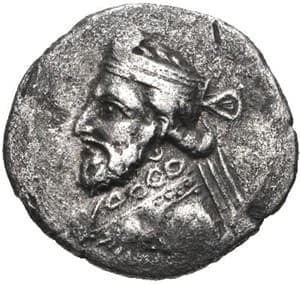

The origins of Gondophares’s power should be sought in his ancestry. Most likely, he belonged to the House of Suren, one of the oldest, noblest, and most influential aristocratic families of Arsacid Iran. The Surens were not merely nobles; they possessed the exclusive hereditary right to place the crown upon the head of the Parthian king during coronation ceremonies and traditionally commanded the royal armies.

The Surens’ path toward creating a kingdom of their own began amid a great crisis. Around 129 BC, the eastern frontiers of the Parthian Empire, particularly the prosperous region of Drangiana, were shaken by the advance of nomadic peoples.
The principal threat came from the eastern Iranian Saka tribes, also known as the Indo-Scythians, and the enigmatic Yuezhi — probably an Indo-European people whose precise origins remain a matter of scholarly debate. This invasion permanently transformed the region, which from that time onward became known as Sakastan, meaning “the land of the Saka.”
The Parthian king Mithridates II, who ruled from 124 to 88 BC, succeeded in inflicting a severe defeat upon the Saka in Sakastan. To maintain control over the region, he appointed governors or satraps, one of whom is believed to have been Tanlis Mardates. This administrative system remained in place until the rise of Gondophares.
The continuing pressure of the nomads, however, forced the Parthian court to adopt more radical measures: the administration of the whole of Sakastan was entrusted to the powerful House of Suren.
This strategy exceeded all expectations. The Surens not only succeeded brilliantly in defending the imperial frontier and repelling Indo-Scythian raids but also launched a major offensive of their own. They invaded enemy territories and annexed Arachosia and Punjab, laying the foundations for the emergence of an independent Indo-Parthian Kingdom.

Gondophares’s moment of triumph came around AD 19 or 20. Upon ascending the throne, he made a bold and unprecedented decision — he proclaimed complete independence from the Parthian Empire.
To consolidate his new status, the king began minting his own coinage in Drangiana. On these coins, Iranian names appeared alongside Greek inscriptions and the local Kharosthi script. Gondophares proudly styled himself with the Greek title Autokrator — an independent or self-ruling monarch.
The exact chronology of his reign remained a subject of scholarly debate for a long time. Earlier historians believed that he had lived considerably later. The issue was finally clarified by a unique archaeological discovery — the rock inscription from Takht-i-Bahi, near the modern city of Mardan in Pakistan.
Carved in AD 46, the inscription established that the king’s regnal era had begun in AD 20. Ernst Herzfeld, analyzing this evidence, further strengthened the interpretation that the dynasty of Gondophares represented the House of Suren itself elevated to royal power.
The reign of Gondophares I was marked by remarkable geopolitical successes. He seized some of the richest territories from the Scythian ruler Azes: the Kabul Valley, Sindh, and Punjab.
Interestingly, these conquests were accompanied by subtle diplomacy. Many of Azes’s vassals voluntarily transferred their allegiance to the increasingly powerful Parthian ruler.
The kingdom of Gondophares grew to enormous proportions, extending across vast territories. He made the celebrated Gandharan city of Taxila, situated in Punjab to the west of modern Islamabad, his capital.
Although this enormous political formation proved fragile and fragmented soon after the death of its founder, the fame of the king of Taxila spread far beyond Asia.

Remarkably, this formidable eastern monarch achieved a kind of immortality in Western Christian tradition.
The linguistic transformation of his name produced unexpected consequences. The Armenian form Gastafar gradually changed in European languages into forms such as Gasbar, Gaspas, Caspus, and eventually the familiar Caspar.
Some researchers have suggested that Gondophares became the prototype for “Gaspar, treasurer and king of Persia,” who entered Christian tradition as one of the Three Biblical Magi who brought gifts to the infant Christ.
Through this enduring association with apocryphal literature, the name Gaspar became permanently established in Western European culture as a popular male given name.
The connection between Gondophares and early Christianity, however, does not end there.
The king occupies a central place in the famous apocryphal work known as the Acts of Thomas, where he appears under the name Gudnaphar.
According to the tradition, following the crucifixion of Jesus Christ, usually dated to around AD 30, the Apostle Thomas traveled to India to preach and was eventually brought directly to the court of King Gundaphar in his capital, Taxila.
In contemporary Pali texts, the city was known as Takkasila, a form derived from the Sanskrit Taksha-shila.

Interest in Taxila and its ruler was not limited to Christians. Ancient philosophers were also fascinated by the city.
According to Philostratus’s Life of Apollonius of Tyana, the famous philosopher visited the capital of Gondophares in AD 43–44. Philostratus also notes that the king bore the Parthian name Phraotes.


