Among the colorful chronicles of the ancient world, the figure of Menander I stands out with particular grandeur. He was a ruler in whom the pragmatism of a Greek commander merged with the depth of an Eastern philosopher. Sources disagree over the exact place of his birth: some, relying on ancient texts, name the village of Kalasi near Alexandria of the Caucasus, modern Bagram in Afghanistan, while others claim that his homeland lay in the vicinity of Sagala, present-day Sialkot in Pakistani Punjab.
His enormous domains encompassed Bactria, corresponding roughly to the modern province of Balkh, and expanded relentlessly eastward, absorbing the territories of present-day Khyber Pakhtunkhwa and Punjab. The Roman historians Gnaeus Pompeius Trogus and Justin respectfully styled him “King of India.” The great Plutarch called him king of Bactria, while the geographer Strabo placed him among the greatest Greek conquerors. It is possible that at the beginning of his reign he indeed controlled part of Bactria, providing strategic support to the Seleucid ruler Demetrius II Nicator during the difficult Seleucid-Parthian wars, before turning his attention beyond the Hindu Kush.
The scale of Menander’s military campaigns astonished his contemporaries. Crossing beyond the Hindu Kush, he incorporated Gandhara and probably the valleys of Kashmir into his realm. The heart of his vast kingdom became prosperous Sagala in northern Punjab — a city overflowing with luxury and wealth.
Ancient chroniclers recognized him as one of the foremost Greek conquerors of the East. Strabo, quoting Apollodorus of Artemita, preserved a remarkable testimony: the Bactrian Greeks, enriched by the prosperity of their land, became masters not only of Ariana but also of India. According to Apollodorus, Menander conquered more tribes and peoples than Alexander the Great himself.
His army crossed the River Hypanis and advanced eastward toward the mountain ranges of Imaus. Together with Demetrius, son of the Bactrian king Euthydemus, Menander subdued Patalene, the coastal kingdoms of Saraostus and Sigerdis, and extended the boundaries of the Hellenistic world as far as the mysterious peoples known as the Seres and Phryni. In the end, as Apollodorus summarized, Bactriana became the true ornament of all Ariana.
His campaigns deep into the Indian subcontinent became legendary. Sources record lightning-fast Indo-Greek advances against Sagala, Mathura, Panchala, and Saketa, modern Ayodhya. More remarkably still, the hooves of his cavalry horses reached the lands surrounding Pataliputra.
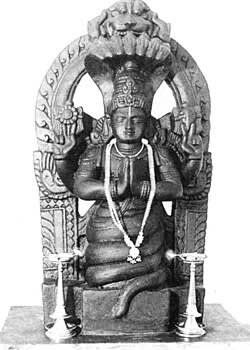
The Indian scholar Patanjali, in his monumental Mahabhashya, written around 150 BC, mentions an attack on Mathura by the Yavanas, an echo of which later appeared in the great Kalidasa’s drama Malavikagnimitram.
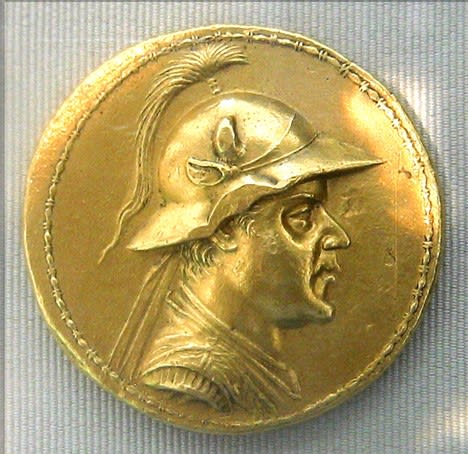
Indian rulers watched the advance of the formidable “Yavanas” — the Greeks — with alarm. In the famous Hathigumpha inscription, dated between the first century BC and the first century AD and carved in the Brahmi script, King Kharavela of Kalinga boasts that in the eighth year of his reign he besieged Rajagriha and that news of this achievement supposedly forced the “demoralized army” of the Yavana king to retreat toward Mathura.
The Yavanas, however, had no intention of surrendering. The prophetic text Yuga Purana, part of the Gargi Samhita, dramatically describes how the fierce and courageous Greeks, after crushing Saketa, Panchala, and Mathura, reached Kusumadhvaja.
The ancient text declares that when their siege engines, described as “tree-like machines,” approached the mud-brick walls of Pataliputra — capital of the Shungas and modern Patna — all the lands of India descended into the chaos of a great battle. Strabo likewise confirms that the successors of Alexander reached the Ganges and Pataliputra.
The exact outcome of these colossal battles has been lost to time. It is known only that Kharavela eventually plundered Pataliputra himself, while during the age of Menander coins of the local Mitra dynasty were minted in Mathura — perhaps indicating that its rulers had become dependent vassals under the authority of the Greek king.
Yavana inscriptions discovered in Mathura, coins from western Uttar Pradesh, and hoards such as the Pachkhura hoard near the Yamuna River and a vessel discovered in Vaishali District in Bihar all support the historical reality of this advance into the Gangetic Plain.
Menander was not merely a master of attack but also a genius of defense. When the ambitious Greco-Bactrian usurper Eucratides rose in the west, Menander struck against him, driving the enemy army back as far as the Paropamisadae and thereby securing Indo-Greek control over northwestern India through iron and blood.
His military philosophy is elegantly revealed in the Buddhist treatise Milinda Panha. When a sage asks whether the king begins preparing his defenses only when enemies revolt, Menander replies that moats, ramparts, towers, and provisions must be prepared long before war begins. In the same way, he had mastered the handling of elephants, chariots, and the sword long before his first battle — “in order to prevent future danger.”

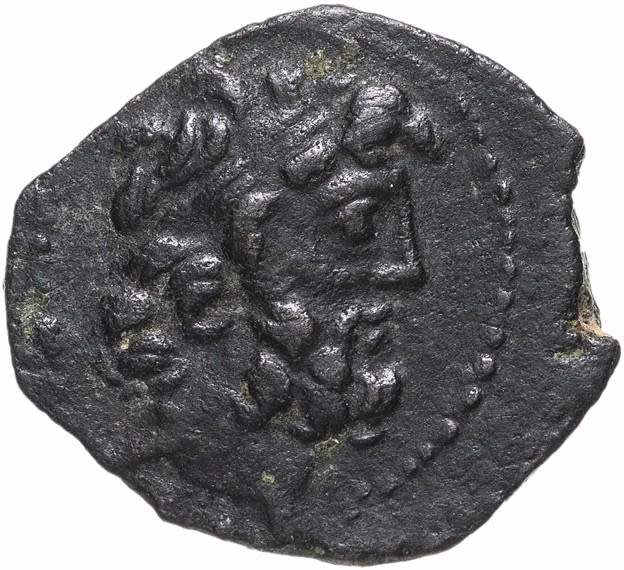
Menander I left behind an enormous material legacy. The quantity of his bronze and silver coinage exceeds that of any other Indo-Greek ruler, testifying to the longevity of his reign and the extraordinary flourishing of trade.
The geographical distribution of these coins is astonishing: from the Siranwali hoard near Sialkot and the Sonipat hoard in Haryana to remarkable finds discovered as far away as Britain.
The very appearance of his coinage reflected the fusion of civilizations. His earliest issues followed the strict Attic weight standard, probably intended for Bactria, and carried monolingual Greek inscriptions, perhaps symbolizing victory over Eucratides. Soon afterward, however, Menander introduced a numismatic revolution. He adopted a new weight standard and united Greek and Indian traditions.
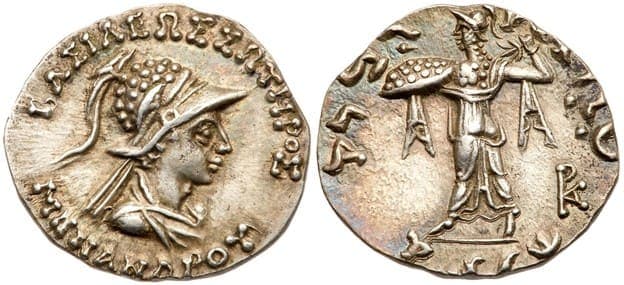
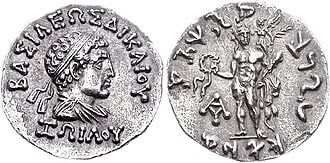
On the obverse of his magnificent silver drachms appeared the king’s portrait — an innovation for Indian lands — sometimes showing him throwing a spear and sometimes viewed from behind in a heroic pose.
Around the portrait ran the proud Greek legend:
ΒΑΣΙΛΕΩΣ ΣΩΤΗΡΟΣ ΜΕΝΑΝΔΡΟΥ
“Of King Menander the Savior.”
On the reverse appeared the emblem of his dynasty — the goddess Athena Alkidemos, “Defender of the People,” advancing with her aegis and hurling a thunderbolt, recalling the famous statue in the Macedonian capital of Pella.
Around Athena appeared an inscription in the local Kharosthi script:
MAHARAJASA TRATARASA MENAMDRASA
“Of the Great King Menander the Savior.”
Menander later ingeniously altered the circular orientation of the inscriptions so that they could be read without rotating the coin — a standard subsequently adopted by all of his successors.
Yet Menander entered the annals of world history not only as a commander, but also as a great seeker of truth. In the Indian tradition he is known as Milinda, ruler of the “Indian city of Euthymedia.” His spiritual journey was immortalized in the classic Pali text Milinda Panha — The Questions of King Milinda — whose style clearly reflects the influence of Platonic dialogue.
The treatise portrays Menander as a man of exceptional intellect, proficient in nineteen arts and sciences — from the four Vedas, the Puranas, and the Itihasas to Samkhya philosophy, yoga, magic, warfare, medicine, and astronomy.
“As in wisdom, so in bodily strength... throughout all India there was no one equal to Milinda.”
He was protected by an elite guard of five hundred Greek Yavanas, while among his closest advisers were the loyal Greeks Demetrius and Antiochus.
The turning point came with his meeting with the Buddhist sage Nagasena. Astonished by the elder’s answers to the deepest philosophical questions, the mighty king bowed before the power of the Dharma.
“May the venerable Nagasena accept me as a follower of the faith, as a true convert from this day until the end of my life!” the ruler exclaimed.
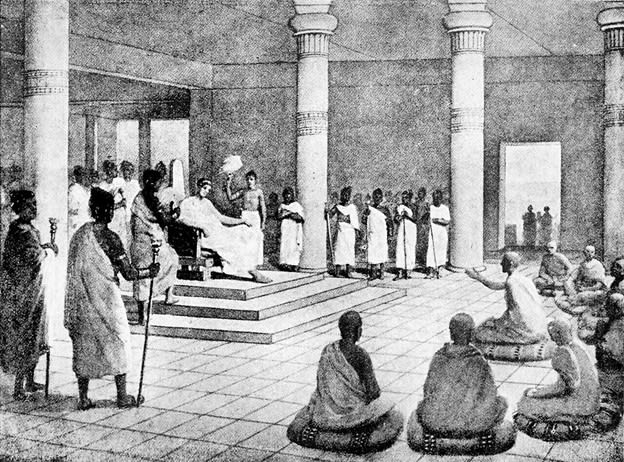
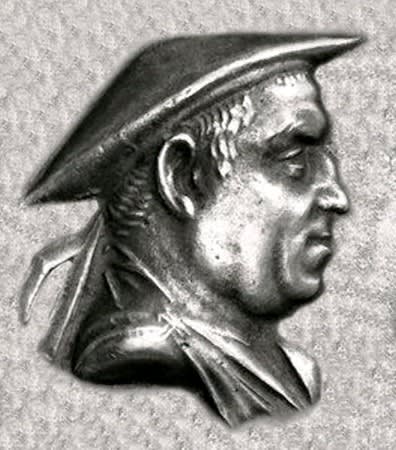
During Menander’s reign, Greek monks became an important force in the spread of Buddhism. The ancient Sri Lankan chronicle Mahavamsa relates that in the second century BC a Greek elder — a Yona Thera — named Mahadhammarakkhita traveled from Alasandra, Alexandria of the Caucasus near Kabul, to Sri Lanka for the foundation ceremonies of the Great Stupa at Anuradhapura, leading no fewer than thirty thousand monks.
The precise chronological boundaries of Menander’s reign remain a matter of scholarly debate. He was once believed to have served as a commander under Demetrius I, but modern historians generally place the two rulers at least thirty years apart and suggest that Menander’s predecessor in Punjab was Apollodotus I.
The final years of the great king’s life are surrounded by contradiction.
Buddhist tradition maintains that Menander voluntarily relinquished power. After handing the throne to his son and “delighting in the wisdom of the Elder,” he entered the monastic life, attained enlightenment, and became an arhat — a saint.
The ancient Greco-Roman tradition, however, presents a different picture. Plutarch, in his Moralia, states that Menander, who had “ruled graciously over the Bactrians,” suddenly died while in a military camp.
Remarkably, even in this version the king assumes an almost sacred status. The cities of his kingdom entered into a fierce dispute over the right to possess his remains. Eventually, his ashes were divided equally and buried in specially constructed monuments or stupas — precisely as had happened with the relics of the Buddha himself.
Perhaps the final days of the ruler were darkened by the bitterness of another civil conflict. In the eastern part of his kingdom, Zoilus I, who ruled in Gandhara, revolted, and Menander was even forced to overstrike the rebel king’s coins.
The Milinda Panha seems to reveal Menander’s weariness:
“Just as the lion, king of beasts, even when placed in a golden cage still looks outward, so do I... But if I were to leave the household life... I would not live long — so numerous are my enemies.”
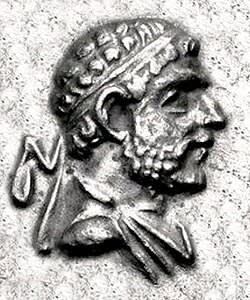
After Menander’s death, his enormous but loosely unified realm began to disintegrate. Power passed to his widow, Queen Agathocleia, who became regent for their young son Strato I. He retained the title “Soter,” or “Savior,” and continued to depict Athena on the reverse of his coins.
They succeeded in retaining only Punjab, while the Paropamisadae passed to Zoilus I. Strato I would continue to rule for decades afterward.
The Indo-Greek dynasty survived in fragmented form until approximately AD 10, when the last king, Strato II, disappeared from the historical record.
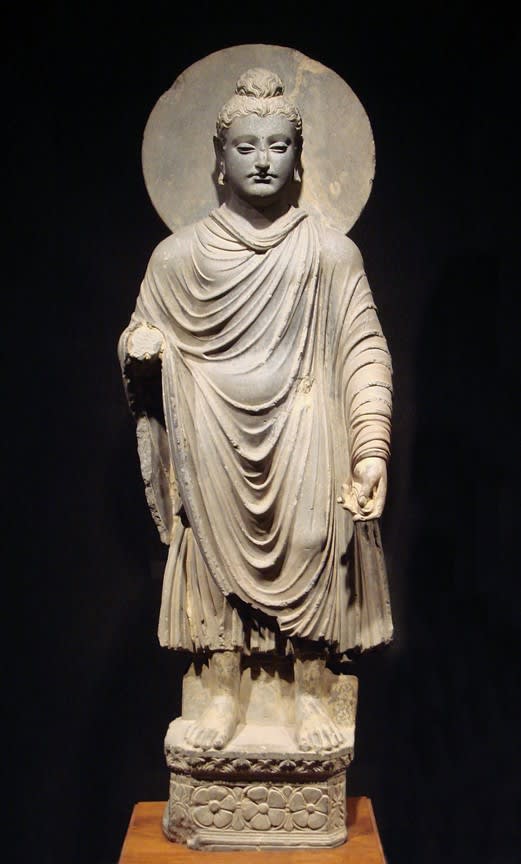
It was probably under Menander’s patronage that one of the greatest phenomena of world art emerged — Greco-Buddhist sculpture.
While Indo-Greek coinage respected the prohibition against depicting the Buddha, in sculpture — according to the theory of Alfred Foucher — Greek or Hellenized craftsmen of the second and first centuries BC were the first to give the Buddha a fully human form rendered with remarkable Hellenistic realism, thereby creating a visual canon that has survived to the present day.
Indochinese traditions even claim that the famous Emerald Buddha was created in 43 BC by Nagasena, Menander’s spiritual teacher.
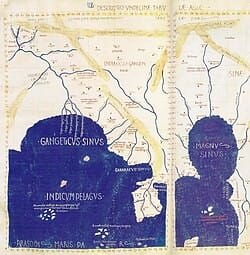
The memory of the great king survived across the millennia. In the first century AD, the famous geographer Claudius Ptolemy marked on his world map, far to the east of India, a mountain range which he named Menander Mons — “the Mountains of Menander,” identified with the modern Arakan Mountains and Naga Hills.
In modern India, in the city of Aurangabad, stands Milind College, named in honor of this Greco-Bactrian king. One of the founders of the institution was the great Bhimrao Ramji Ambedkar — leader of the Dalits and principal architect of the Constitution of India.
Thus the circle was complete: a Greek youth from the foothills of the Caucasus became an immortal Indian sage, whose name still stands as a symbol of justice, enlightenment, and the enduring connection between East and West.


