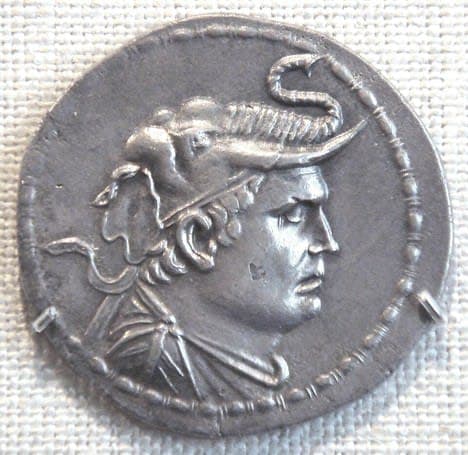

Demetrius entered the arena of world history in the midst of a brutal war. Around 210 BC, the lands of his father, the Bactrian ruler Euthydemus I, were invaded by the powerful Seleucid Empire under King Antiochus III. Although Euthydemus marched out to meet the enemy with 10,000 elite cavalrymen, he was defeated on the banks of the River Arius and retreated to his seemingly impregnable capital, Bactra. The siege dragged on for three long years. When Antiochus finally realized that further bloodshed offered little prospect of success, the time for diplomacy arrived. It was then, around 206 BC, that Euthydemus’s young son Demetrius entered the Seleucid camp as an envoy.

Antiochus received the royal envoy and was so impressed by his appearance, noble speech, and regal bearing that he not only agreed to recognize Euthydemus as king of Bactria but also promised one of his daughters in marriage to the young prince. Polybius uses the term neaniskos (νεανίσκος) when referring to Demetrius, a word which in the ancient tradition suggests an age of approximately sixteen. Thus, the future great commander was probably born around 222 BC.

The young prince soon became an official co-ruler alongside his father. This is supported by remarkable archaeological evidence — the Kulob inscription, carved in stone in the western part of Greco-Bactria, in the territory of modern Tajikistan, and dated to approximately 200–195 BC.
A Greek named Heliodotus erected a fragrant fire altar in a sacred grove of Zeus and dedicated it to the most revered goddess Hestia. In his prayers, he asked the divinely minded Tyche to deliver from suffering “Euthydemus, greatest of all kings,” as well as his son, “the glorious, victorious, and distinguished Demetrius.”
The death of his father made Demetrius the undisputed ruler of Bactria. His attention, however, was directed not toward the west, where the Seleucids ruled, but toward the enticing lands beyond the Hindu Kush.
Between 190 and 180 BC, Demetrius launched an unprecedented invasion of northwestern India. The geopolitical situation favored his ambitions. The once-powerful Mauryan Empire had collapsed after the general Pushyamitra Shunga overthrew his sovereign and founded the new Shunga dynasty, which ruled from 180 to 78 BC.
The Greco-Bactrian invasion was driven by several factors. First, Demetrius sought to protect the numerous Greek settlers who remained on the Indian subcontinent. Second, the Mauryas had long been regarded as allies of the Greeks. The Sri Lankan chronicle Paramparapustaka even preserves a tradition that Demetrius gave one of his daughters in marriage to the Mauryan emperor Brihadratha shortly before the latter was overthrown around 180 BC.

Demetrius descended upon the Indian lands like a hurricane. He first restored his control over Arachosia, the region south of the Hindu Kush, which the Parthians referred to as “White India.”
In his Parthian Stations, Isidore of Charax lists the Greek strongholds of this region: Biit, Pharsana, Chorochoad, the capital Alexandropolis on the River Arachotus, and the city of Demetrias, almost certainly founded by the conquering king himself.
The scale of the Greco-Bactrian advance astonished ancient geographers. Strabo, drawing on Apollodorus of Artemita, wrote admiringly that the Bactrian rulers had conquered more peoples and territories than Alexander the Great himself, reaching as far as the River Hypanis and the mountain range of Imaus.
Although the campaigns deep into eastern India — toward the Ganges and Pataliputra, modern Patna — mentioned in ancient texts are often associated by historians with the later Indo-Greek king Menander I, it is clear that Demetrius was the ruler who first opened the path eastward.
Judging from the enormous quantity of coins discovered at the archaeological complex of Sirkap, Taxila became the principal center of his Indian possessions.

Demetrius’s rapid triumph ended abruptly.
He is generally believed to have died for unknown reasons around 180 BC, although this date is largely conventional and is used to reconcile the complicated chronology of his numerous successors.
His death plunged the empire into a period of internal conflict and temporary partition. A whole succession of rulers appeared on the Bactrian and Indian thrones: Pantaleon, Agathocles — probably a biological son of Demetrius I — Antimachus I, and Euthydemus II.
Later, the powerful usurper Eucratides seized control of Bactria, while Demetrius II, perhaps a son or nephew of Demetrius I, ruled in India.
Demetrius II was defeated by Eucratides around 150 BC, leaving behind celebrated commanders such as Apollodotus and Menander. Before long, these men placed royal diadems upon their own heads and firmly established an independent Indo-Greek Kingdom.


