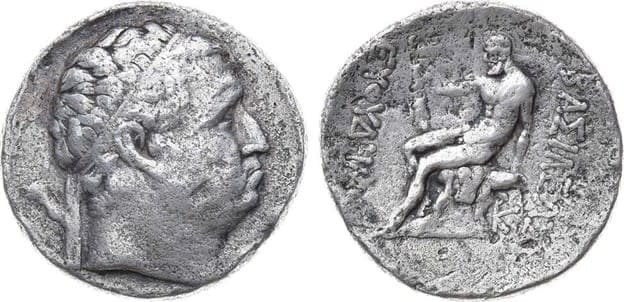

An Ionian Greek by origin, Euthydemus was born in one of the cities named Magnesia — either Magnesia on the Maeander or Magnesia ad Sipylum. The ancient historians Strabo and Polybius preserve the information that he became the father of the future great conqueror Demetrius I. The ancestry of Euthydemus himself, however, remained a mystery for a long time. The British historian William Woodthorpe Tarn proposed a bold hypothesis: in his view, Euthydemus was the son of the Greek commander Antimachus or Apollodotus, who had been born around 295 BC and was himself the son of Sophytes. To strengthen his position amid the turbulent politics of the East, Tarn believed, Euthydemus married the sister of the Greco-Bactrian king Diodotus II.

Euthydemus’s path to supreme power was far from easy. A number of modern scholars believe that his influence initially extended across the Central Asian steppes and the region of Sogdiana. The historian Lucas Christopoulos goes even further, suggesting that between 250 and 230 BC, before seizing the Bactrian throne, Euthydemus already controlled enormous territories stretching from Sogdiana as far as Gansu and the fortified oases of the Tarim Basin, relying on the formidable strength of Hellenized Saka cavalry.
Archaeological evidence strikingly confirms the extraordinary scale of military and construction activity during this period. In the territory of modern Surxondaryo Region in Uzbekistan, amid the rugged landscapes of the Hissar Mountains and the Koytendag range, intensive fortification work was underway. The Seleucid fortress of Uzundara was substantially expanded, and it was there that archaeologists discovered large numbers of bronze coins issued by Euthydemus.
It is believed that the construction of the massive defensive structure known to history as the “Iron Gates” also began on Euthydemus’s orders. This colossal stone wall, 1.6–1.7 kilometers long, bristling with towers and crowned by a central citadel, completely blocked a strategically vital mountain pass.
The researcher Ladislav Stančo cautiously connects these fortifications with the threat of nomadic invasion. Yet he notes a curious detail: judging by the orientation of hundreds of arrowheads discovered there, the Derbent Wall was designed not to defend against attacks from the northwest, from Sogdiana, but rather from the southeast — from Bactria itself. Stančo therefore suggests that Euthydemus, having established himself in Sogdiana, initially defended his territory from the Bactrian rulers before eventually launching the decisive attack that gave him control over the entire kingdom.

After overthrowing the Diodotid dynasty, Euthydemus claimed that he had destroyed the descendants of rebels who had betrayed the empire. Yet the true test of both his legitimacy and his military skill still lay ahead.
Little is known about his reign before 208 BC, but in that year the armies of the Seleucid king Antiochus III the Great appeared on the horizon. Antiochus was determined to restore the eastern satrapies that had broken away from Seleucid rule.
Euthydemus did not hide behind the walls of his cities. Instead, he assembled an army whose vanguard included 10,000 elite cavalrymen and marched out to confront the enemy. The decisive clash took place on the banks of the River Arius, the modern Hari Rud.
Despite fierce resistance, Euthydemus was defeated by the superior Seleucid forces in the Battle of the Arius and was forced to retreat with the remnants of his army behind the powerful walls of his capital.

There began the exhausting siege of Bactra, which dragged on for three long years. Neither Antiochus’s military strength nor his siege engines could break the resolve of the defenders.
Realizing that victory would come at an excessive cost, Antiochus agreed to negotiations, mediated by his close associate Teleas. Euthydemus constructed his diplomatic defense brilliantly.
The historian Polybius records the Bactrian king’s argument: Euthydemus insisted that he had never rebelled against the Seleucids but had merely seized the throne after destroying the descendants of Diodotus, the original rebel.
His strongest argument, however, was the existential threat from the north. Euthydemus warned Antiochus directly that if he were deprived of power, “neither of them would be safe, since enormous hordes of nomads were close at hand... and if they allowed them to enter the country, it would undoubtedly be completely barbarized.”
The three-year war was finally brought to an end around 206 BC.
To finalize the peace settlement, Euthydemus sent his son Demetrius to the enemy camp. The young prince made an unforgettable impression on Antiochus III. Impressed by his appearance, the nobility of his speech, and his dignified bearing, Antiochus declared that Demetrius truly deserved royal status.
The Seleucid ruler not only formally recognized Euthydemus as king but also promised one of his daughters in marriage to Demetrius. As a reciprocal gesture of goodwill and to strengthen the new alliance, Euthydemus handed over all of his Indian war elephants to Antiochus.
The Seleucid army then withdrew from the region, and under Euthydemus’s capable leadership, the kingdom quickly recovered from the devastation of war.

Toward the end of his life, Euthydemus sought to strengthen his dynasty by making his son Demetrius a full junior co-ruler.
A remarkable confirmation of this arrangement is provided by the Kulob inscription, discovered in the territory of modern Tajikistan and dated to approximately 200–195 BC. In it, a Greek named Heliodotus dedicated a fragrant altar to the goddess Hestia in the sacred grove of Zeus. The inscription asks the goddess to grant good fortune to “Euthydemus, greatest of all kings, and his distinguished son Demetrius, renowned for glorious victories.”
Euthydemus the Great died sometime between 200 and 195 BC, leaving the throne to Demetrius, who would soon become famous for his large-scale invasion of northwestern India.
The prestige of the founder of the new dynasty was so great that later Bactrian rulers, Agathocles and Antimachus I, issued commemorative coins in his honor, granting Euthydemus the divine epithet Theos — “God” or “the Divine.”
Whether Euthydemus had already adopted this title during his lifetime remains a mystery.


