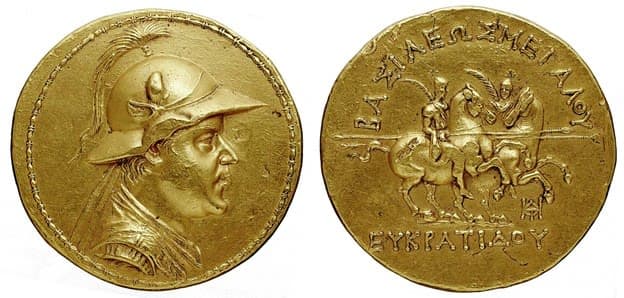

His life, which began around 210–205 BC, became a story of unprecedented conquests, desperate courage, and a tragic, bloody end.
The mystery of his origins continues to intrigue historians. Surviving coins preserve portraits of his parents — Heliocles and Laodice. This numismatic record contains one particularly important detail: while his father is shown bareheaded, like an ordinary nobleman, Laodice proudly wears a royal diadem.

Eucratides won his throne by the sword. Taking advantage of the fact that the army of King Demetrius had become bogged down in campaigns across northwestern India, Eucratides carried out a swift coup d’état. He ruthlessly overthrew the ruling Euthydemid dynasty, and the principal victim of his rise to power was most likely King Antimachus I, who had remained in Bactria.

From that moment onward, the young ruler was forced to fight a war on two fronts. While Demetrius I was conquering India, Parthia struck from the west. Around 170 BC, Mithridates I seized the rich territories of Tapuria and Margiana from the Euthydemids and then turned his attention toward Bactria itself. There, however, the Parthian military machine encountered the iron resolve of Eucratides, who succeeded in halting the invasion and securing his western frontiers.

Having protected Bactria from the Parthians, Eucratides turned his own attention toward the wealthy East. He launched a large-scale invasion of the Indian territories, cutting his way far to the south, as far as Barygaza, modern Bharuch.
While strengthening the Greek presence in northern India, he faced a terrible ordeal that nearly cost him his life but permanently secured his name in the annals of military history.
According to Justin, Eucratides, exhausted by endless warfare, found himself trapped under siege. Opposing him was a ruler whom the Roman historian calls “Demetrius, king of the Indians.” Scholars still debate whether this was Demetrius I, Demetrius II, or, perhaps more plausibly, the formidable Menander I.
The situation appeared hopeless. For four exhausting months — or, according to some readings of Justin, perhaps five — Eucratides and a tiny garrison of only three hundred men held a fortress against an enormous army of sixty thousand.
Through extraordinary courage and constant daring sorties, Eucratides achieved what seemed impossible. He defeated an enemy vastly superior in numbers, broke through the siege, and ultimately emerged victorious, bringing Indian territories under his authority.
His reign became an age of remarkable wealth and cultural prosperity. The greatest monument to Eucratides’s ambition was the magnificent city of Eucratideia, situated on the banks of the Oxus River. Whether it was an entirely new polis constructed from the ground up or an older city renamed in honor of the victorious king — perhaps even the famous Ai-Khanoum — remains uncertain. Ancient geographers nevertheless described it as a place of extraordinary wealth.


Between 162 and 158 BC, the western frontiers erupted in war once again. Eucratides permanently lost the satrapies of Aria and Margiana, which were seized by the Parthian king Mithridates I.
Later, while returning from yet another Indian campaign, the celebrated commander was treacherously murdered on the road. Justin claims that the killer was Eucratides’s own son, with whom the king had shared the burden of power.
Consumed by savage hatred, the parricide made no attempt to conceal his crime. As though he had slain his bitterest enemy, he drove his chariot directly through pools of the king’s blood and ordered the body of the great Eucratides to be cast aside in the dust without proper burial.
But who was the murderer?
Justin strongly implies that it was the king’s own son, Heliocles I. Yet parricide was such an outrageous crime in the Hellenistic world that many modern historians suspect the story may reflect a distortion of events.
A substantial alternative theory identifies the killer as Demetrius II — a surviving member of the Euthydemid dynasty that Eucratides had overthrown. It is even possible that Demetrius II was the very same “Indian” opponent whom Eucratides had previously fought.

The death of the great monarch plunged the empire into a bloody civil war. The throne was contested by Eucratides II and Heliocles I. The latter, who ruled approximately between 145 and 130 BC, became the last Greek ruler of Bactria.
Exhausted by endless conflicts with Sogdians, Arachosians, and Indians, the Bactrians eventually lost their independence. They found themselves trapped between an increasingly powerful Parthia and a new storm advancing from the east.
The mighty nomadic Yuezhi tribes defeated Heliocles and permanently drove the Greeks from the lands north of the Hindu Kush. The magnificent Hellenistic city of Ai-Khanoum, whose last ruler may have been Eucratides, was destroyed by fire around 145 BC.

Although Bactria had fallen, the Indo-Greek states south of the Hindu Kush continued to survive for approximately another century and a half. Only around 10 BC, under relentless pressure from the Scythians — the Saka — and the same Yuezhi tribes, did the kingdom of the last Indo-Greek ruler, Strato II, finally cease to exist.


