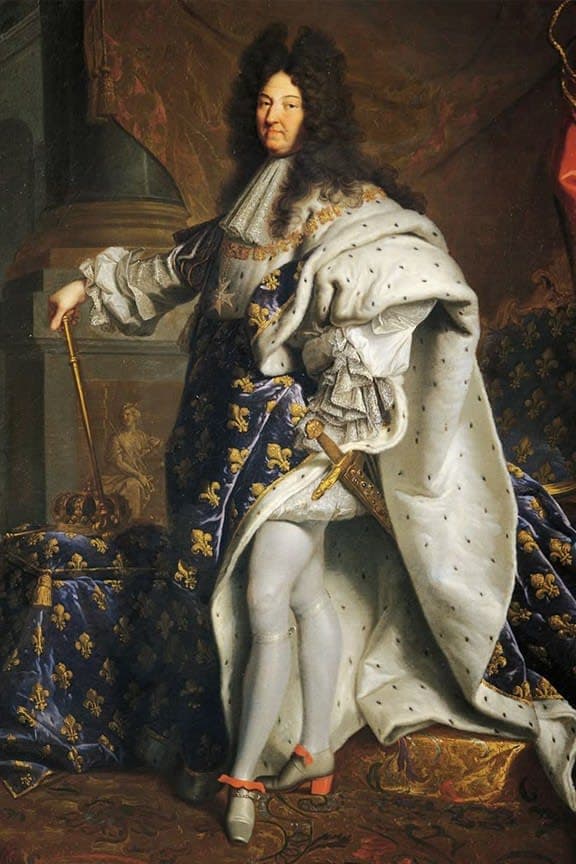
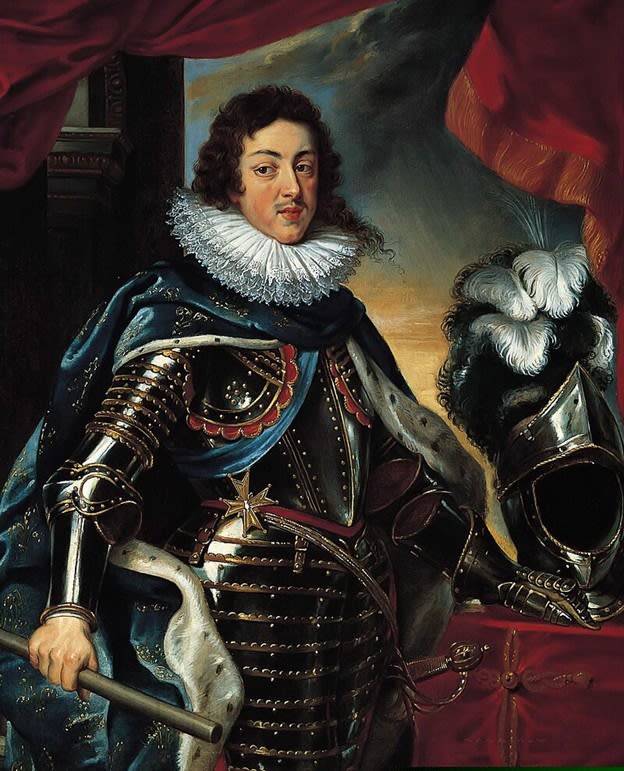
The future king of France Louis XIV was born on September 5, 1638, at the Château of Saint-Germain, becoming the long-awaited firstborn in the royal family. His birth was a true miracle, for his parents, King Louis XIII and Queen Anne of Austria, had waited for an heir for 23 years. The people perceived this as a gift from God, giving the prince the name Louis-Dieudonné, which translates as “given by God.” After him another son, Philippe, appeared in the family. Both princes descended from the two most powerful dynasties of Europe, the Bourbons and the Habsburgs.

In May 1643 Louis XIII died suddenly; Louis XIV was only four years old. Shortly before his death, the king, who trusted neither his wife nor his brother, drew up a will establishing a Regency Council. However, Anne of Austria, having secured the support of the Parlement of Paris, contested her husband’s will and became the sole regent for the underage king. She moved the court from the Louvre to the former Cardinal’s Palace, which thereafter became known as the Palais-Royal.

The education of the young king was overseen by various tutors, but from the age of seven his education was entrusted to Cardinal Mazarin, whom the queen appointed as chief minister. Mazarin, who succeeded Cardinal Richelieu in this post, became not only Louis’s teacher but also his political mentor. In childhood the future king more than once was on the brink of death, surviving smallpox, a tumor, and typhoid fever, but each time he miraculously recovered.

The period of Anne of Austria’s regency and Mazarin’s rule was overshadowed by a bloody civil war known as the Fronde (1648–1652). Discontent among the nobility and the Parlement of Paris with Mazarin’s growing power, his tax policy, and his course toward centralization of authority spilled over into open rebellion.
In 1648, on the Day of the Barricades, the royal family was forced to flee Paris. The unrest was supported by princes and the high aristocracy, as well as by the popular Cardinal de Retz. In 1649 the court besieged the capital, but peace was soon concluded. However, this was only a temporary lull.
In 1651, after the arrest of the princes Condé and Conti, Mazarin fled the country. The alarmed queen and her son attempted to leave Paris, but they were stopped by a crowd that burst into the Palais-Royal. That night the 12-year-old Louis XIV found himself a prisoner of his own people, which became for him a deep humiliation. He remembered this episode all his life and, in the opinion of historians, it became the driving force behind his striving for absolute power.

On September 7, 1651, Louis came of age and officially became a fully empowered king. But the civil war did not abate. Prince Condé raised an army and moved on Paris. In October 1652, after the Parisians had grown tired of Condé’s tyranny, Louis XIV and his mother triumphantly returned to the capital. Soon the king sent a letter to the Parlement of Paris in which he clearly set out his policy: “All power belongs to Us. We hold it by God’s will….” This statement became a harbinger of absolutism.
After the death of Cardinal Mazarin in 1661, the 22-year-old Louis XIV astonished everyone by announcing that he would not appoint a new chief minister and would take all power into his own hands. He began his rule with decisive measures: on September 5, 1661, he ordered the arrest of the superintendent of finances, Nicolas Fouquet, on charges of embezzlement. Fouquet, who posed a threat to the king’s authority, was sentenced to life imprisonment, and his enormous wealth was confiscated in favor of the treasury.

Louis appointed new ministers, among whom were outstanding figures. Jean-Baptiste Colbert became minister of finances, and under his leadership reforms were carried out that strengthened the economy, trade, and the fleet. Michel Le Tellier and his son Louvois reformed the army, making it one of the most powerful in Europe.
In 1682 the royal court moved to a new residence Versailles. This palace became a symbol of the grandeur and luxury of the French monarchy. Louis XIV introduced the strictest etiquette, turning the high aristocracy into courtiers who vied for the slightest favor of the monarch. Living far from Versailles was considered a sign of royal disfavor.


Despite successes in the economy and the army, the reign of Louis XIV also had its dark sides. Louis XIV created the cult of the “Sun King,” under which all power issued only from him. According to his own assertion, “L’État, c’est moi”— “The State is me.” He turned the doctrine of the divine rights of the king into an inviolable dogma, destroying any other authority in the country.
Louis XIV’s religious policy was aimed at strengthening royal power, including over the clergy. He sought to limit the influence of the Pope in France, even dreaming of creating an independent French patriarchate. However, under the influence of Bishop Bossuet, the French clergy limited itself to the official “Declaration of the Gallican Clergy” in 1682, which proclaimed the autonomy of the French church but not a complete break with Rome.

In matters of faith, the king fell under the strong influence of the Jesuits, who succeeded one another as his confessor. They made him an obedient instrument of Catholic reaction. This was manifested in the merciless persecution of the Huguenots (French Protestants). Their temples were taken away, mixed marriages were forbidden, and pastors were deprived of the ability to perform rites. The Protestant aristocracy was forced to adopt Catholicism so as not to lose its privileges.
In 1683 “dragonnades” were applied against the Huguenots the forced billeting of soldiers in Protestant homes, which was often accompanied by violence and looting. The culmination of this policy was the revocation of the Edict of Nantes in 1685, which for almost a century had guaranteed the Huguenots freedom of religion. This decision raised the prestige of Louis XIV in the eyes of Catholic Europe but had catastrophic consequences for France. Hundreds of thousands of Protestants, despite strict prohibitions, fled to England, the Netherlands, and Germany, taking with them their capital, craft skills, and knowledge. This dealt a serious blow to the country’s economy.
Louis XIV’s military policy was aggressive and ambitious. Over 54 years of his reign he spent almost 33 years in wars, striving to make France the leading power in Europe. The king’s mentor and example, Marshal Turenne, taught him the art of war. Louis won his first victories in his youth, taking part in the Battle of the Dunes in 1658, where the French troops defeated the Spaniards.
After the death of the Spanish king Philip IV in 1665, Louis asserted his rights to part of the Spanish Netherlands, which led to the Devolution War of 1667–1668. As a result of the Peace of Aachen, France received French Flanders and a number of other territories.


But the most serious mistake of Louis XIV was the war with Holland of 1672–1678. The king, who considered Holland his main trade and political opponent, managed to isolate it from its allies. In 1672 the French troops crossed the Rhine and in six weeks captured half of Holland. However, the intervention of other European powers, led by William III of Orange, stopped the French advance. The war ended in 1678 with the Peace of Nijmegen, under which France received new lands from Spain but did not achieve its main goal the complete subjugation of Holland.

In the 1680s Louis continued a policy of annexations, called the “policy of reunions.” He seized border territories, asserting his rights to them. In 1681 French troops unexpectedly occupied the Imperial city of Strasbourg. This caused outrage in Europe and led to the creation of a new coalition against France, which forced Louis to conclude in 1684 a 20-year truce.
However, the peace was short-lived. In 1688 the War for the Palatinate began, provoked by Louis’s claims to the Palatinate on behalf of his daughter-in-law. England, the Netherlands, Spain, Austria, and the German states united against France. The war exhausted both sides. The French troops won victories, but by 1695 France was exhausted. In 1697 a peace treaty was signed by which Louis had to renounce all his acquisitions.
In 1701, after the death of the Spanish king Charles II, the last and most destructive war of the reign of Louis XIV began the War of the Spanish Succession. Louis wanted to place his grandson Philip of Anjou on the Spanish throne, which provoked the resistance of all Europe. The war inflicted irreparable damage on the power of France. Despite the king’s personal steadfastness, his army suffered defeats, and the country was drained by debts and taxes. Under the peace concluded in 1713–1714, Philip kept the Spanish throne, but France lost its possessions in Italy and the Netherlands, as well as numerous colonies in America.


The last years of Louis XIV’s life were overshadowed by personal tragedies. From 1711 to 1714 he lost almost all his legitimate heirs. His son, grandsons, and great-grandsons died of illnesses, leaving as the only living heir a two-year-old great-grandson, the future Louis XV.
Striving to keep power in his family’s hands and to exclude from the throne his disliked nephew Philippe of Orléans, Louis XIV in 1714 issued an edict by which his illegitimate but legitimized sons by Madame de Montespan received rights of succession to the throne. However, after his death this edict was annulled by the Parlement of Paris, which sought to regain its lost power.
Louis XIV died on September 1, 1715, at the age of 76, from gangrene of the leg. His reign, the longest in the history of France, lasted 72 years. The king’s body was laid out for farewell, but his funeral procession was booed by the Parisians, which testified to the people’s fatigue with his wars and taxes. In 1793, during the French Revolution, his tomb was desecrated.
Louis XIV left behind a powerful but exhausted state. His reign became the golden age of the French monarchy, but it also laid the foundations for future crises that led to the French Revolution.


