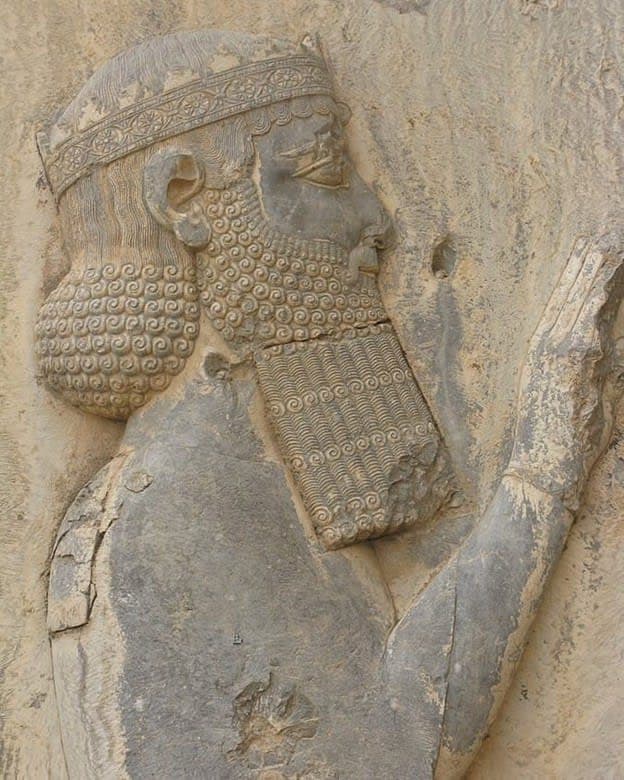

Darius I, a representative of the younger branch of the Achaemenid dynasty and the son of Vishtaspa, or Hystaspes, entered the historical stage at the age of 28. His rise to power was not peaceful: it was the result of a conspiracy of seven noble Persians who eliminated the Magus Gaumata, who had been posing as Bardiya, the brother of the late King Cambyses. To definitively secure his rights to the throne and link his fate with the founder of the empire, Darius married Atossa, the daughter of the great Cyrus II. This marriage was not merely a political act, but the foundation of a new legitimacy, uniting two branches of the family. However, recognition by the elite did not mean the obedience of the peoples: hardly had Darius put on the crown when the flames of rebellion broke out across the empire.

The first blow came from Elam and Babylonia. In Elam, a certain Assina attempted to restore independence, but he was quickly captured and executed. A far more serious challenge arose in Babylon under the leadership of Nidintu-Bel, who proclaimed himself Nebuchadnezzar III. By October 3, 522 BC, the largest cities of the region had already recognized his authority. Darius, understanding the scale of the threat, personally led the army.

The decisive clash took place on the banks of the Tigris on December 13, 522 BC. The Babylonians relied on the river’s inaccessibility, but Darius displayed military ingenuity: he transported his army across on camels, horses, and inflated skins, scattering the enemy with a sudden strike. Five days later, on December 18, a second battle took place near the city of Zazana on the Euphrates. The Babylonian army was literally driven into the water. Nidintu-Bel fled to Babylon, but the city fell under the Persian assault. Darius was harsh: the impostor and 48 of his associates were executed.
Interestingly, Herodotus, relying on oral traditions, described these events differently — as an exhausting twenty-month siege that ended only thanks to the self-sacrifice of Zopyrus, who mutilated himself, deceived the Babylonians by becoming their commander, and immediately afterward handed the city over to Darius. However, the documents of the Egibi banking house and the Behistun Inscription confirm the speed of Darius’s campaign: by December 22, 522 BC, Babylon had completely submitted to the king.

While Darius was in Babylonia, rebellions broke out simultaneously in Persia, Media, Margiana, Parthia, Armenia, and other provinces. This was a critical moment: it seemed that the work of Cyrus the Great was crumbling into dust. In Margiana, the movement took on a popular character under the leadership of Frada. Only on October 10, 522 BC, was the satrap Dadarshish able to suppress the revolt, carrying out a monstrous massacre in which more than 55,200 people were killed.
In Persia itself, a new “false Bardiya” appeared — Vahyazdata. He was supported by the masses and even tried to extend his influence to Arachosia. In that distant province, the satrap Vivana fought fierce battles: the battle near the fortress of Kapishakanish on December 29, 522 BC, produced no victor, but on February 21, 521 BC, at Gandutava, Vivana crushed the rebels. Vahyazdata was finally defeated by the general Artavardiya in two battles — on May 25 and July 16, 521 BC. The pretender’s end was terrible: he and his companions were impaled.

The Median revolt of Fravartish, who claimed descent from King Cyaxares, posed a deadly threat to the central regions. The general Hydarnes held back his forces at the Battle of Marush on January 12, 521 BC, but the decisive turning point came when Darius arrived in person. On May 7, near the city of Kundurush, the Medes were defeated, losing 34,500 men killed. Fravartish fled but was captured; Darius subjected him to cruel torture — cutting off his nose, ears, and tongue, putting out his eyes, and then displaying him publicly before executing him in Ecbatana.
At the same time, a difficult war was being fought in Armenia. The commanders Dadarshish and Vaumisa fought five major battles over seven months, from December 522 to June 521 BC. Only after such stubborn resistance was Armenia brought into submission.
In August 521 BC, taking advantage of Darius’s preoccupation in the north, Babylon rebelled again. This time the leader was an Armenian named Arakha, who also called himself Nebuchadnezzar. Darius sent the commander Intaphernes there, and on November 27, 521 BC, he finally crushed the rebels. Despite Babylon’s double betrayal, Darius preserved its status as a capital, although he deprived it of some ritual privileges.
Having secured his rear, in 519 BC the king undertook a large-scale campaign against the Saka — “those who wear pointed caps.” The Persians crossed the rivers of Central Asia and captured the leader Skunkha. Although the Saka were not fully subjugated, Darius clearly demonstrated that the borders of his power reached the “ends of the earth.”
Darius’s Egyptian campaign, around 518 BC, showed him as a wise politician. Unlike his predecessor Cambyses, Darius deliberately emphasized respect for local traditions. He adopted the title “Descendant of Ra,” or Setut-Ra, and allocated enormous funds to find a new sacred Apis bull. A grand achievement was the completion of the canal from the Nile to the Red Sea through Wadi Tumilat, which opened a direct route for Persian ships from Egypt to Persia. The stelae erected along the canal proclaimed: “I am a Persian, and from Persia I conquered Egypt.”
Around 517 BC, the king turned his gaze eastward. The expedition of the navigator Scylax along the Indus River prepared the ground for the conquest of northwestern India. The new satrapy of Hindush became the richest province of the empire, paying an enormous tribute of 360 talents of gold dust annually.


At the same time, Darius completed the integration of the Aegean islands. In 517 BC, Samos and Chios fell, becoming vassal territories. A few years after ascending the throne, after passing through twenty great battles and suppressing the rebellions of nine “false kings,” Darius I transformed a collapsing realm into a monolithic world empire stretching from India to Ethiopia and from Central Asia to the shores of Hellas. Victory was achieved through a combination of extraordinary cruelty toward enemies, diplomatic flexibility, and skillful troop maneuvers, at the center of which stood the legendary “Ten Thousand Immortals.”
After the flames of internal strife had been extinguished and the rule of Darius I had been established with an iron hand, the Great King faced a different task: to transform a conglomerate of conquered lands into a well-functioning mechanism of world empire. The era of great reforms began, changing the face of the ancient Near East.
Realizing that the old system of administration had outlived itself, Darius carried out a radical administrative reform. He divided the enormous state into administrative and tax districts — satrapies. Unlike in the time of Cyrus II, when their boundaries had been blurred, these were now clearly defined structures. The main innovation was the separation of functions: the satrap became a purely civil governor, deprived of direct authority over the army. Military forces were subordinated to commanders who answered only to the king himself.
To supervise this system, a wide network of secret police was created — the “eyes and ears of the king” — while supreme oversight was exercised by the hazarapati, the commander of the royal guard. This system of checks and balances allowed Darius to keep even the most distant corners of the empire under control, suppressing any attempts at separatism at their very beginning.


The reforms also affected the land itself. Vast estates were granted to Persian nobles and members of the royal family, who were exempt from taxes. At the same time, ordinary soldiers received allotments in exchange for service. Around 518 BC, Darius introduced a strictly fixed taxation system. Each satrapy knew its quota, calculated according to the fertility of its soil. The total annual tax amounted to the colossal sum of 7,740 Babylonian talents of silver, more than 230 tons, with the main burden falling on the richest regions — Babylonia and Egypt.
A revolution in trade came with the introduction of the daric — a gold coin weighing 8.4 grams and distinguished by an unprecedented purity of metal, 97 percent. The minting of gold became the exclusive right of the king, making the daric the main currency of the ancient world for centuries to come. Satraps, by contrast, were permitted to mint only silver sigloi and copper coins for local circulation.

To connect the capitals and provinces, Darius ordered the construction of a network of paved roads. The famous Royal Road linked Susa with Ephesus, while the system of mounted relays allowed reports to be transmitted with a speed incredible for that era.
However, the most ambitious project was the construction of the canal between the Nile and the Red Sea. Darius completed what the Egyptian pharaohs had failed to accomplish. According to ancient sources, the canal was so wide that two triremes could sail through it side by side, about 45 meters across.
“I commanded that this canal be dug from the waters of the Nile to the sea that begins from Persia,” proudly declared the inscription on one of the twelve three-meter stelae erected along the waterway.
This canal not only connected Egypt with the heart of the empire, but also allowed a flotilla of 24 ships to deliver Egyptian tribute directly to Persia, to the feet of the Great King.
Having secured his rear, Darius turned his gaze toward Europe. Around 512 BC, he conceived a grand campaign against the Scythians of the northern Black Sea region. Having built a unique pontoon bridge across the Bosporus, the enormous Persian army crossed into Thrace. After crossing the Danube, Darius’s army advanced deep into the boundless steppes.
The Scythians, led by their ruler Idanthyrsus, used a strategy of scorched earth. They retreated, filling in wells and driving away livestock, wearing down the Persians with small cavalry raids. When Darius demanded that they send “earth and water” as a sign of submission, Idanthyrsus answered with mockery, explaining that the Scythians were not fleeing, but simply roaming as they were accustomed to doing. After passing through the lands of the Budini and reaching desert regions, Darius realized that his army was exhausted. Leaving the campfires burning to conceal the retreat, the Persians fled back to the Danube at night. Only thanks to the loyalty of the Greek tyrants guarding the bridge did the remnants of the army manage to return. Although the campaign brought no victory, Darius formally included the “overseas Saka” in the list of his subjects.


Despite the failure in Scythia, the Persians firmly established themselves in Europe. The general Megabazus conquered Thrace and forced the Macedonian king Amyntas to recognize Darius’s authority. In these territories, a new satrapy was created — Skudra, which became a bridgehead for future wars against the Greeks. At the same time, the general Otanes captured Byzantium, Chalcedon, and the islands of Lemnos and Imbros, effectively taking control of the trade routes through which grain was delivered to Athens.

The calm of the empire was shattered in the autumn of 499 BC by the Ionian Revolt. Its inspirer was Aristagoras, the tyrant of Miletus. The rebellion quickly spread to the Greek cities of Asia Minor and the island of Cyprus. In 498 BC, the rebels carried out a daring raid on Sardis — the residence of the satrap Artaphernes. The city was burned, including the sacred temple of Cybele, which provoked the fury of the Persians and gave Darius a reason for sacred revenge.
Persia responded with a massive offensive:
During stubborn battles in 497–496 BC, the island of Cyprus was brought back under the king’s control.
The Battle of Lade in 494 BC became the decisive naval battle in which the Persian fleet utterly defeated the Ionians.
The fall of Miletus: the city, once a center of culture, was destroyed, and its inhabitants were taken into slavery.


By 493 BC, the revolt had been completely suppressed. Darius, however, did not limit himself to punitive measures: he ordered his son-in-law Mardonius to prepare a new and even larger expedition. The target was no longer the rebellious provinces, but Athens itself. Thus began the era of the Greco-Persian Wars, which became a test for the entire world order created by Darius I.
In 492 BC, Darius entrusted his son-in-law and general Mardonius with leading a grand invasion. The Persian army crossed the Hellespont and moved along the coast of Thrace, accompanied by a huge fleet. Along the route, strongpoints and food depots were created, while the Macedonian king Alexander I, understanding the power of the Achaemenids, preferred to take a friendly position, ensuring the Persians’ unimpeded passage.

However, the triumphal advance was interrupted by the wrath of the elements. When the fleet rounded Mount Athos, a powerful storm shattered Persian naval power: 300 ships sank, and the sea swallowed about 20,000 men. To complete the disaster, the Thracian tribe of the Brygi attacked the land camp at night, inflicting heavy losses on the Persians and wounding Mardonius himself. Overwhelmed by the scale of the damage, the commander was forced to turn back to Asia.
Darius did not abandon his plans, but changed tactics. Envoys were sent to the Greek poleis demanding “earth and water” — the symbol of absolute submission. Many islands, including Aegina, and mainland cities bowed their heads, fearing the king’s wrath. However, Athens and Sparta displayed unheard-of defiance: the Athenians threw the envoys into a pit, while the Spartans threw them into a well, suggesting that they “collect earth and water there themselves.” This meant war. In Athens, amid the growing threat, Miltiades, the former tyrant of the Chersonese, who knew Persian tactics from within, came to power.
In the summer of 490 BC, Darius equipped a new expedition. This time, an army of 15,000 men and cavalry was loaded onto 600 ships. Command was divided between the Mede Datis and the younger Artaphernes. Their route lay through the islands of the Aegean Sea:
Naxos was burned to the ground in revenge for past offenses.
Delos, by contrast, was spared as a sign of respect for the Greek gods.
Eretria on the island of Euboea became the main target. After a six-day siege, the city fell because of betrayal within its walls; its sanctuaries were desecrated, and the surviving inhabitants were enslaved.
On the advice of the elderly exiled tyrant Hippias, who hoped to regain power with Persian help, Datis’s fleet landed at Marathon. This plain was ideally suited for the actions of the formidable Persian cavalry. The Athenians, finding themselves in a critical situation, sent a runner to Sparta, but the Spartans refused to march before the full moon because of religious customs. Against the Persian colossus stood only 10,000 Athenians and 1,000 Plataeans.
On September 12, 490 BC, the decisive moment arrived. Miltiades, knowing that during the night the Persians had loaded part of their cavalry onto ships for a strike against defenseless Athens, ordered an immediate attack.
The Greeks strengthened their flanks, deliberately weakening the center.
The hoplites crossed the zone under enemy fire at a run, crashing into the enemy with the full force of the phalanx.
The Persians broke through the weak Greek center, but at that moment the Athenian flanks closed in, trapping the enemy in a deadly pocket.
The result of the battle was astonishing: 6,400 Persians fell, compared with only 192 Athenians. The Persian fleet hastily withdrew, attempting to capture Athens by sea, but the Athenian army made a heroic march and met the enemy at the harbor of Phaleron. Convinced that a surprise attack was impossible, Datis and Artaphernes led the remnants of the armada back to Asia.


Despite the defeat at Marathon, Darius remained, in the eyes of his contemporaries, a wise and just ruler. Even the Greek playwright Aeschylus spoke of him with respect. However, the final years of his life were overshadowed by new challenges. In 486 BC, Egypt rebelled under the leadership of Psamtik IV; the population was exhausted by taxes and forced labor on the construction of palaces in Susa and Persepolis.
Preparing to personally lead the suppression of the revolt and a new campaign against Greece, Darius faced a dynastic crisis. His eldest son Artobazanes claimed the throne by right of primogeniture. However, Xerxes, the son of Atossa, daughter of Cyrus the Great, argued that he was the son of a king born during his reign and the grandson of the founder of the empire. Atossa’s influence proved decisive: Xerxes was declared successor.

Darius I died in October or November 486 BC at the age of 64, according to Herodotus, or 72, according to Ctesias, after ruling for 36 years. His body was placed in a majestic rock-cut tomb at Naqsh-e Rustam.
The inscriptions on the tomb proclaim Darius as ruler of the world, whose spear reached far beyond the borders of Asia.
Darius I left behind not merely an empire, but a powerful state with a single currency, roads, and clear administration. His successor Xerxes inherited the greatest empire of the time, but also the burden of an unfinished war with the Greeks, a war that was destined to change the course of world history.


