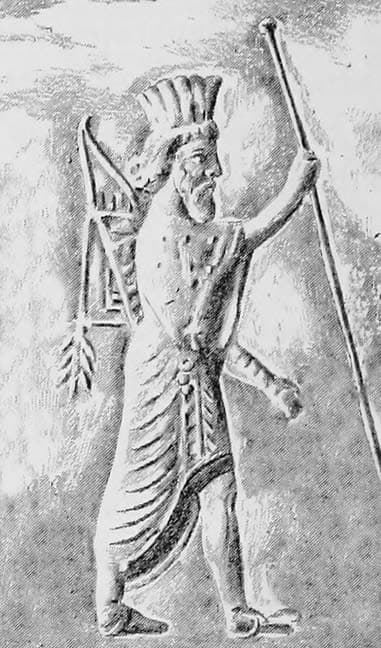

Even before the Persian banners had finally secured their position in Mesopotamia, Cyrus the Great demonstrated political wisdom by appointing his eldest son and heir by Queen Cassandane, Cambyses, as king of Babylon. The solemn enthronement ceremony took place on the 4th of Nisan, March 27, 538 BC, in accordance with the ancient ritual of the New Year festival. The young prince received power “from the hands of Marduk,” which was meant to legitimize Persian rule in the eyes of the Babylonians. Although the formal co-regency lasted only eight months, this period became an important stage: surviving documents show that Cambyses conducted active financial affairs, including through the famous banking house of Egibi. His father trusted his son, publicly mentioning him in his proclamations as “the offspring of his loins,” to whom the blessing of the gods also extended.

When news of Cyrus’s death in the steppes of the Massagetae reached Babylon in July 530 BC, Cambyses officially took the Persian throne. However, his succession was not smooth. The vast empire, assembled from many restless peoples, was shaken by rebellions. In the eastern satrapies, especially in Bactria, discontent was growing, and rumors claimed that it was being encouraged by the king’s younger brother, Bardiya, known to the Greeks as Smerdis. To secure his rule, Cambyses resorted to an extreme measure: he ordered his brother to be secretly killed. The Behistun Inscription states that for a long time no one among the people knew of this crime, which later created the conditions for the appearance of impostors.

Unlike Cyrus, whom the Persians called “father” for his humanity and care, Cambyses received from his contemporaries the nickname “despot.” He was flesh of the flesh of the new empire, aware of his own greatness and looking upon his subjects, including the Ionian Greeks, as “hereditary slaves.” If Cyrus still preserved the patriarchal habits of the leader of a small tribe, Cambyses already felt himself to be ruler of the world. His main goal became Egypt — the last great kingdom of antiquity that still preserved its independence and constantly plotted against Persia.
Preparations for the Egyptian campaign were thorough and large-scale. Cambyses understood that victory over the land of the pyramids required not only soldiers, but also allies. By the spring of 525 BC, he had concentrated his forces in Palestine and concluded an agreement with the Arab nomads, who supplied his army with water during the crossing of the Sinai Desert. At sea, the Persians were supported by the fleets of Phoenicia and Cyprus, as well as by the Samian tyrant Polycrates.

A decisive factor was betrayal within the enemy camp. The outstanding Greek mercenary Phanes of Halicarnassus fled to Cambyses, revealing all the military secrets of the Egyptians. This was compounded by internal instability: the energetic pharaoh Amasis had just died in Egypt, leaving the throne to the young Psamtik III. Even nature seemed to foreshadow disaster — in Thebes, an extremely rare rain fell, which the superstitious Egyptians interpreted as an evil omen.

In May 525 BC, a bloody battle took place near the walls of the fortress of Pelusium, known as the “key to Egypt.” The ferocity was so great that the pharaoh’s Greek mercenaries, seeking revenge on Phanes, stabbed his sons to death and drank their blood mixed with wine before the battle. Nevertheless, the Egyptians were defeated. There is a legend that Cambyses used a stratagem by placing cats and ibises — sacred animals that the Egyptians feared hitting with arrows — in front of his ranks. After suffering defeat, the remnants of the Egyptian forces took refuge in Memphis. After a long siege, the city fell in June. Psamtik III was captured, and for the murder of the Persian envoy, two thousand noble Egyptians were executed. By the end of August 525 BC, Cambyses was officially proclaimed pharaoh of Egypt, founding the Twenty-Seventh Dynasty.
The sources portray two completely different images of Cambyses in Egypt. Official Egyptian inscriptions, such as the autobiography of the nobleman Udjahorresnet, present him as a wise ruler who adopted the throne name Mesut-Ra, meaning “Offspring of Ra,” offered sacrifices to the goddess Neith, and cared for the temples. He ordered the looting to stop and behaved like a legitimate successor rather than a conqueror.
However, the Greek tradition, led by Herodotus, describes Cambyses as a madman. According to these accounts, the king allegedly stabbed the sacred Apis bull with his own hand, desecrated tombs, and violated the mummy of Pharaoh Amasis. Herodotus explained this by saying that the gods struck Cambyses with madness because of his sacrileges. Nevertheless, archaeological evidence, including the sarcophagi of Apis bulls bearing dedications in Cambyses’s name, casts doubt on these horrors, suggesting that they may have been part of later propaganda created to discredit his line.
Having established himself in Egypt, Cambyses turned his gaze southward — toward the Kingdom of Kush, or Ethiopia, and the western oases. The campaign against Kush in the winter of 524–523 BC proved extremely difficult. Because of a lack of provisions, the army reached the point of cannibalism, and Cambyses was forced to retreat. Another expedition, sent to the Oasis of Amun, or Siwa, according to legend, disappeared completely in a sandstorm — fifty thousand soldiers were buried beneath the dunes. Despite these failures, the northern regions of Nubia nevertheless entered the empire, supplying it with gold and ivory.


In the spring of 522 BC, while still in Egypt, Cambyses received terrible news: a rebellion had broken out in Persia. A certain Magus named Gaumata, pretending to be the murdered Bardiya, had seized the throne. Cambyses immediately set out on campaign to suppress the revolt, but he never reached home.
The circumstances of his death in April 522 BC remain one of the great mysteries of antiquity. According to the official version of Darius I, Cambyses “died from a wound inflicted by himself.” Herodotus gives this episode in greater detail: in Syria, when the king angrily leapt onto his horse, the tip of the scabbard of his sword fell off, and the blade entered his thigh — the very place where he had allegedly once struck Apis. Twenty days later, he died of gangrene. Ctesias, by contrast, claimed that the king accidentally wounded himself with a knife while whittling a branch out of boredom.
Cambyses II ruled for seven years and eight months. He left no heirs, and his death plunged the empire into the chaos of civil war, from which Darius I emerged victorious. Despite his reputation as the “mad king,” Cambyses completed his father’s work, turning Persia into a truly world empire spanning three continents. His reign became a bridge between the heroic age of Cyrus’s conquests and the organized imperial order of Darius.


