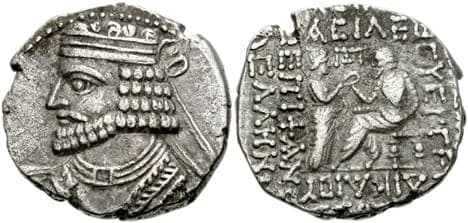

The accession of Vologases I to the throne (c. 51 CE) coincided with a crisis on the northern frontiers. Armenia, the perennial apple of discord, once again became the stage of a bloody drama. The Iberian king Pharasmanes, wishing to rid himself of his ambitious son Rhadamistus, sent him to conquer Armenia.
Events developed rapidly and brutally. Rhadamistus besieged his uncle, King Mithridates, in the fortress of Gorneae (Garni). The Roman garrison, assigned to protect the king, betrayed him. Prefect Pollio, bought with gold, forced Mithridates to surrender. Rhadamistus, having sworn not to shed his kinsman’s blood by sword or poison, ordered him strangled and massacred his entire family.

Upon learning of this, the Roman governor of Syria, Ummidius Quadratus, hesitated, but the procurator of Cappadocia, Julius Paelignus, a petty and greedy man, not only recognized the usurper Rhadamistus but also took part in his coronation. For Vologases I, this became a signal: chaos reigned in Armenia, and this was the ideal moment to place his brother Tiridates on the throne.
Vologases swiftly occupied Artaxata and Tigranocerta, expelling Rhadamistus. However, a harsh winter and disease forced the Parthians to withdraw. Rhadamistus returned and began terrorizing the population, which led to a new uprising. The Armenians themselves expelled the tyrant and invited Tiridates to return.
In 54 CE, the young Nero came to power in Rome. The empire decided to respond decisively. Command of the eastern legions was given to Gnaeus Domitius Corbulo — a general of the old school. Upon arrival, Corbulo was horrified: the Syrian legions had deteriorated, veterans were selling their equipment, many had no armor. Corbulo imposed the harshest discipline (execution for the slightest offense) and within a single winter in tents transformed a rabble into a war machine.

In 58 CE, Corbulo began his offensive. While Vologases was distracted by a revolt in Hyrcania, the Romans advanced through Armenia with fire and sword. Artaxata was burned to the ground, Tigranocerta surrendered. Tiridates was expelled, and Rome placed its puppet on the throne — Tigranes V (a great-grandson of Archelaus of Cappadocia). It seemed that Parthia had lost.
However, the Roman client Tigranes V made a mistake by attacking a Parthian vassal — Adiabene. This gave Vologases free rein. He concluded peace with the Hyrcanians and moved all his forces west.

Rome, dissatisfied with the protracted war, replaced the cautious Corbulo with the overconfident Lucius Caesennius Paetus. Boasting that he would soon conquer all Parthia, he crossed the Euphrates but acted ineptly, dividing his forces. In 62 CE, at Rhandeia (on the banks of the Arsanias River), a catastrophe occurred. Vologases I surrounded Paetus’s legions. The Romans found themselves trapped. Paetus, losing his composure, capitulated.
The terms were humiliating: the Romans had to withdraw from Armenia. All supplies and fortifications were handed over to the Parthians. To save their lives, the legionaries passed under the “yoke” — a symbol of disgrace. The Romans were even forced to build a bridge across the river for the convenience of the Parthians. This was Vologases’ triumph. He proved that Parthia was capable of defeating Rome in open battle.
Nero, wishing to save face, restored command to Corbulo. He assembled a huge army, but both sides understood: a new war would exhaust everyone. In 63, at the same place, in Rhandeia, a historic meeting took place. A compromise was concluded, becoming a diplomatic victory for Parthia: the King of Armenia would be an Arsacid (Vologases’ brother Tiridates). But he had to receive the crown from the hands of the Roman emperor.

In 66 CE, Tiridates I traveled to Rome. It was a grand journey: 3,000 Parthian horsemen, sons of kings, and a vast retinue traveled across the world at Rome’s expense. Nero crowned Tiridates on the Forum, allowing Rome to claim the “submission” of the East, although de facto Armenia became a domain of the Arsacids.
Having secured the western borders, Vologases faced a new threat. In 72 CE, hordes of Alans poured through the Iron Gates of the Caucasus (Derbent). The nomads devastated Media Atropatene and Armenia. The king’s brother Pacorus was forced to flee, leaving his harem to the enemy (his wife and concubines had to be ransomed). The Armenian king Tiridates narrowly escaped capture — an Alan warrior threw a lasso over him, and the king saved himself only by cutting the rope with his sword. Vologases requested help from Rome (from the new emperor Vespasian), but he refused, limiting himself to strengthening the Iberian fortress of Mtskheta. The Alans withdrew on their own, sated with plunder.
Relations with Vespasian were complex. When civil war raged in Rome (69 CE), Vologases nobly offered Vespasian 40,000 horsemen, but he politely declined. Later, in 72 CE, Rome annexed Commagene, accusing its king Antiochus of conspiring with the Parthians. Antiochus’ sons fled to Vologases, and he, faithful to the laws of hospitality, received them with honor.
Vologases I entered history not only as a warrior but also as a great reformer. Under him began a rejection of Hellenism (Greek culture) and a return to Iranian roots.
On coins, inscriptions in Pahlavi (the Parthian language) appear for the first time instead of corrupted Greek. For the first time, an image of a fire altar appears, which would become a symbol of Zoroastrianism for centuries to come.
Vologases ordered the collection of all scattered texts of the Avesta — the sacred book of the Zoroastrians — initiating its codification.
To undermine the influence of Greek Seleucia, eternally rebellious and pro-Roman, the king founded a new city — Vologesocerta (Vologasia). The city became a new trade center, intercepting caravan routes.
Vologases I died around 79–80 CE, leaving Parthia stronger than ever. He managed to bring Roman legions to their knees, place his brother on the Armenian throne, and, most importantly, restore his people’s cultural identity, building a bridge from the Parthian era to the future greatness of the Sassanids.


