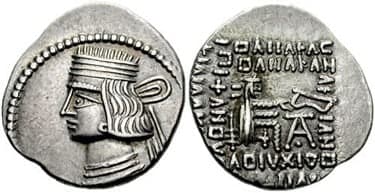

In April 78 CE, a unique situation arose in the Parthian Empire. At the mint of the great capital Seleucia-Ctesiphon, the hammers simultaneously struck, minting the profiles of two different kings. The old ruler Vologases I was still issuing his drachms, but alongside them coins bearing the name of a new claimant — Pacorus II — entered circulation.

Who was this audacious rival? Historians have debated his origin for centuries. Some considered him the brother of Vologases I (a son of Vonones II) and a former governor of Atropatene. But numismatics suggests otherwise: on Pacorus’ early coins he is depicted as a very young, beardless youth. If he had been the brother of the old king and had ruled Media for 27 years, he would have been a mature man. Therefore, Pacorus II was most likely the son of Vologases I, who rebelled against his father or asserted his claim to the throne as the latter declined.
His accession signaled the outbreak of civil war. As soon as Vologases I disappeared from the historical stage (c. 80 CE), another claimant — Artabanus IV — rose against the young Pacorus. In 80–81, Artabanus seized the mint and power, but Pacorus proved a tenacious opponent. By 82/83 he managed to defeat his rivals, expel Artabanus, and establish himself as sole ruler, at least for a time.

Pacorus II’s reign coincided with a strange period in Roman history — the era of the False Neros. In 79, a man named Terentius Maximus appeared on the Euphrates. He resembled the late emperor Nero, played the cithara, and sang. The impostor found refuge with Pacorus’ rival — Artabanus IV — promising to return Armenia to the Parthians in exchange for support. But when the deception was uncovered, the adventurer perished.
Far more serious was the situation in 89. A new False Nero appeared, and the Roman emperor Domitian, unwilling to tolerate the specter of his predecessor, demanded his extradition. Pacorus II, by then having consolidated his power, showed diplomatic wisdom. Understanding that a war with Rome would now be disastrous, he handed over the impostor, preventing a legionary invasion.

However, storm clouds were gathering. Domitian dreamed of the glory of Alexander the Great. His intelligence service (the secretary Abascantius) was already probing routes across the Euphrates, planning the conquest of Bactria and India. Roman poets (Statius) celebrated the coming campaign, and General Marcus Mettius Celer had already arrived in Syria. Only Domitian’s death saved Pacorus from war at the end of the first century.
Pacorus II was not only a warrior but also a ruler whose gaze was directed toward the Far East. It was under him that Parthia (Anxi in Chinese chronicles) reached the peak of its commercial power on the Silk Road.
In 97 CE, Gan Ying — an envoy of the famous Chinese general Ban Chao — arrived at the court of Pacorus (or his governor in Mesene). Gan Ying intended to reach “Da Qin” (Rome). The Parthians, unwilling to lose their role as intermediaries in the silk trade, resorted to deception. Sailors in Mesene told the Chinese envoy frightening tales of the voyage: “The sea is vast. With a favorable wind it takes three months, but if there is a calm, it may take two years. And homesickness there is so strong that people die.” Frightened, Gan Ying turned back without ever meeting the Romans. Parthia’s monopoly was preserved.
In 101, Pacorus (whom the Chinese called King Man-qiu) sent a return embassy to the Celestial Empire. He presented the emperor with curiosities — live lions and ostriches, probably brought from Arabia. It was a gesture of a ruler who controlled global trade.
Amid endless wars, Pacorus found time for construction. The Roman historian Ammianus Marcellinus attributes to him the chief credit for developing the capital. Before Pacorus, Ctesiphon had been more of a large military camp opposite Seleucia. Pacorus II transformed it into an impregnable fortress and metropolis: he built powerful walls, significantly increased the population by resettling people there, and gave the city a Greek name and structure, making it “the finest model of Persian cities.” It was under him that Ctesiphon finally eclipsed old Seleucia.


At the beginning of the second century CE, the star of Emperor Trajan rose in the West. Relations grew tense. In 98, a dispute arose between the empires over the violation of a certain frontier treaty.

But Pacorus had unexpected allies. In distant Dacia (modern Romania), King Decebalus was waging a mortal war against Trajan. As a sign of friendship and possibly calling for the opening of a second front, Decebalus sent Pacorus an unusual gift — a Greek slave named Callidromus, captured from the Romans. This slave lived at the Parthian court for several years and possessed a gem bearing Pacorus’ image. There is a theory that the Parthians secretly aided the Dacians: on Trajan’s Column are depicted heavily armored cavalrymen in scale armor (Roxolani or Sarmatians) whose equipment suspiciously resembles Parthian cataphracts.

The final years of Pacorus’ reign (after 105) became a tragedy. The empire began to disintegrate. In 105–106, Vologases II rebelled, seizing part of the territory. In 109–110, Pacorus’ brother (or brother-in-law), Orodes (Osroes), proclaimed himself king and began minting coins.
In the east, the Kushan Empire strengthened, taking lands and resources. Raids by nomads from Central Asia became constant.
The treasury was depleted. Pacorus went so far as to sell his own possessions. In 110, he officially sold the kingdom of Osroene (with its capital at Edessa) to the son of Izates, Abgar VII. It was an act of desperation — the king was selling provinces to buy mercenaries for the civil war.
The end of Pacorus II’s reign sank into chaos, which led to Parthia’s downfall under Trajan’s blows. Pacorus’ sons — Axidares and Parthamasiris — became pawns in the game of their uncle Orodes. Orodes expelled Axidares from the Armenian throne and installed Parthamasiris there. Rome regarded this as a violation of the treaty of 63 (coronation only with Rome’s consent). This gave Trajan the perfect pretext for invasion.
Pacorus’ numismatic record ceases (with interruptions) around 115–116. Whether he was alive during Trajan’s invasion or died shortly before remains unknown. He remained in history as the king who first began writing his name on coins (“Arsaces Pacorus”), built great cities, and deceived Chinese envoys, but could not stop the disintegration of his state, leaving his heirs a country engulfed in the flames of the greatest war with Rome.


