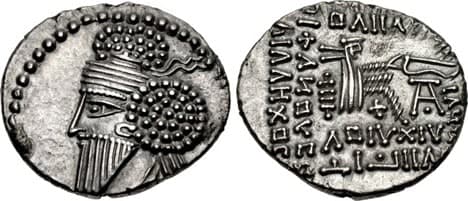
The accession of Osroes to the Parthian throne (c. 109 CE) marked the end of an era of caution. While his brother and predecessor Pacorus II had avoided conflicts with Rome, Osroes chose to act boldly. He removed Axidares (the son of Pacorus), who had been approved by Rome, from the Armenian throne and placed there his own protégé — another nephew, Parthamasiris.
This was a direct violation of the treaty of 63 (from the time of Nero), according to which the king of Armenia was to be approved by Rome. Emperor Trajan, who had just conquered Dacia and longed for the glory of Alexander the Great, received the perfect pretext for war (casus belli).
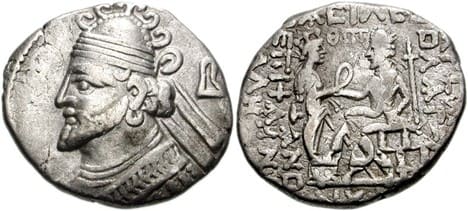
In the autumn of 113, on October 27, Trajan sailed from Rome to the East. Realizing what he had done, Osroes attempted to settle the conflict. His envoys met the emperor in Athens with gifts and a request to recognize Parthamasiris as king. But Trajan, confident in his strength, did not even accept the gifts and did not honor the envoys with a reply. War was inevitable.
At the beginning of 114, Trajan arrived in Antioch. Having assembled a huge army of veterans of the Dacian wars and eastern legions (IV Scythica, VI Ferrata, X Fretensis, etc.), he moved north. The rulers of the Caucasus, seeing Rome’s power, hurried to express their submission.
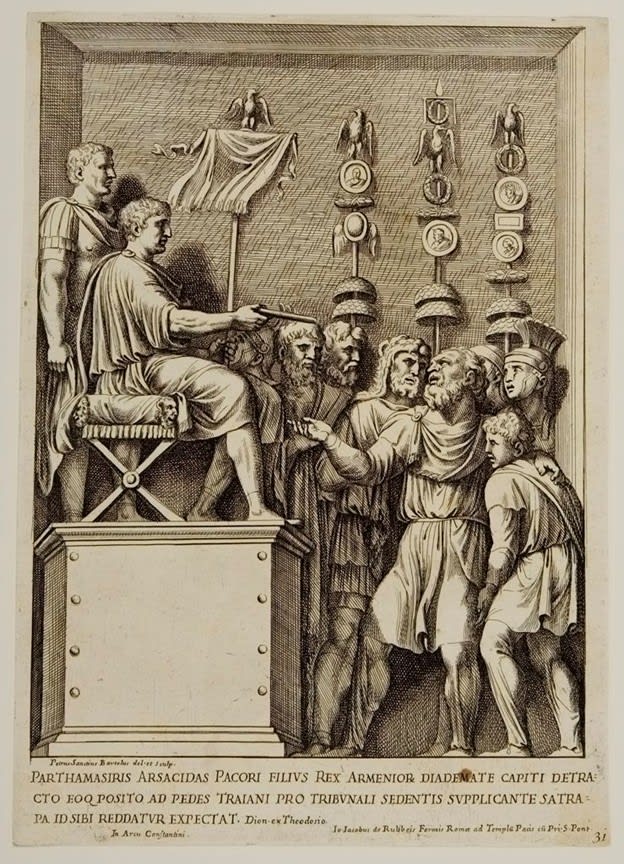
The culmination of the Armenian campaign occurred at Elegeia (west of Erzurum). Parthamasiris, hoping for mercy, arrived at the Roman camp. In the presence of the legions, he removed his diadem and placed it at Trajan’s feet, expecting the emperor to return it, as Nero had once done for Tiridates. But Trajan coldly declared: Armenia was no longer a kingdom but a Roman province.
Parthamasiris attempted to leave but was detained. In the ensuing scuffle, Roman cavalry killed the would-be king. Armenia was annexed, and Trajan assumed the title Optimus (“The Best”).
In 115, the war shifted south. The Romans captured Nisibis and Batnae, for which Trajan received the title Parthicus (“Parthian”). Osroes’ position was complicated by the fact that Parthia was at war with itself. In Seleucia, his rival Vologases II had entrenched himself. This civil strife paralyzed the defense.
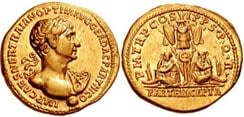
Trajan, using the engineering genius of his legions, built a fleet in the forests of Nisibis and launched it onto the Tigris. Adiabene fell and was turned into the province of Assyria. Advancing along the Euphrates, the Romans passed the legendary wall of Semiramis and Dura-Europos.
The finale of the campaign was astonishing: the great capital Ctesiphon fell without a fight. Osroes fled, abandoning everything. Trajan captured the king’s daughter and the dynasty’s chief relic — the Golden Throne of the Arsacids. The Romans celebrated triumph, issuing coins with the inscription PARTHIA CAPTA (“Parthia Captured”). Trajan sailed down the Tigris to the Persian Gulf itself, where he gazed wistfully at ships bound for India, regretting that he was too old to follow Alexander’s path.
But Rome’s victory proved Pyrrhic. In the winter of 115–116, while Trajan was in Babylon, a massive uprising erupted behind Roman lines. Garrisons were slaughtered, cities shut their gates. Osroes’ brother Meherdates (Mithridates) attempted to organize resistance but died after falling from his horse. The banner of struggle was taken up by his son — Sanatruces.
Trajan responded with extreme terror. General Lusius Quietus burned Edessa and Nisibis. Seleucia on the Tigris was put to the torch. The Jewish population, which had supported the Parthians, was subjected to extermination.
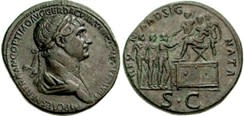
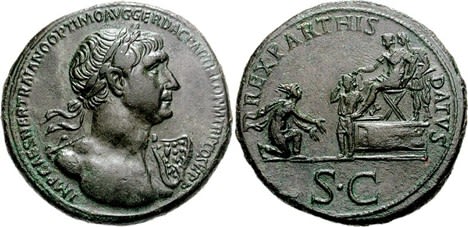
Realizing that the country could not be held by force, Trajan employed the stratagem of “divide and rule.” Osroes sent his son Parthamaspates to assist Sanatruces. The Romans secretly met with Parthamaspates and persuaded him to betray his cousin. Sanatruces was defeated and killed. In Ctesiphon, Trajan crowned the traitor Parthamaspates, proclaiming him king (REX PARTHIS DATUS — “King Given to the Parthians”).
In the spring of 117, Trajan was retreating. On his path stood the desert fortress-city of Hatra. The siege of Hatra became a symbol of the collapse of Roman expansion. Cassius Dio wrote that the Sun god himself protected the city: the Romans suffered from terrible heat, lack of water, and swarms of flies that settled on food and drink. Trajan personally took part in the assault and nearly perished when his cavalry was scattered.
Ill and broken by failure, the emperor lifted the siege and withdrew to Syria, where he died in August 117.
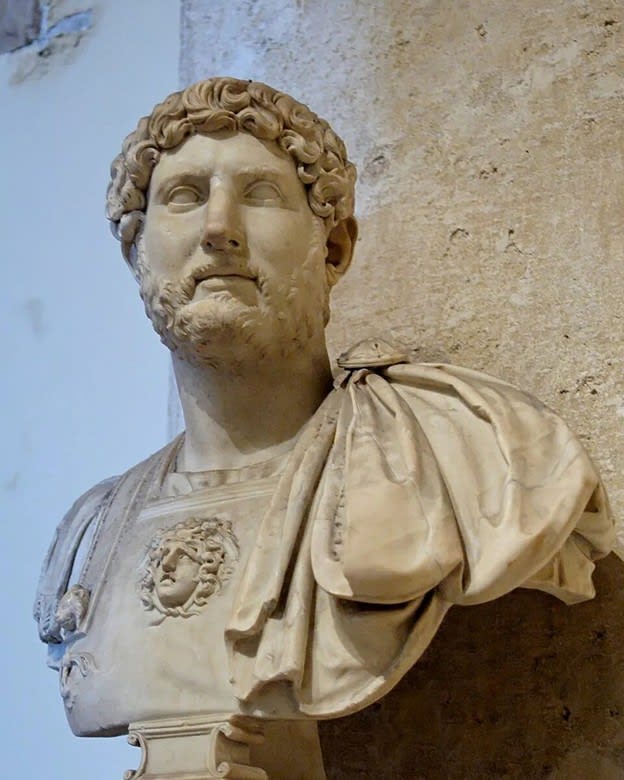
Trajan’s death saved Parthia. The new emperor Hadrian, being a pragmatist, understood that holding the East was impossible. He abandoned all of Trajan’s conquests: Armenia, Mesopotamia, and Assyria were relinquished. The frontier returned to the Euphrates.
The puppet Parthamaspates was expelled by the Parthians and received from Rome only the small kingdom of Osroene as consolation. Osroes regained his power. In 123, Hadrian personally arrived at the frontier for negotiations. To secure peace, he made a noble gesture: he returned Osroes’ daughter, who had been captured by Trajan. The emperor also promised to return the Golden Throne, but history shows that this relic remained in Rome (likely as a pledge of peace).
Osroes (Orodes) survived a war that was meant to destroy Parthia. He rebuilt the empire from ruins, outlived the greatest Roman conqueror, and regained his daughter. However, internal strife did not cease, and the struggle with Vologases II continued until his death.
After 128–129, coins bearing Osroes’ name cease to be minted, marking the end of his long and dramatic reign. He remained in memory as the king who lost his capital and throne but managed to regain them.


