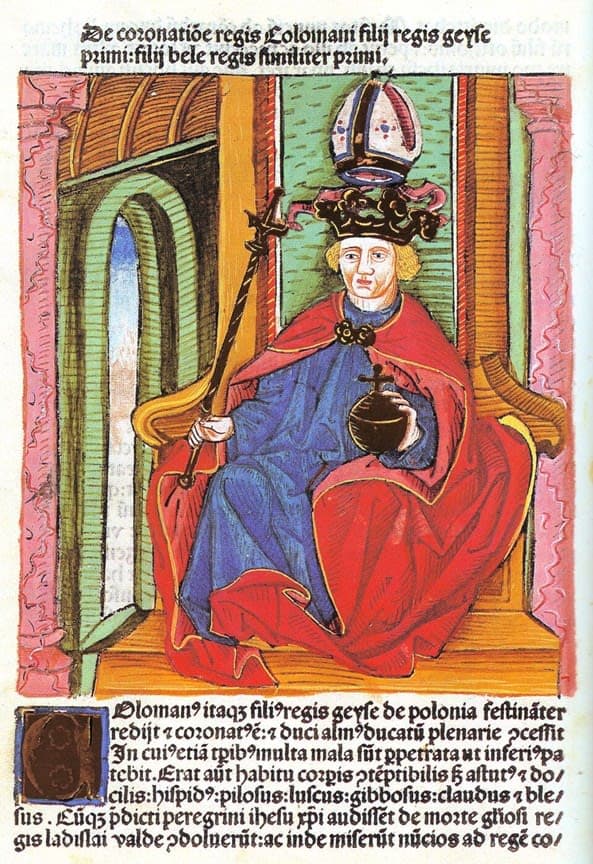

The Hungarian throne, left vacant after the death of the great knight-king Saint Ladislaus I, was destined to pass to a man of an entirely different character.
The eldest son of King Géza I, named Coloman in honor of the holy martyr Coloman, had not originally been prepared for the role of a stern ruler. Ladislaus I had intended his intellectually gifted nephew to enter the clergy. However, shortly before his death, he changed his decision and designated Coloman as his official successor.
When Ladislaus fell seriously ill following a military campaign in Poland, Coloman was urgently summoned to the royal court.
Yet his accession to the throne was far from peaceful. Immediately after the death of his great uncle on July 29, 1095, Coloman encountered fierce resistance from his younger brother, the ambitious Prince Álmos.
Thus began an exhausting and prolonged struggle for power that would leave its mark on all the years that followed.

The new monarch's first serious challenge came in the form of a storm approaching from the West.
Saint Ladislaus I had died on the eve of the First Crusade, never having fulfilled his solemn promise to personally lead the united armies of Christian Europe.
Coloman, completely absorbed in his internal struggle against his brother, could not realistically leave the country to participate in a distant expedition to the Middle East.
Demonstrating diplomatic flexibility, he agreed to allow the crusading armies to pass through Hungarian territory.
However, the reality proved catastrophic.
In 1096, disorganized crowds participating in the so-called People's Crusade — unruly bands of religious fanatics and marauders — poured into Hungary and began mercilessly looting, burning, and devastating the towns and villages along their route.
The king responded firmly and decisively.
Using his regular troops, he launched military operations to block their advance and completely expelled the marauding bands from his territory.
An entirely different reception awaited the organized and disciplined armies of knights commanded by Godfrey of Bouillon.
They were greeted with exceptional courtesy and honor.
To guarantee the safety of the Hungarian population and prevent any atrocities by the foreign warriors, Coloman kept Godfrey's own brother at his court as a noble hostage.
The Hungarian army carefully escorted the knights all the way to the kingdom's southern border, demonstrating to Europe the strength and organization of the young state.

Coloman entered European history with the unique nickname Könyves, meaning "the Learned" or "the Book-Lover."
In the harsh medieval world, when literacy was rare among laypeople and especially among rulers, this title initially carried a slight undertone of contempt from the warrior aristocracy, which valued physical strength above all else.
However, time eventually put everything into perspective, and modern historians rightly interpret the nickname as synonymous with "the Wise."
Coloman was one of the most educated and widely read men of his century.
His court became a major intellectual center, attracting prominent figures in scholarship, literature, and the arts from across the continent.
Under the king's direct patronage, the educated elite engaged in the profound study of Latin classical literature, the codification of laws, and the compilation of extensive historical chronicles.
It was during this period that the famous Chronicle of Hungary emerged, the legend of Saint Gerard was recorded, and the foundational Life of Saint Stephen, written by Bishop Hartvik, was composed.
The country experienced a cultural flourishing, marked by the widespread adoption of the elegant Romanesque architectural style, which the king enthusiastically supported.
The official chronicles compiled by later generations portrayed Coloman as a man suffering from severe physical deformities — lame and hunchbacked from birth.
However, modern scholars approach this description with considerable skepticism.
It is possible that such an unattractive image, comparable to the traditional portrayal of England's King Richard III, was deliberately fabricated and spread by his successors.
Ironically, these successors were direct descendants of Prince Álmos, whom Coloman would later have blinded, and they had every reason to tarnish the memory of the great ruler.

Coloman proved himself a brilliant and farsighted legislator, leaving his descendants two extensive collections of laws, adopted approximately in 1100 and 1115.
The first legal code formally established and regulated the traditional "Judgment of God," including the harsh practice of trial by water.
The second code regulated complex legal and economic disputes between the Christian population and Jewish communities in considerable detail.
However, the true monument to his rationality and intellectual superiority over the superstitions of his age was his famous decree:
"De strigis vero quae non sunt, nulla amplius quaestio fiat."
"Concerning witches, who do not actually exist, no further judicial investigations shall be conducted."
With a single stroke of the pen, the Hungarian king prohibited the madness of witch hunts and superstition in his country centuries ahead of the broader development of European legal thought.
Almost the entire twenty-year reign of Coloman was overshadowed by the unending and exhausting defense of his throne against the ambitions of his younger brother.
Immediately after his coronation, Coloman attempted to appease Álmos. He summoned him from Croatia and granted him extensive and wealthy ducal estates.
This significantly improved the prince's financial position, but at the same time allowed royal spies to monitor his every move.
Álmos failed to appreciate this generosity and launched his first open rebellion as early as 1098.
After his failure, the rebellious prince became a perpetual wanderer and conspirator, constantly seeking assistance from Hungary's foreign enemies — whether the German emperor or the Polish and Kievan relatives of his wife.

In 1099, the rebels confronted the royal forces in a fierce battle on the Vág River, where Álmos suffered a crushing defeat.
In 1106, the restless prince managed to win the support of the Polish king Bolesław III Wrymouth, who provided him with an entire army for an attack against Hungary.
Coloman responded with a lightning-fast and sophisticated diplomatic counterattack.
He contacted the Polish monarch directly, explained the true circumstances of the conflict, and succeeded in resolving the dispute entirely through peaceful negotiations.
As a result, his brother was deprived of the allied army and forced once again to swear an oath of loyalty.

In the autumn of 1108, the conflict escalated to an international level.
A massive army under the German king Henry V invaded Upper Hungary, the territory of present-day Slovakia, to support Álmos.
The German troops laid siege to the strategically important fortress of Pozsony, now Bratislava.
At the same time, the Germans' ally, the Bohemian prince Svatopluk, treacherously invaded the fertile valley of the Vág River, subjecting it to widespread devastation.
Coloman demonstrated remarkable composure and strategic brilliance.
The courageous resistance of the Pozsony garrison, combined with the king's countermeasures, forced Henry V to abandon the siege and hastily conclude a peace agreement with Hungary.

Having freed his forces, Coloman turned his sword against his brother's allies.
Between November 4 and 12, 1108, the Hungarian army carried out a devastating campaign across the lands of Moravia.
A retaliatory attack followed in February 1109, when Svatopluk, together with his brother Otto, Prince of Moravia, once again ravaged the Hungarian borderlands with fire and sword, advancing as far as Nitra.
Álmos had once again lost this grand political chess match, but his obsessive desire to possess the crown remained undiminished.
The final confrontation came in 1115.
Having secured the secret support of leading Hungarian feudal lords, Álmos organized yet another extensive conspiracy aimed at physically eliminating the king.
Coloman's widespread network of spies completely uncovered the betrayal.
Realizing that neither mercy nor treaties could stop his brother, and determined to protect the kingdom permanently from future civil wars, Coloman made a terrible decision, one entirely characteristic of medieval brutality.
He ordered Álmos to be arrested and blinded, along with his young son Béla, thereby depriving both of them of any legal right to claim the throne under the laws of the time.

Coloman the Learned's foreign policy was characterized by extraordinary energy, pragmatism, and a broad understanding of the geopolitical landscape.
He skillfully took advantage of the fact that the leading powers of Western Europe and the Roman Curia had become deeply involved in the Crusades.
He directed his efforts southward and eastward, continuing the expansionist policies of Saint Ladislaus.
Coloman's greatest triumph was the final subjugation of Croatia and Dalmatia.
In 1102, in the sacred city of Biograd (Tengerfehérvár), Coloman was officially crowned King of Croatia, establishing a centuries-long union between the two kingdoms through a personal and inseparable dynastic connection.
The Hungarian lion continued its advance toward the sea.
By 1105, the wealthy Adriatic ports of Split and Zara had passed under the authority of Buda, followed by all the strategically important neighboring islands.
From that historic moment until the collapse of the dual monarchy in 1918, the rulers of Hungary continuously bore the title of Kings of Croatia.
This rapid expansion toward the warm waters of the Adriatic provoked deep resentment in the powerful Republic of Venice.
However, the Croats themselves and the inhabitants of the coastal cities strongly supported Coloman.
They preferred the relatively liberal and religiously tolerant rule of the Hungarian bans, who guaranteed the full preservation of the Adriatic ports' ancient commercial privileges and freedoms, to the aggressive expansionism of the Venetians.
To protect Hungary from becoming entangled in the exhausting European conflict known as the Investiture Controversy, fought between the popes and the Holy Roman emperors, Coloman made an important political move in 1106.
He publicly renounced the right of investiture — the independent appointment of bishops.
This decision earned him Rome's goodwill and gave the king greater freedom to pursue an independent foreign policy.
In practice, however, this concession remained a brilliant formality.
Coloman and his successors retained absolute control over ecclesiastical appointments, since the pope could only approve candidates proposed by the Hungarian king and had no right to nominate candidates independently.
Later, the Learned King redirected his geopolitical attention from Rome toward the magnificent city of Constantinople.
Having concluded a strong alliance with Byzantine Emperor Alexios I Komnenos, Coloman reinforced it through a crucial dynastic marriage.
He arranged for Piroska (Irene), daughter of Ladislaus I, to marry John II Komnenos, heir to the Byzantine throne.
Remarkably, the son born of this marriage, the great Emperor Manuel Komnenos, would later launch extensive wars against his mother's homeland in a struggle for dominance over the Balkans.

Coloman himself was a master of the art of "marriage diplomacy" and married twice.
In 1097, he married Felicia, daughter of the great Sicilian count Roger I.
She bore him three children: two sons, Ladislaus and Stephen II, and a daughter, Sophia.
Unfortunately, Prince Stephen II, his father's pride and the kingdom's greatest hope, was the only son who survived to adulthood.
Following Felicia's death in 1102, the king remained unmarried for many years.
However, around 1112, he entered into a second marriage, taking Euphemia, daughter of Vladimir Monomakh, Grand Prince of Kievan Rus', as his wife.
This union ended in personal tragedy and an enormous political scandal.
Shortly after the wedding, the young queen was accused of adultery and disgracefully sent back to her homeland.
In Kiev, in 1113, she gave birth to a son named Boris Conrad.
Coloman categorically refused to recognize the child as his own for the rest of his life.
As a result, Boris would spend decades unsuccessfully attempting to seize the Hungarian throne by force of arms.
This family drama led to an unexpected conclusion.
When Coloman's direct male line came to an end in 1131 with the death of the childless Stephen II, the Hungarian crown passed to Béla — the very son of his rebellious brother Álmos whom Coloman had ordered to be blinded.

Seeking to expand his influence in the northeast, Coloman actively intervened in the bloody dynastic struggles among the princes of Rus'.
In 1099, his armies achieved a historic breakthrough by completely annexing Transcarpathia, which until then had remained a neutral buffer zone between Poland, Rus', and Hungary.
Encouraged by this success, Coloman advanced his troops deep into the Principality of Galicia.
However, this large-scale intervention ended in a devastating military catastrophe.
Near Przemyśl, the Hungarian armies were utterly defeated and scattered by the combined forces of the Rus' princes Volodar and Vasylko Rostyslavych.
The earthly journey of the great educator and reformer came to an end on February 3, 1116.
Coloman I the Learned died, leaving behind a powerful, centralized kingdom with access to the Adriatic Sea, an advanced legal code for its time, and a flourishing culture.
His body was laid to rest with the highest honors in Székesfehérvár — the sacred burial place of the Hungarian kings.
There, he was buried beside the founder of the Hungarian state, Saint Stephen I, forever securing his place in the pantheon of Hungary's greatest rulers.


