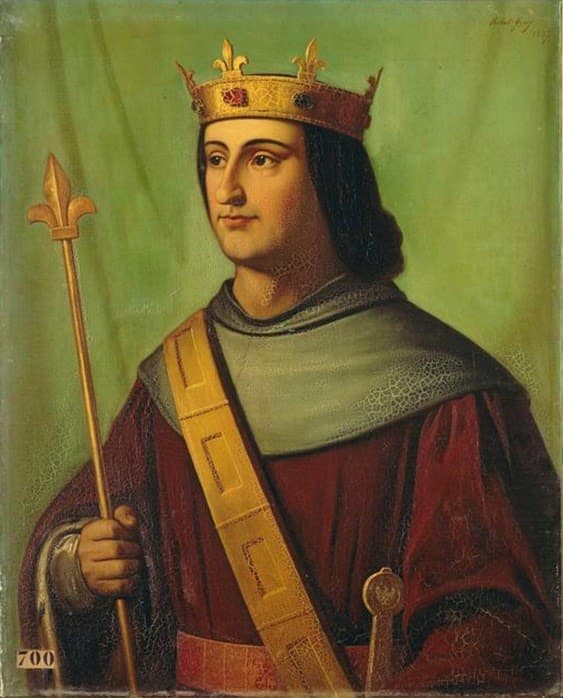

Philip VI became the first king of France from the Valois dynasty. His accession to the throne in 1328 occurred during a dynastic crisis following the extinction of the direct Capetian line.
After the death of King Charles IV the Fair, his widow, Jeanne d’Évreux, was left pregnant. Philip of Valois, being the late king’s cousin, was appointed regent. When the queen dowager gave birth to a daughter, Blanche, the Salic Law, which excluded women and their descendants from succession, was fully applied. The candidacy of King Edward III of England, nephew of Charles IV through his mother, was rejected. Thus, Philip was recognized as king. Edward III was forced to yield and swore fealty to Philip for his French fiefs.

Immediately after his coronation, Philip VI demonstrated determination. He intervened on behalf of his vassal, Louis of Flanders, who complained about the urban communes that had supported a peasant uprising. In 1328, Philip marched against the Flemish communes, defeated their militia at the Battle of Cassel, and restored Louis’s authority over the county.
Despite his oath, Edward III of England waited for a favorable moment to renew his claim to the French throne. The French chronicler Jean Froissart recounts that Edward’s hesitation ended under the influence of Robert of Artois, who, having been disgraced at Philip’s court, fled to England and began plotting against his homeland. In October 1337, Edward III sent a formal challenge to Philip.
This event marked the beginning of the Hundred Years’ War between the English and French kingdoms. During Philip’s lifetime, the war led to a devastating defeat for the French army at the Battle of Crécy on August 26, 1346. The rout at Crécy, followed by the English capture of the port city of Calais, were severe blows to the French crown.

Philip of Valois was forced to conclude a truce with Edward III but died before its expiration, in 1350. The throne then passed to his son, John II the Good.


