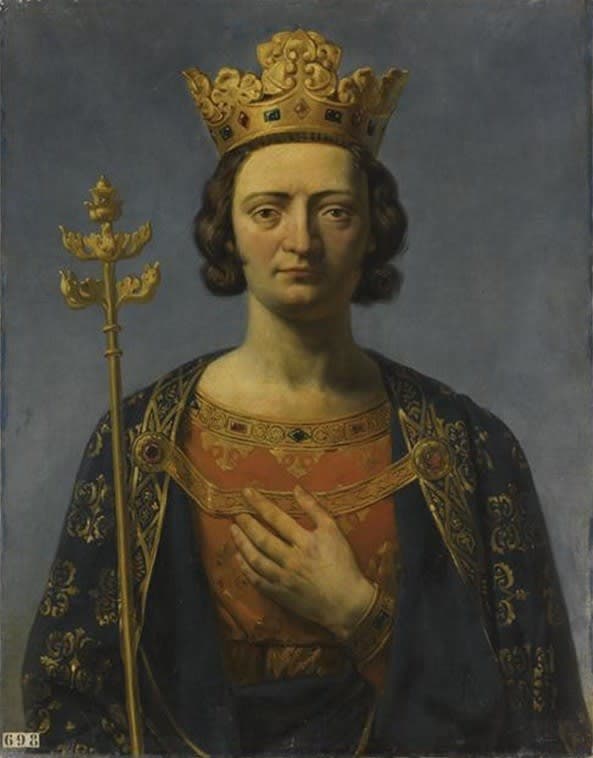

Philip V, known as the Tall, held the title of Count of Poitiers before ascending the throne. His short reign became an important period in the development of French legislation and the strengthening of royal authority.
After the sudden death of his elder brother Louis X the Quarrelsome in 1314, Philip declared himself regent for his brother’s pregnant widow, Clementia of Hungary. When the queen gave birth to a son, John I the Posthumous, Philip continued to hold the regency. However, the infant king lived only five days. The child’s death was so advantageous to Philip that rumors spread about his possible involvement.
To secure the throne for himself and his heirs, Philip became one of the founders of the application of the Salic Law regarding royal succession. This law prohibited women from inheriting the crown of France or transmitting it through their descendants. Thus, he excluded Joan, the elder daughter of Louis X, from the line of succession and deprived her offspring of any claim to the crown.


The hastily convened Estates-General, summoned by Philip V, confirmed the decision of the Royal Council to exclude women from succession and recognized Philip V as the lawful king of France. His accession marked the first application of the Salic Law, which later, after the extinction of the senior Capetian line, would serve as one of the main causes of the Hundred Years’ War.
Immediately upon ascending the throne, Philip V ended the inherited war with Flanders and removed his uncle Charles of Valois from the governance of the kingdom. He sincerely devoted himself to domestic administration and was full of good intentions, striving to restore order within the government.

The reign of Philip V can be regarded as the culmination of the work of the Capetian dynasty: what had previously been practiced without formalization was now codified into law. To carry out this work, Philip frequently convened councils, preferring assemblies of city representatives over the Estates-General.
Philip V undertook two major reforms, which he did not manage to complete due to his short reign. He sought to restore the royal right of coinage (monetary regalia), which had been lost during the feudal turmoil. He also aimed to introduce uniformity into the confusing system of measures and weights throughout the country.

In early August 1321, Philip V fell ill with dysentery and fever. His illness lasted five months, and the king died on the night of January 2–3, 1322.
The Salic Law, which Philip himself had introduced only six years earlier, turned against him since he left only daughters, the crown passed to his younger brother, Charles IV. The new king largely abandoned Philip’s internal reforms, and real power once again passed to Charles of Valois.


