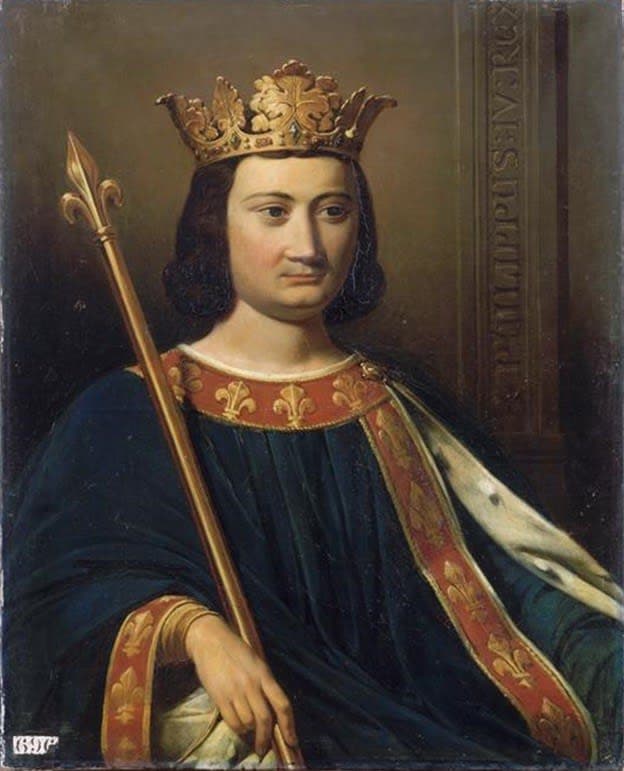

The reign of Philip IV the Fair became a key stage in the history of France, marking the decline of the political power of the feudal lords and the strengthening of the monarchy. He continued the policy of his predecessors, but his era demanded aggressive and harsh measures, mainly aimed at replenishing the royal treasury and strengthening the army.
Philip IV was brought up in the spirit of Roman law. His advisers, the so-called legists, especially Guillaume de Nogaret and Pierre Dubois, always sought to give the king’s actions a legal form. As a result, his reign was filled with diplomatic litigation, and disputes often took the form of judicial processes.
The main driving force of all Philip’s activity was his constant effort to fill the empty royal treasury. It was this financial necessity that dictated both his foreign and domestic policies.
By confirming the right of the English king Edward I to possess Guyenne, Philip nevertheless summoned him to court, knowing that Edward was occupied with the war in Scotland and would not be able to appear. Edward, wishing to avoid war, allowed Philip to occupy Guyenne for forty days. However, Philip refused to return the duchy. Although subsequent military actions and negotiations led to the restoration of Guyenne to England in 1299, Edward still had to swear fealty to Philip as his vassal. To strengthen peace, Philip gave his daughter Isabella in marriage to Edward’s heir, the future Edward II.
Philip IV took advantage of the discontent of the urban population of Flanders, which led to the capture of the count and the annexation of Flanders to France in 1301. However, the oppression arranged by the French governor Châtillon provoked a Flemish uprising. In the Battle of Courtrai in 1302 the French were utterly defeated. The war continued until 1305, when the Flemings were forced to cede part of their territory to Philip, recognize vassal dependence, and pay enormous indemnities.


The conflict with Pope Boniface VIII became one of the most dramatic episodes of Philip’s reign. In 1296 the pope issued the bull Clericis laicos, forbidding the clergy to pay taxes to laymen without Rome’s consent. Philip, who needed money and was guided by the doctrine that the clergy must aid the state, responded by prohibiting the export of gold and silver from France, depriving the pope of a major source of income. Boniface was forced to yield and even canonized the king’s grandfather, Louis IX.
In 1300 the conflict flared again. The king accused the papal legate, Bishop Bernard Saisset, of treason. The pope, in turn, in the bull Ausculta fili issued in December 1301, accused Philip of encroaching on spiritual authority and summoned him to court.
Philip, who according to legend burned the bull, convened the first Estates-General in the history of France in April 1302, which expressed unconditional support for the king. In response, the pope at the council issued the bull Unam Sanctam in autumn 1302, reaffirming the supremacy of spiritual power over secular authority.


Philip sent Guillaume de Nogaret to Italy to arrest the pope. Nogaret and his detachment entered the papal palace in Anagni. Although the locals soon freed the pope, Boniface VIII died a few days later.
The sudden death of his successor Benedict XI in 1304 allowed Philip to secure the election of the French cardinal Clement V in 1305. The new pope moved his residence to Avignon. Thus, Philip the Fair effectively turned the papal curia into an instrument of his influence.
The most famous and cruel act of Philip’s reign was directed against the Order of the Templars.
It began with the report of a condemned criminal claiming that the Order, possessing enormous wealth, was plotting against secular monarchies. Relying on rumors of vice and heresy, Philip secretly prepared a plan for arrest.
On October 13, 1307, a mass arrest of all members of the Order in France began. At the ensuing trials, where evidence was obtained under torture, the Templars were accused of heresy (spitting on the cross, denying Christ), financial fraud, usury, and other crimes.
The Order was dissolved and banned, and its property confiscated. Philip not only replenished the treasury but also eliminated the crown’s largest creditor. Jacques de Molay, the Grand Master of the Order, was executed in 1314.


The constant lack of money forced Philip to resort to desperate and unpopular measures: offices were sold, forced loans imposed, and high taxes introduced.
The king minted debased coins with a high copper content. The gilded surface quickly wore off, and copper appeared on the king’s nose on the coin, for which he was nicknamed “the Red-nosed.” In 1306 public outrage over his financial policy even forced Philip to flee from Paris.

In 1306 he expelled the Jews from France, and in 1311 the Lombard Italian bankers. In both cases their property was confiscated, replenishing the treasury.
Under Philip IV the administration was significantly centralized, and the rights of feudal lords (including coinage) were severely limited.
Philip IV the Fair died on November 29, 1314 in Fontainebleau, twenty-five days after a stroke suffered while hunting. Many linked his sudden death to the curse of Jacques de Molay, who before his execution had foretold the king’s imminent end.
Philip’s death led to the extinction of the senior Capetian line only fourteen years later. His sons Louis X, Philip V, and Charles IV died without male heirs. This gave King Edward III of England (Philip’s grandson through the female line) grounds to claim the French throne. The French nobility, to prevent this, adopted the Salic Law, which forbade inheritance through women. In 1328 Philip VI of Valois, nephew of Philip the Fair, ascended the throne. These dynastic disputes became one of the main causes of the Hundred Years’ War.



