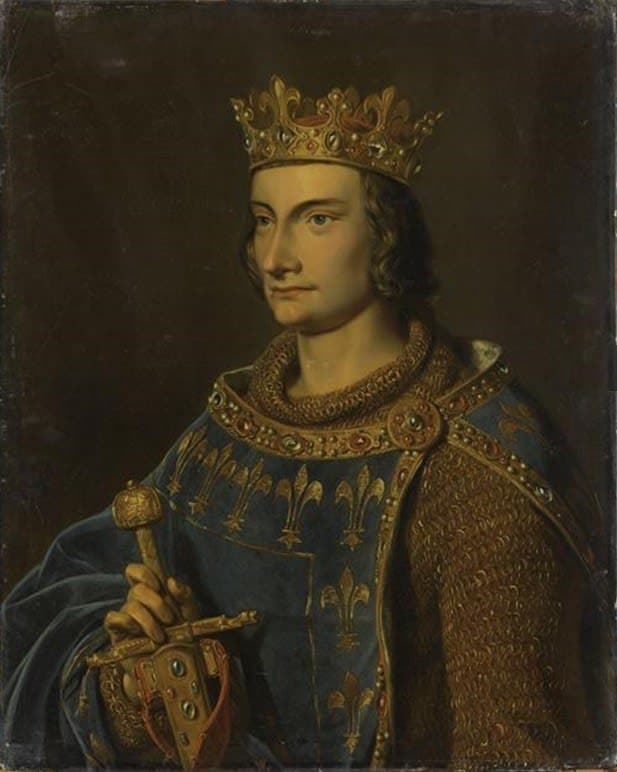

Philip III the Bold was the second son of King Louis IX the Saint and Margaret of Provence. He was named after his great-grandfather, the famous Philip II Augustus. After the death of his elder brother Louis in 1260, Philip became heir to the throne.
Philip III took part with his father in the Eighth Crusade and was proclaimed king directly in the military camp on the African coast in 1270, after the death of Louis IX in Tunis.
Immediately upon his return to France, Philip III, known for his weak and indecisive character, subdued several rebellious vassals and achieved recognition of his supreme authority by the Archbishop of Lyon. However, throughout his reign, real influence on state affairs was held by his favorites rather than the king himself.
At the beginning of his rule, the greatest influence was wielded by chamberlain Pierre de la Brosse, a man of humble origin. But in 1278 he fell victim to noble intrigues, carried out through Queen Maria of Brabant. After his execution, Abbot Mathieu de Vendôme of Saint-Denis and Seneschal Étienne de Bomarchais rose to prominence.


The key figure influencing Philip III was his uncle Charles of Anjou, the king of Sicily. Yielding to Charles’s pressure, Philip put forward his candidacy for the throne of the Holy Roman Empire, though unsuccessfully. Ultimately, it was the influence of Charles of Anjou that dragged Philip into Spanish affairs, which led to his defeat and death.
Philip III also had personal interests on the Iberian Peninsula. In 1275 he successfully defended Navarre from the claims of the kings of Castile and Aragon. However, his attempt to defend the rights of a French princess deprived of her inheritance in Castile after her husband’s death in 1276 was unsuccessful.
The most disastrous of all was the Aragonese expedition of 1285, undertaken at the insistence of Charles of Anjou after the uprising known as the Sicilian Vespers in 1282. Pope Martin IV excommunicated King Peter III of Aragon and transferred his throne to one of Philip’s younger sons. The French army and fleet were prepared to carry out this plan. However, the French fleet was twice defeated, and the army, delayed by the siege of Girona, fell victim to an epidemic. Philip III, who personally led the campaign, also fell ill and died during the retreat.

Despite the king’s weak character and foreign policy failures, during his reign the crown’s possessions expanded significantly. After the extinction of the Counts of Toulouse, Philip III annexed their vacant fiefs to the royal domain: Poitou, Saintonge, Toulon, Albigeois, Auvergne, Quercy, Agenais, and Rouergue.
The marriage of the heir to the throne with Joan of Navarre prepared the incorporation of the Kingdom of Navarre and the Counties of Champagne and Brie into France. The annexation of strategically important cities such as Lyon and Montpellier were also prepared.
Thus, although Philip III was not a strong ruler, he continued the policies of his predecessors toward centralization and expansion of the royal domain, inheriting from Louis IX a strong administrative state machine.


