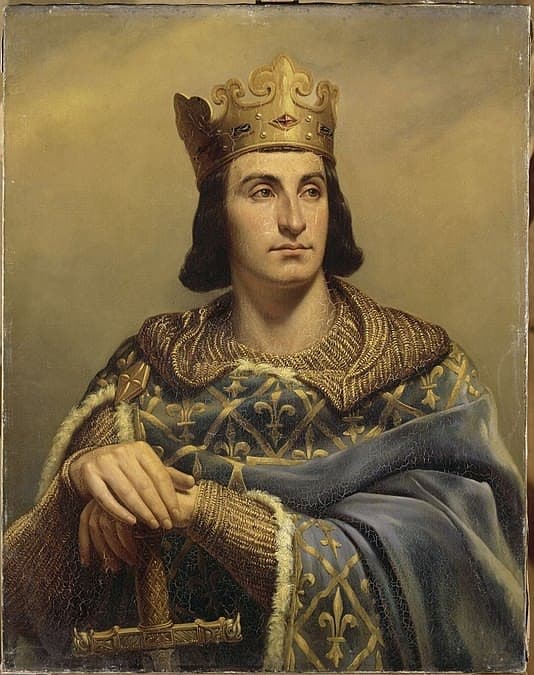

Philip II, known as Augustus, was the only son of King Louis VII by his third wife, Adèle of Champagne. After Louis’s two childless marriages, the birth of an heir on August 21, 1165, was celebrated as a “gift of God” (Dieudonné), a name by which the infant prince was often called. Louis VII had married Adèle of Blois-Champagne to form an alliance against their common enemy, Henry of Anjou who, after marrying Eleanor of Aquitaine, became King of England in 1154 and ruler of vast French territories, thus creating the Angevin Empire.
Louis VII hesitated to crown his son, fearing ill omens, but under pressure from church leaders finally agreed. Shortly before the planned coronation, in August 1179, young Philip lost his way while hunting and was found in grave condition. Louis VII went to England to pray at the tomb of Thomas Becket for his son’s recovery. Philip recovered, but Louis, upon returning, was stricken with paralysis. The coronation took place on 1 November 1179, conducted by Philip’s maternal uncle, Archbishop William “White Hands” of Reims.


After his father’s stroke, the queen’s brothers sought to rule in the young king’s name. To counter their influence, Philip allied with Philip of Alsace, Count of Flanders, and against his mother’s wishes married the count’s niece, Isabella of Hainault, on 28 April 1180. Queen Adèle attempted to forge an alliance with King Henry II of England, but Henry refused to wage war against his young overlord and instead concluded peace with Philip in June 1180.
Louis VII died on 18 September 1180. Philip’s growing friendship with the Plantagenets provoked a powerful anti-royal coalition, but its members acted without coordination. By 1182 the House of Blois was reconciled with Philip under Henry II’s mediation. In 1184, following the death of Philip of Alsace’s wife, the French king claimed part of her inheritance. Under the Treaty of Boves, Philip II Augustus gained the strategically important counties of Amiens and Montdidier, greatly strengthening royal power and paving the way for future expansion.
Philip’s principal aim was to weaken the Angevin Empire of the Plantagenets. He continued the traditional Capetian policy of supporting rebellious members of the English royal family first Henry the Young King, and after his death, Prince Richard the Lionheart.
In 1188, Richard swore homage to Philip for his French fiefs, and in June 1189 Henry II died.


Philip and Richard took the cross together, agreeing on mutual aid and the division of future conquests. Yet their alliance quickly turned to rivalry. Meeting in Messina in 1190, they wintered there, while Richard meddled in Sicilian affairs. Philip, unwilling to wait, sailed to Syria in March 1191. After the capture of Acre, convinced that Richard plotted his murder, he hurried back to France.
When Philip learned of Richard’s capture in Austria in December 1192, he invaded Normandy in early 1193, seizing Gisors and Ivry, and made a pact with Prince John Lackland to divide Normandy.

In February 1194 Richard was released despite Philip’s protests. The French king was defeated at Fréteval on July 5, 1194, and for several years the two fought a war of raids and sieges until Richard was killed in April 1199 at the siege of Châlus.
Richard’s death gave Philip new opportunities. He exploited the claims of Arthur of Brittany, nephew of the new English king, John Lackland. Though excommunicated by the pope over a second divorce, Philip signed peace in 1200, recognizing John as Richard’s heir in exchange for Évreux and much of the Vexin.
When John abducted the fiancée of Hugh IX of Lusignan, Philip summoned him to the court of peers in Paris. After John refused to appear, his French possessions were declared confiscated in April 1202. Philip invaded Normandy; John’s murder of Arthur of Brittany late in 1203 turned Norman barons against him. In March 1204 Château-Gaillard fell, and by June 1204 Philip controlled all Normandy, Anjou, Maine, and Touraine.

By 1206 Philip had also conquered Poitou, though he accepted a truce that confirmed his control over Normandy and all lands north of the Loire.
To counter Philip’s growing power, a grand anti-French coalition formed, led by Emperor Otto IV John’s nephew and including the counts of Flanders, Holland, and Boulogne. Philip in turn supported the candidacy of Frederick II Hohenstaufen for the German throne. With papal backing, Frederick was elected King of Germany in 1211, restoring the traditional alliance between the Hohenstaufens and the Capetians against the Welfs and the Plantagenets.
The coalition planned a two-pronged invasion John from Aquitaine and Otto IV from the north. John’s army was defeated by Philip’s son Louis at La Roche-aux-Moines, while on 27 July 1214, at the Battle of Bouvines, Philip Augustus won a decisive victory over Otto IV’s forces.


The triumph at Bouvines secured Frederick II’s position in Germany and forced John Lackland to sue for peace, effectively acknowledging the loss of Normandy, Anjou, Maine, Touraine, and Poitou.
During the last nine years of his reign, Philip devoted himself to reorganizing his greatly expanded domain. He died on 14 July 1223 at Mantes. His son Louis VIII had not been crowned during his father’s lifetime perhaps reflecting the dynasty’s new stability, which no longer required the institution of co-kingship.
Philip II’s forty-three-year reign was of immense importance to France. Through war and diplomacy, he gained all the Plantagenet lands north of the Loire as well as Vermandois, Valois, and Artois. These acquisitions made the Capetian king the most powerful ruler in France and laid the foundation for further territorial expansion.
Philip transformed the monarchy’s outlook from a feudal and private one to a state and governmental conception. He actively supported communes, viewing them as allies against rebellious nobles. He also established a centralized administration: the Royal Court (Curia Regis), and a system of royal officials the provosts (prévôts) in towns and villages, and the bailiffs (baillis) in larger regions. Offices ceased to be hereditary.
Under his rule, new defensive walls were built around Paris in 1190, and the city became firmly established as the capital of France.
Philip Augustus not only defeated his enemies but also created the essential framework for France to emerge as a unified, centralized state.


