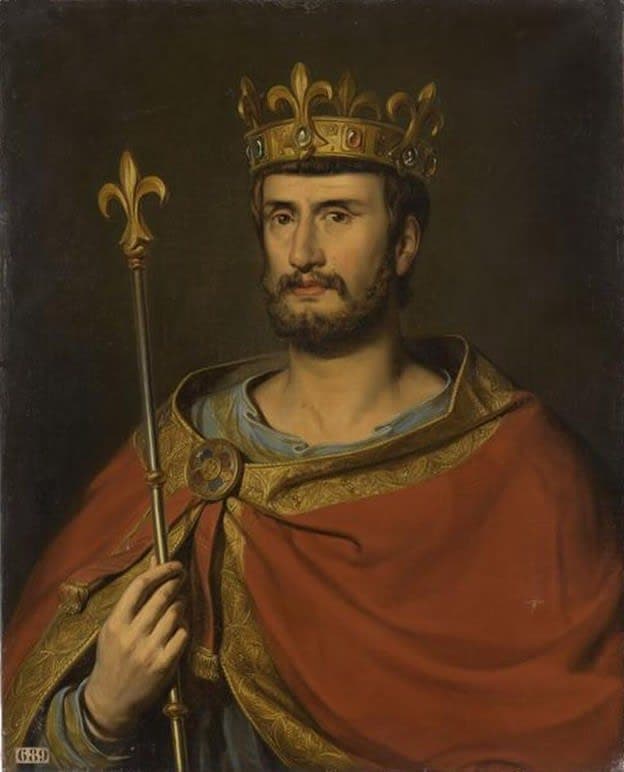
Philip I was the eldest son of King Henry I from his second marriage to Anna Yaroslavna, daughter of Grand Prince Yaroslav the Wise of Kiev. The prince received the uncommon Greek name Philip, which would thereafter become a traditional name among the Capetians.

Because Philip was a late-born child (his father was forty-four at the time), Henry followed Capetian tradition and organized the coronation of the seven-year-old prince. The ceremony took place on May 23, 1059, in Reims, in the presence of all major vassals of the crown, except for William of Normandy. The coronation was meant to guarantee the automatic, election-free transfer of power upon the king’s death.
When Henry I died on August 4, 1060, Philip was recognized as king without any difficulty. The regency during his minority was held by his maternal uncle, Count Baldwin V of Flanders, who ruled until his death in 1067, when Philip turned fifteen. Queen Mother Anna also took part in governance, but her influence faded after she married Count Raoul of Crépy in 1061.
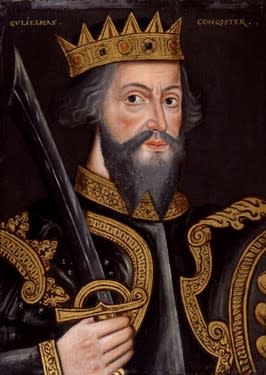
At the beginning of Philip’s reign, royal authority extended only over the royal domain the lands surrounding Paris and Orléans. Powerful vassals such as William the Conqueror, Duke of Normandy who in 1066 conquered England pursued independent policies and often exceeded the king in power.
Philip managed to expand the borders of the royal domain through the acquisition of strategically important territories. In 1068, Count Fulk the Red of Anjou transferred his ancestral county of Gâtinais to Philip in exchange for recognition of his rights following a feudal war.
In Flanders, after the death of Philip’s cousin, a conflict erupted. The king supported his young nephews against their uncle, Robert the Frisian, but was defeated in the decisive Battle of Cassel on February 22, 1071. As a result, Philip had to recognize Robert as Count of Flanders, though he secured an alliance with him through marriage to Robert’s stepdaughter, Bertha of Holland, forming a bloc against the Anglo-Norman monarchy.


Philip’s chief foreign policy goal was to counter the growing power of William the Conqueror, who posed a major threat to the French crown. Their first open clash occurred in 1076, when Philip unexpectedly intervened in a Breton feud and defeated the English king near Dol. The following year, peace was concluded, and Philip regained the strategically vital Vexin territory lost by his father.
When William’s son, Robert Curthose, rebelled against him, Philip supported the revolt by providing him the fortress of Gerberoy. However, in February 1079, Philip likely abandoned the alliance in exchange for a large sum of money from William and formal recognition of the Vexin as French territory.
Events turned in Philip’s favor when William the Conqueror, having invaded the Vexin and destroyed Mantes in 1087, fell from his horse and died soon afterward. His death led to the division of the Anglo-Norman realm between his sons: William Rufus received England, and Normandy went to Robert Curthose a longtime ally of the French king. Thus, Philip finally secured his long-sought goal: the permanent attachment of the Vexin to the French crown.
Philip also managed to expand the royal domain through Berry. In 1101, Eudes Arpin, Viscount of Bourges, mortgaged his lands (the viscounty of Bourges and the lordship of Dun) to the king to finance his crusade. Unable to redeem them, he became a monk, and Bourges passed permanently into royal possession.

In the early 1090s, Philip’s life took a dramatic turn that brought him into sharp conflict with the Church. In 1090, he imprisoned his wife, Bertha of Holland, and on the night of May 15, 1092, he abducted the beautiful Bertrade de Montfort wife of his powerful vassal, Count Fulk of Anjou probably with her consent. Philip divorced Bertha and married Bertrade.
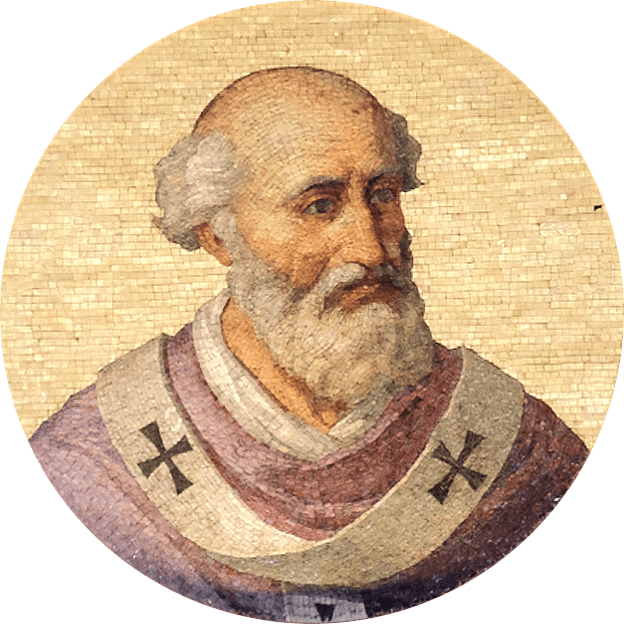
This act scandalized the clergy. Bishop Ivo of Chartres protested publicly, and a church council in Autun on October 16, 1094 excommunicated the king. Pope Urban II confirmed the sentence at the famous Council of Clermont in 1095.

Philip agreed to dissolve the marriage to lift the excommunication but soon resumed living with Bertrade. He remained excommunicated for ten years, which severely weakened the crown. Because of this, he could not take part in the First Crusade instead, his brother Hugh of Vermandois went in his place. During this time, his ecclesiastical vassals were free to ignore his authority.
When Robert Curthose of Normandy departed for the Holy Land, he left the duchy under the control of William Rufus, which once again led to border conflicts with the reunited Anglo-Norman monarchy.
The conflict with the Church was resolved only in 1104, four years before Philip’s death. In 1107, he and Pope Paschal II reached a compromise on the issue of investiture: the king recognized the canonical election of bishops, but the prelates, in turn, swore fealty to him. This agreement became the foundation for a lasting alliance between the French crown and the Holy See.

By Bertha of Holland, Philip had one son Louis. In 1100, Philip proclaimed him co-ruler. However, Bertrade de Montfort plotted against her stepson, attempting to place her own son on the throne; some sources even suggest she tried to poison Louis. In his later years, Philip, who suffered from severe obesity, withdrew from active rule. From 1101 onward, Louis took charge of royal affairs, suppressing rebellious barons within the domain.

Philip I died on July 29 or 30, 1108, in Melun. He was buried at the Abbey of Fleury in Saint-Benoît-sur-Loire, rather than at the royal necropolis of Saint-Denis a decision that saved his tomb from desecration during the French Revolution.
Philip’s forty-eight-year reign was the longest in France up to that time. His contemporaries often judged him harshly, mainly because of his personal scandals and excommunication. Historian Georges Duby later observed that in this era “royal functions became confined to the household sphere,” and attention was focused on “domestic events.”
Yet despite the narrowing of royal authority and the growing power of the barons, Philip I achieved several key successes: the expansion of the royal domain through Gâtinais and Bourges, the defense of France from Anglo-Norman aggression, the establishment of Paris as the kingdom’s administrative center, and the creation of an independent royal bureaucracy (including offices such as constable and seneschal).
Although his reign was turbulent, it ensured dynastic continuity and preserved the royal domain for his more energetic successor Louis VI.


