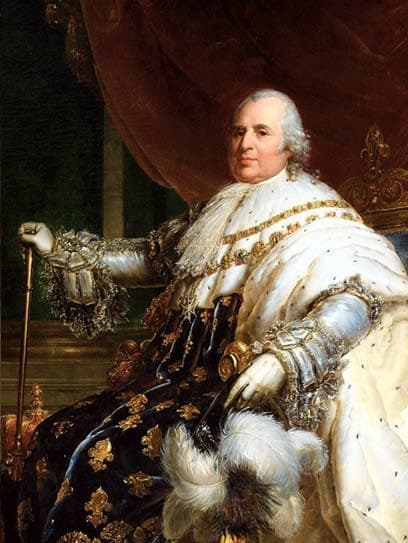

The future monarch was born in 1755 and given the second name Stanislas, in honor of his great-grandfather, King Stanisław Leszczyński of Poland. After his father’s death in 1765, Louis became second in line to the throne. In 1771, at the age of 15, he married Marie Joséphine of Savoy, but their marriage was reportedly unconsummated and childless.

From 1774, and until the birth of his nephew Louis Joseph in 1781, the Count of Provence was the direct heir to his elder brother, Louis XVI. At court he led a modest life, though privately he showed greater flexibility and tact than his brother.
When the French Revolution began in 1791, the Count of Provence successfully fled France, unlike Louis XVI, and became the recognized leader of the royalist émigrés.
For the next two decades, he lived as a wanderer across Europe, reflecting the turbulent political climate of the age residing in Brussels, Coblenz, Verona, and repeatedly finding refuge in Russia, whose rulers alternately welcomed and expelled him for political reasons (notably after the Treaty of Tilsit).
In 1795, upon learning of the death of his young nephew Louis XVII, the Count of Provence proclaimed himself King of France as Louis XVIII.

After a brief stay in Sweden, he finally settled in England, purchasing Hartwell House, where he lived in relative seclusion. Overweight and physically frail, he lacked energy and pursued a cautious policy, yet he refused all offers of compromise, including Napoleon Bonaparte’s proposal of a 2-million-franc pension in exchange for renouncing his royal claims.
Unlike many émigrés, Louis XVIII learned from experience. His years in England convinced him that a constitutional monarchy could coexist with royal authority and that a complete return to the past was impossible.
In April 1814, after Napoleon’s defeat, the Senate proclaimed the Bourbon Restoration. Although Louis initially refused to recognize any constitution, he was forced to yield under pressure from Emperor Alexander I of Russia.
On May 3, 1814, Louis XVIII made a triumphal entry into Paris, and on June 4, he promulgated the Constitutional Charter of 1814, establishing a constitutional monarchy. However, violations of the Charter soon began, and Republican and Bonapartist sympathizers were persecuted.
When Napoleon returned from Elba in March 1815, beginning the Hundred Days, Louis XVIII fled Paris in haste. After Napoleon’s final defeat at Waterloo, the king returned to the capital under the protection of the Duke of Wellington.


Although Louis proclaimed a general amnesty, a harsh reactionary purge soon followed executions, confiscations, and exile of Bonapartists and Republicans. The king disapproved of these excesses but was too weak to resist them. This “White Terror” lasted about a year.
In later years, brief liberal moderation gave way to renewed reaction after the assassination of the Duke of Berry (Charles-Ferdinand d’Artois), the king’s nephew and heir presumptive.

During his final years, Louis XVIII suffered from severe gout and gangrene, which confined him to a chair. He died on September 16, 1824, becoming the last French monarch buried in the royal basilica of Saint-Denis.
His death marked the only peaceful and lawful succession of royal power in 19th-century France, as he was succeeded by his younger brother, Charles X.
Though physically weak and politically cautious, Louis XVIII left a legacy of compromise between monarchy and constitutionalism, restoring royal authority without entirely extinguishing the liberal ideas born of the Revolution.


