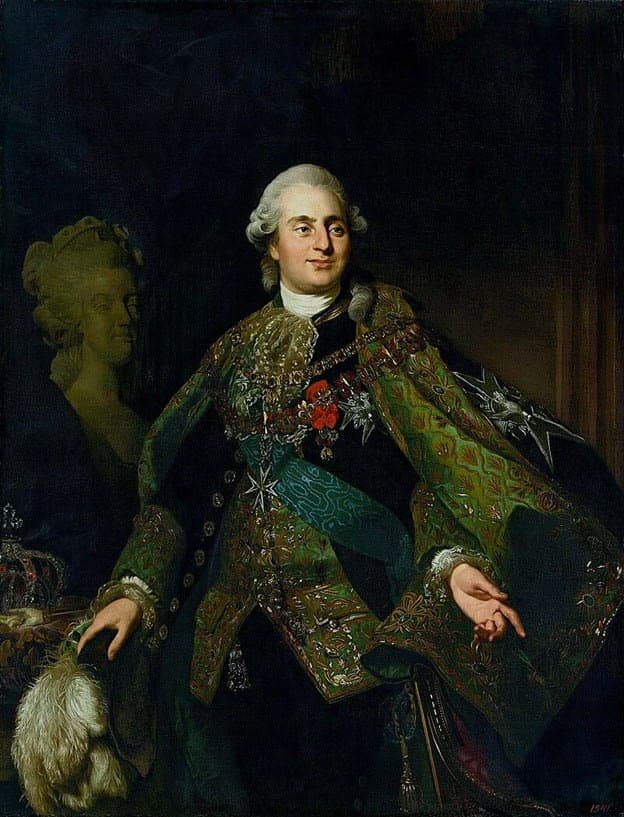

The future king was born in 1754 at Versailles. His grandfather, Louis XV, disliked him for his disapproval of courtly decadence and the king’s mistress, Madame du Barry, keeping him away from affairs of state. His education was thorough but theoretical, giving him little practical preparation for governance.

Louis had a passion for manual labor, particularly locksmithing, and for hunting. Despite the corruption of the court, he was morally upright, honest, and simple in his habits. He ascended the throne with sincere intentions to improve his people’s welfare and abolish abuses, but his indecisiveness prevented him from completing reforms. Easily influenced by his aunts, brothers, ministers, or his wife Marie Antoinette he often reversed his own decrees.

The new king’s first act was to dismiss Madame du Barry and her faction. He appointed talented reformers, Turgot and Malesherbes, as ministers, inspiring national hope for renewal.

Under Controller-General Turgot, a brief yet bold wave of reform began: tax equality, an extension of the land tax to nobles and clergy, free trade in grain, and the abolition of internal tariffs, guilds, and monopolies. He proposed eliminating feudal dues totaling 40 million livres and ending sinecure offices.
Meanwhile, Malesherbes sought to abolish the lettres de cachet (arbitrary royal arrest warrants) and promote freedom of conscience. But their efforts faced fierce resistance from the nobility, clergy, and parlements, who clung to their privileges.
Louis XVI admired Turgot, saying, “Only Turgot and I love the people,” yet his timidity led him to yield to aristocratic pressure, dismissing Turgot. He also refused to extend the abolition of serfdom (introduced on crown lands) to noble estates, claiming respect for property rights.
After Turgot’s fall, financial chaos ensued. Successive ministers Necker, Calonne, and Loménie de Brienne all failed to stop the mounting deficit. Meanwhile, aristocratic reaction intensified: the 1781 ordinance barred the Third Estate from high military and judicial offices, and seigneurs even revived feudal rights.
France’s participation in the American War of Independence (1778–1783) further drained the treasury but also fueled liberal ideals among French intellectuals, inspiring a new demand for freedom.


By the late 1780s, the budget deficit reached 198 million livres per year. The queen’s extravagance and lavish court spending worsened public anger. Efforts to reform local administration failed, and the government finally admitted its impotence.
The king convened an Assembly of Notables (1787), which refused to approve new taxes, insisting that only the Estates-General could authorize them. When the Paris Parlement echoed this demand, Louis tried to impose his will by force, but national outrage forced him to relent. In 1788, he agreed to summon the Estates-General.
On May 5, 1789, the Estates-General met at Versailles. The Third Estate, demanding sweeping change, declared itself the National Assembly on June 17. Louis hesitated torn between reformers and aristocrats alternately yielding and resisting, even plotting a counterrevolution.

The dismissal of Necker on July 11 and the concentration of troops near Paris sparked revolt. On July 14, the Bastille was stormed. Fearing civil war, the king backed down: he withdrew the troops, recognized the National Guard, and approved decrees abolishing feudal privileges.
Following the October Days (5–6 October 1789), the royal family was forced to move to Paris, becoming virtual prisoners of the Revolution. The king lapsed into passivity, merely “present” as events unfolded.
On the night of June 20–21, 1791, Louis XVI and his family attempted to escape Paris, aided by Count Axel von Fersen. They were stopped at Varennes, when postmaster Drouet recognized the king. The family was escorted back to Paris in grim silence.
On September 14, 1791, Louis swore an oath to the new Constitution, becoming a constitutional monarch. Yet he continued secret correspondence with émigrés and foreign powers, urging them to invade France. On April 20, 1792, with tears in his eyes, he declared war on Austria. His refusal to approve decrees against émigrés and refractory priests provoked the uprising of June 20, 1792, and his secret dealings led to the insurrection of August 10, which overthrew the monarchy.


On August 11, the king and his family were imprisoned in the Temple. Louis, now called “Citizen Louis Capet,” was charged with conspiring against the liberty of the nation. His trial opened on December 11, 1792 before the National Convention. He defended himself with dignity and composure, calmly arguing that he had always acted in good faith.
On January 16, 1793, the Convention voted on his fate by a single-vote majority, he was condemned to death.
On January 21, 1793, Louis XVI ascended the scaffold. His final words, addressed to the people, were noble and serene: “I die innocent of all the crimes imputed to me. I forgive those who are the cause of my death. I pray that my blood may never fall upon France.”


