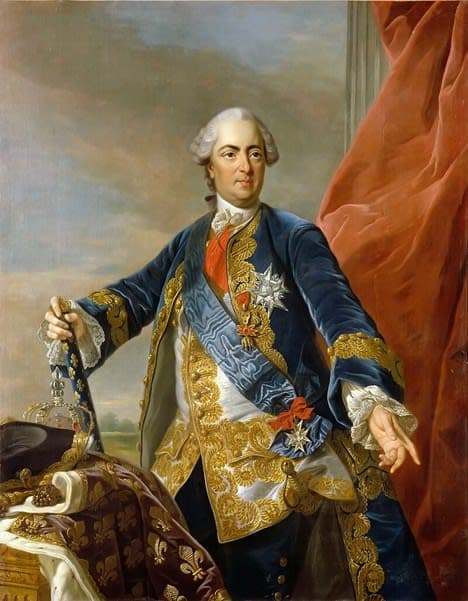

The future monarch, born as Duke of Anjou, was initially fourth in line to the throne. However, between 1711 and 1714, a tragic succession of deaths struck the House of Bourbon his grandfather (the Grand Dauphin), his parents (the Duke and Duchess of Burgundy), and his elder brother all died. The two-year-old Louis survived only thanks to the devotion of his governess, the Duchess de Ventadour, who protected him from the deadly medical fashion of the time bloodletting. Sympathy for the frail orphan, whose every breath was watched by the nation, made him immensely popular in his early years.
After the death of his great-grandfather, Louis XIV, on September 1, 1715, the five-year-old Louis became King of France. However, real power passed to Philippe II, Duke of Orléans, who ruled as Regent.

The regent’s foreign policy reversed that of Louis XIV he allied with England and waged war on Spain. Domestically, his rule was shaken by financial turmoil following the introduction of John Law’s system, which culminated in one of the worst economic crashes in French history.
The young king’s education was overseen by Bishop André-Hercule de Fleury, who instilled piety, and Marshal de Villeroi, whose indulgence of the boy’s whims encouraged idleness and dependence. In 1722, Louis was crowned at Reims, and in 1723, declared of age. Real power, however, remained in the hands of the regent and later the Duke of Bourbon, who arranged Louis’s marriage to Marie Leszczyńska, daughter of the exiled King of Poland, to secure an heir for the dynasty.
In 1726, Louis XV announced that he would rule personally but in practice, Cardinal de Fleury, his old tutor, became First Minister. Fleury’s cautious rule aimed at maintaining stability. He avoided reforms, exempted the clergy from taxation, and persecuted Jansenists and Protestants. His attempts to balance the finances failed due to poor economic understanding.
Though Fleury preferred peace, France was drawn into two costly wars. The War of the Polish Succession (1733–1738) brought France the duchy of Lorraine, granted to the king’s father-in-law Stanisław Leszczyński. The War of the Austrian Succession (1740–1748) ended with the Treaty of Aix-la-Chapelle, forcing France to return all its conquests in the Low Countries.


During that war, Louis fell gravely ill at Metz, and his recovery was celebrated nationwide earning him the affectionate title “Louis the Beloved” (le Bien-Aimé).
After Fleury’s death in 1743, the king nominally took control but never appointed a new First Minister. His inability to govern led to administrative chaos, as ministers pursued conflicting agendas while the king retreated into luxury and sensuality.
From 1745, royal influence was dominated by Madame de Pompadour, a woman of charm and intelligence who catered to the king’s whims but drained the treasury through extravagance. In 1757, an assassination attempt on the king revealed the growing hostility of the Parisian public.
Around the same time, Controller-General Machault d’Arnouville proposed a universal income tax (vingtième) on all social classes, including the clergy. The Church and the Paris Parliament united to block the reform.
In 1756, France entered the Seven Years’ War, forming an unprecedented alliance with Austria, its traditional enemy. The war ended disastrously with the Treaty of Paris (1763): France lost most of its colonies in India and Canada to Britain, marking the collapse of French maritime power.


Pompadour elevated Duke Étienne de Choiseul, who forged the Family Compact between the Bourbon monarchies and expelled the Jesuits from France. However, financial deficits ballooned. When the Paris Parliament refused to register new taxes, the king imposed his will through a lit de justice asserting royal supremacy over the judiciary.
After Pompadour’s death in 1764, the king found solace in Jeanne Bécu, Countess du Barry, a courtesan of humble origin whose wastefulness and low birth provoked scandal and deepened public contempt for the monarchy. Du Barry engineered Choiseul’s dismissal and promoted his rival, Duke d’Aiguillon.
In 1771, Louis XV made a final attempt to restore absolute authority by abolishing and exiling the members of the Paris Parliament, which had long defied him.
Indifferent to the nation’s suffering, the king spent his final years in pleasure, hunting, and escapism, responding to warnings with the fatalistic words: “The monarchy will last as long as we do,” or, as history remembers it: “After us, the flood” (après nous le déluge).
Louis XV died of smallpox on May 10, 1774. The public celebrated his death, seeing it as the end of decadence and decline — a prelude to the French Revolution.
Historians judge Louis XV harshly. His ineffectual leadership, corruption, and self-indulgence led France into economic ruin and military humiliation, fatally undermining the monarchy’s prestige. His successor, Louis XVI, would inherit a throne already doomed.
After his death, Louis XV’s personal chest nicknamed “the tickler” (la chatouille) — was found to contain a mere 50,000 livres, far short of the vast fortunes rumored to have passed through his hands.



