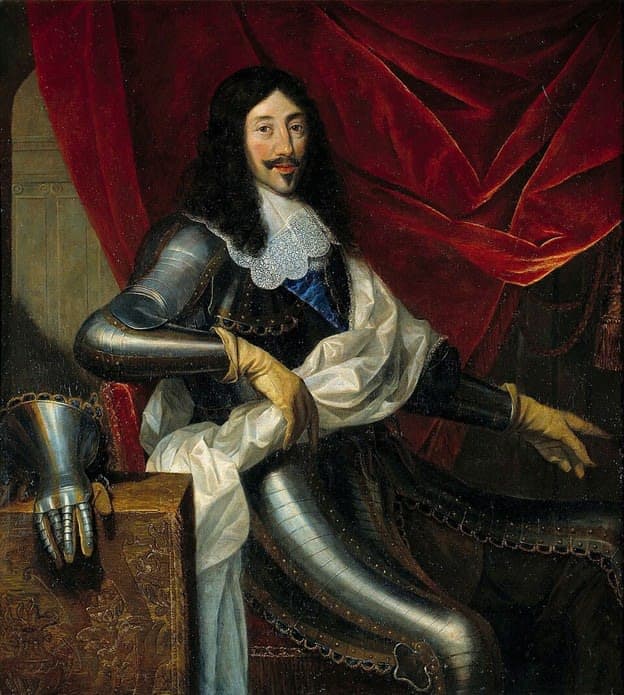
Louis XIII was born in 1601 at the Palace of Fontainebleau, the son of King Henry IV and Marie de’ Medici. His childhood, described in the diaries of court physician Jean Héroard, was spent largely at Saint-Germain-en-Laye, where his mother kept him isolated. From an early age, Louis showed a deep interest in music, playing the lute and harpsichord, singing, drawing, and studying military arts. He learned to shoot the arquebus and loved military parades. Though he disliked French and Latin, he was fascinated by history.
The assassination of his father Henry IV in 1610, combined with a lack of maternal affection, made Louis shy, silent, and prone to stammering and speech difficulties.


After his father’s death at the hands of a Catholic fanatic, the eight-year-old Dauphin became King of France. Until 1614, his mother Marie de’ Medici ruled as regent. She declared that her son was “too weak in body and spirit” to govern and excluded him from the royal council.
Marie surrounded herself with Italian favorites, notably Concino Concini and his wife Leonora Dori (Galigaï), who amassed enormous power. Her pro-Spanish policy, which contradicted the late Henry IV’s plans, alarmed the Huguenots and nobility, leading to political unrest and the last meeting of the Estates-General in 1614.


In 1617, the sixteen-year-old Louis asserted himself as an independent ruler: he ordered Concini’s execution, Galigaï’s trial and death, and sent his mother into exile at Blois. He then promoted his favorite, the Duke of Luynes, to high office.
By 1619, Marie de’ Medici escaped from Blois and raised an army against her son. Louis personally commanded his troops and triumphed at the Battle of Pont-de-Cé (1620). To prevent further conspiracies, he accepted reconciliation, under the guidance of Cardinal Armand Jean du Plessis de Richelieu, who soon became his chief minister.

The domestic policy of Louis XIII focused on strengthening absolutism and eliminating all forces that weakened royal authority. His primary enemies were the Huguenots, whose political and military privileges under the Edict of Nantes (1598) made them a “state within a state.”
Louis personally led royal forces, capturing the Huguenot stronghold of Saint-Jean-d’Angély in 1621. Despite setbacks at Montauban, he persisted. In 1624, Marie de’ Medici helped Richelieu enter the royal council. Both the king and the cardinal shared a common goal — the greatness of France. Richelieu’s policies targeted the reduction of noble power, centralization of administration, and above all, opposition to the Habsburgs.
After the siege of La Rochelle (1627–1628) and the final defeat of the Huguenot forces, the Edict of Alès (1629) was signed. Though it preserved freedom of worship, it abolished Huguenot political and military autonomy. As Richelieu noted, the king now “granted mercy rather than negotiated with equals.”

Louis steadfastly supported Richelieu, despite the fierce opposition of the court and his family. This was most dramatically shown on November 10, 1630, known as the “Day of the Dupes”, when the king unexpectedly sided with Richelieu, banished his mother, and executed her pro-Habsburg allies.
Demonstrating his absolute resolve, Louis in 1627 ordered the execution of Duke François de Montmorency-Bouteville for dueling proving that the state’s authority stood above noble privilege.
In 1635, France entered the Thirty Years’ War, siding with Protestant Sweden under Gustavus II Adolphus against the Catholic Habsburgs — a move that placed national interest above religion and ensured France’s rise as Europe’s dominant power.


Louis’s marriage to Anne of Austria remained childless for 23 years, fueling political intrigue and Spanish conspiracies. Anne even secretly leaked military intelligence to Spain. However, on September 5, 1638, a miracle occurred the birth of an heir, Louis-Dieudonné (“God-given”), the future Louis XIV. The event was hailed as divine providence.

After Richelieu’s death in 1642, Louis appointed his protégé Cardinal Jules Mazarin, who continued Richelieu’s policies.
Louis XIII died on May 14, 1643, exactly 33 years after his father’s assassination, at the age of 41, likely from Crohn’s disease. In his will, he tried to restrict his wife’s regency powers, but Anne of Austria annulled his wishes.
Despite his fragile health and introverted nature, Louis XIII relying on Richelieu’s genius completed the creation of the absolute monarchy, strengthened the state, and secured France’s dominance in Europe.


