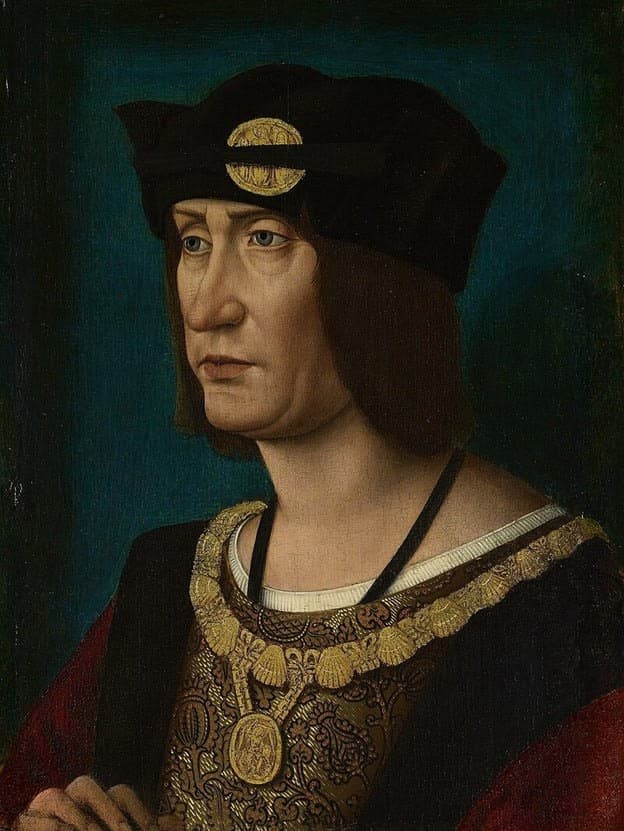

Louis XII was born in 1462 and, before ascending the throne, held the title of Duke of Orléans. Naturally lively and cheerful, he was more interested in tournaments, hunting, and feasts than in politics. However, his belonging to the Orléans branch of the Valois made him a dangerous rival to Anne of Beaujeu, the regent for the young Charles VIII, her brother-in-law.

Louis, who was the king’s brother-in-law (married to the unattractive and lame Joan of France, daughter of Louis XI), joined forces with the Count of Dunois and other princes to wrest power from Anne. This conflict, known as the “Mad War”, ended in Louis’s defeat at the Battle of Saint-Aubin-du-Cormier in 1488. He was captured and imprisoned in Bourges, and released only three years later through the intercession of his wife, Joan.

After the childless death of Charles VIII in 1498, Louis ascended the throne without opposition. His first actions were marked by generosity, earning him the love of his subjects. He refused to avenge himself on his former enemies, declaring the famous phrase: “The King of France has forgotten the injuries done to the Duke of Orléans.”
Seeking to keep Brittany within the French crown, Louis, with the approval of Pope Alexander VI, divorced his first wife Joan and married Anne of Brittany, widow of Charles VIII.
Louis’s internal policy greatly influenced by his minister Georges d’Amboise aimed to improve the lives of his people.
He reduced taxes, and at the session of the Estates General in Tours (1506) was solemnly proclaimed “Father of the People” (Père du Peuple).


He reformed the judicial system, clarified feudal duties, and regulated relations between peasants and lords.
As the grandson of Valentina Visconti, Louis XII inherited claims to the Duchy of Milan and, like his predecessor Charles VIII, dreamed of conquering the Kingdom of Naples.
In July 1499, Louis crossed into Italy, and by September 14 he had taken Milan, driving out Lodovico Sforza (Il Moro). Although Sforza briefly regained control, in 1500 he was betrayed by his Swiss mercenaries and captured, allowing Louis to consolidate his hold on northern Italy.
In the same year, Louis concluded the Treaty of Granada with Ferdinand of Aragon, dividing the Kingdom of Naples. The French occupied Abruzzo and Campania, and King Frederick of Naples was taken prisoner.
Disputes over the territories led to war with Spain in 1503, and the French suffered two severe defeats at Cerignola and Garigliano.


Defeated, Louis was forced to sign the Treaty of 1504, renouncing claims to Naples.
In 1509, Louis joined the League of Cambrai against Venice. Soon, however, Pope Julius II, wishing to drive the French from Italy, broke away and organized the Holy League against France. Louis responded by convening an assembly of the clergy in Tours, which approved his plan to summon a general council in Pisa to defend the rights of the Gallican Church.
From 1512 onward, fortune turned against Louis. He was defeated at Novara and Guinegate (1513), and Milan slipped from his hands when Massimiliano Sforza was proclaimed duke. Exhausted, he made peace with England and Spain in 1514.


Louis XII died on January 1, 1515. According to popular rumor, his death resulted from “excessive exertion in the bedchamber” while trying to produce an heir, for shortly before his death he had married for the third time to Mary Tudor, daughter of Henry VII of England.
Louis left no sons, and his successor was his cousin and son-in-law, Francis I, Count of Angoulême.


