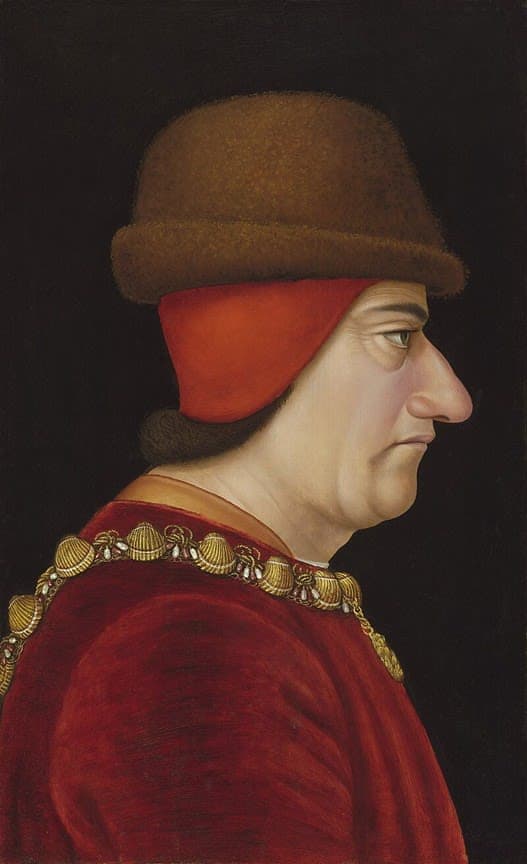

Louis XI was the son of Charles VII and was born in Bourges in 1423, during the height of the Hundred Years’ War. His childhood unfolded amid a struggle for survival, as his father controlled only central and southern France while the English held the north, including Paris.
Though not impressive in appearance, Louis received an excellent education studying Latin and theology and underwent superb military training. He was a skilled horseman, which later allowed him to make frequent journeys and pilgrimages.
In 1436, at the age of not quite thirteen, he married Margaret Stewart, daughter of the King of Scotland, in a union arranged for political necessity by his father. In 1440, he participated in the Praguerie a rebellion of nobles against Charles VII.

After being pardoned, he remained at court for a time but in 1446 was dismissed for showing disrespect toward the king’s mistress, Agnès Sorel. Louis settled in the Dauphiné, where he began to act as an independent ruler. In 1451, he married Charlotte of Savoy against his father’s will, openly defying him. When summoned repeatedly to court, he refused to appear. In August 1456, Louis fled to the protection of the powerful Duke of Burgundy, Philip the Good.

When Charles VII died in 1461, Philip the Good accompanied Louis to his coronation an event that, according to contemporaries, drew enthusiastic cheers for the duke but a cold reception for the new king himself.
Louis XI differed sharply from his predecessors. He was ambitious, secretive, and cold-hearted, but also a shrewd psychologist. He earned the nickname “the Universal Spider” for his skill in weaving political webs. Where earlier kings had ruled by force, Louis ruled by cunning, deceit, and prudence, making trickery the foundation of his feudal policy.
Immediately after his accession, Louis dismissed his father’s counselors and began a relentless campaign against the great nobles to create an absolute monarchy. He used bribery to recover lands and meddled in English affairs to weaken his rivals.
His despotism provoked a major aristocratic revolt, leading to the formation of the League of the Public Weal in 1465, headed by his brother Charles, Duke of Berry, and the powerful Charles the Bold, Duke of Burgundy.
In July 1465, Louis was defeated at the Battle of Montlhéry and was forced to sign the humiliating Treaty of Conflans on October 29, 1465, which curtailed royal authority.
However, Louis masterfully applied the principle of divide et impera (“divide and rule”). He recovered Normandy for the crown and, through deceit, deprived his brother of the promised Champagne, granting him instead the Duchy of Guyenne in 1469.
In 1468, Louis made a seemingly reckless mistake on his constable’s advice, he traveled to Péronne to negotiate with Charles the Bold, feigning trust. But while he was there, a rebellion broke out in Liège, a city Louis had secretly encouraged. Furious, Charles detained the king and forced him to sign the Treaty of Péronne on October 14, 1468, in which Louis renounced feudal claims to Flanders and Picardy. He was also compelled to witness the brutal punishment of the rebels before returning to Paris in disgrace.


Despite this humiliation, Louis soon achieved political revenge. In 1470, he convened an assembly of notables at Tours, summoning the Duke of Burgundy to trial. The unexpected death of his brother, the Duke of Guyenne, dismantled the feudal coalition. Louis consolidated power in the south by destroying the Armagnac family.
Seeking allies against Charles the Bold, he concluded a “perpetual alliance” with Switzerland and reconciled with King Edward IV of England, who landed in France in 1475 but was persuaded by Louis to sign the Treaty of Picquigny, accepting a large financial payment in exchange for peace.
The final act of Louis’s triumph came in his struggle with Charles the Bold, who suffered crushing defeats at Grandson and Murten in 1476. On January 5, 1477, Charles was killed at the Battle of Nancy, an event that brought immense joy to Louis.


The king immediately seized Burgundy, Franche-Comté, Picardy, and Artois. Though the marriage of Charles’s heiress, Mary of Burgundy, to Maximilian of Austria thwarted some of his ambitions—and the French were defeated at Guinegate in 1479 Louis retained the core Burgundian lands. By 1481, he had annexed Provence and Maine.
As an all-powerful monarch who had unified almost all of France, Louis XI began sweeping internal reforms. He relied on a High Council composed of men of humble birth commoners, Flemings, and Italians excluding princes of the blood to reduce their influence.
He established a standing army, released towns from military obligations, and allowed vassals to pay for exemption from personal service. He expanded the cavalry gendarmerie and relied heavily on Swiss mercenary infantry.

Louis also founded a printing press at the Sorbonne, supported book publishing, reorganized the medical faculty, and restored the ancient postal system. In 1466, he made Lyon a center of silk production.
In his later years, Louis XI was tormented by paranoia and fear of death. He withdrew to the fortified Château of Plessis-lès-Tours, living “as if in prison,” surrounded by his Scottish guards and astrologers. Popular rumor spread terrifying tales about his servants the barber Olivier le Daim and the provost Tristan l’Hermite. Seeking divine aid, Louis invited Saint Francis of Paola, founder of the Order of Minims, to heal him.

Louis XI died on August 30, 1483, at Plessis-lès-Tours. Before his death, he appointed his daughter Anne de Beaujeu as regent.
His reign marked a turning point: he expanded France’s frontiers to the Alps, Jura, and Pyrenees, and laid the solid foundations of a national state, uniting the kingdom under one monarch.


