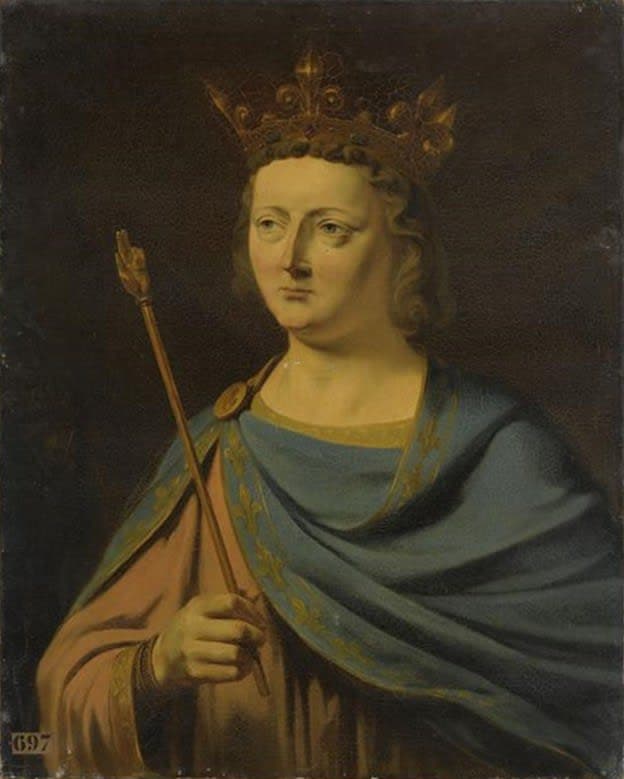

Louis X, called the Quarrelsome, was the eldest son of King Philip IV the Fair and Queen Joan I of Navarre. After his mother’s death in 1305, Louis inherited her domains the Kingdom of Navarre and the County of Champagne. Since he was only sixteen years old, the administration remained in the hands of his father, which caused discontent among the Navarrese. Eventually, Louis went to Navarre and was crowned there on October 1, 1307.
Louis X proved to be a weak-willed ruler, unable to continue his father’s policy of creating an absolute monarchy. During his reign, real power passed to his uncle Charles of Valois. The assistants and advisers of Philip IV were immediately dismissed, and some of them, including the first counselor Enguerrand de Marigny, were put on trial and executed.
The king promised to restore the feudal and judicial rights of the lords, to mint coins “of the time of Saint Louis,” and to reduce the influence of the royal administration. However, Louis failed to bring back the “good customs” of past times, since, like his father, he was constantly in need of money.
It was precisely financial considerations that explain his most famous act the Ordinance of 1315 abolishing serfdom in the royal domain. The king invited other lords to follow his example and declared that “in the land of the Franks, no one should be a serf” (au pays de Francs nul ne doit être serf). However, this measure had a fiscal character: peasants had to buy their freedom, thus replenishing the treasury.


Louis X continued the struggle with Flanders, begun by his father, but his campaign ended in failure. It seems that all of this king’s undertakings were doomed to fiasco.
Louis was married to Margaret of Burgundy, who was accused of adultery and sentenced by his father to life imprisonment. According to canon law, Louis remained bound by marriage to his imprisoned wife. Persistent rumors spread that Margaret’s death in the Château-Gaillard prison in 1315 was violent and sanctioned by the king himself.

Once free, Louis immediately married Clementia of Hungary. However, he died young, shortly after returning from an unsuccessful campaign in Flanders, having contracted a fever.
Louis X left behind a daughter, Joan, from his first marriage. After his death, a son, John I the Posthumous, was born, but he lived only five days. There were rumors that Countess Mahaut of Artois had a hand in the child’s death, but no evidence was ever found.
The deaths of Louis X and his infant son marked the beginning of a dynastic crisis. Since his younger brothers, Philip V the Tall and Charles IV, also left no male heirs, the senior Capetian line became extinct in 1328. To prevent the English king Edward III (grandson of Philip IV through the female line) from ascending the throne, the French aristocracy adopted the Salic Law. As a result, Philip VI of Valois took the throne an event that became one of the main causes of the Hundred Years’ War.



