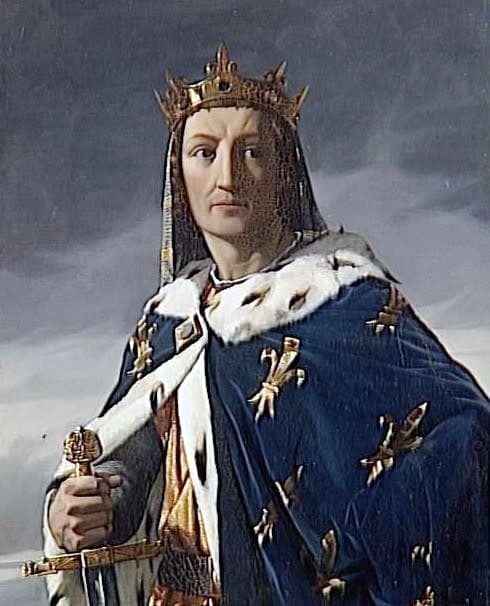

Louis VIII, known as the Lion, was the only son of King Philip II Augustus and Isabella of Hainault, which made him the natural heir to the French throne. From childhood he was frail and nearly died of fever in 1191.

In 1200, as part of the Treaty of Le Goulet, the thirteen-year-old prince married twelve-year-old Blanche of Castile, niece of King John Lackland of England and granddaughter of the famous Eleanor of Aquitaine, who personally arranged the match. This marriage gave Louis formal dynastic rights to the English crown rights he would later claim.
Throughout his father’s reign, Louis took part in Philip Augustus’s wars, beginning with the campaign against John in 1204. The king, however, kept his son away from real power and delayed his knighthood perhaps fearing that Louis might become a figurehead for discontented nobles.
In 1209, Philip finally knighted his son, making him swear never to take part in tournaments, as his life was deemed too precious for the dynasty. In 1212, Louis led his first independent campaign in Flanders, allowing him to secure part of Artois for himself. That same year, on behalf of his father, he concluded an alliance with Emperor Frederick II of the Holy Roman Empire against the Welfs and the Plantagenets.
In 1213, Philip Augustus announced his intention to claim the English crown for his son, who, as the husband of Eleanor’s granddaughter, had a legitimate pretext. Though Pope Innocent III, reconciled with John, forbade the invasion, in 1214 Louis led an army against the English king and won a bloodless but decisive victory at La Roche-aux-Moine, celebrated by chroniclers alongside Bouvines.


In 1215, rebellious English barons invited Louis to take the English throne. In May 1216, the prince landed in England and was proclaimed king in London, though never crowned. He quickly took control of the eastern part of the kingdom, but his position collapsed after the sudden death of John Lackland in October 1216. John’s young son, Henry III, gained the backing of most barons and of the new pope, Honorius III.
In 1217, Louis’s army suffered defeat at the Battle of Lincoln, and his fleet was destroyed at Sandwich. Forced to negotiate, Louis signed peace on 11 September 1217 and permanently withdrew from England.

In the last years of his father’s life, Louis also took part in the Albigensian Crusade in Languedoc, though without major success.
Philip Augustus died on 14 July 1223, and Louis VIII was crowned on 6 August 1223 in Reims. The fact that he was not crowned during his father’s lifetime unusual for the Capetians demonstrated that the principle of hereditary succession had become secure.
Immediately after his accession, Louis renewed the alliance with the Hohenstaufens against the Plantagenets. When the truce with England expired in 1224, he used the opportunity to expand the royal domain south of the Loire. He invaded Poitou, received the submission of Hugh X of Lusignan, and on 13 August 1224 captured La Rochelle, gaining control over all Saintonge. The English retained only Gascony.
The most significant event of his brief reign was the Crusade in Languedoc against the Albigensians. In November 1225, at a church council in Bourges, Louis secured an interdict against Raymond VII of Toulouse and was proclaimed commander of the crusaders.
In June 1226, the royal army advanced down the Rhône valley. The main resistance came from Avignon, which surrendered only in September after a three-month siege. Impressed by this, other cities Nîmes, Montpellier, and Carcassonne surrendered peacefully. Royal administration began to be installed throughout the occupied territories. During the siege of Avignon, however, Louis contracted dysentery, which led to his sudden death.

On 8 November 1226, Louis VIII died unexpectedly at Montpensier and was buried at Saint-Denis, beside his father. Before his death, he ordered his vassals to swear fealty to his young son Louis IX.
Although his reign lasted barely three years, Louis VIII continued his father’s work, driving the Plantagenets from most of Aquitaine and extending royal authority deep into Languedoc laying the groundwork for its later incorporation into the royal domain.
He also became the founder of the apanage system, stipulating in his will that parts of the royal domain should be granted as fiefs to his younger sons.
Louis VIII “the Lion” thus stands as a transitional monarch: a warrior king who completed the Capetian conquest of western France and began the transformation of France into a truly unified realm.


