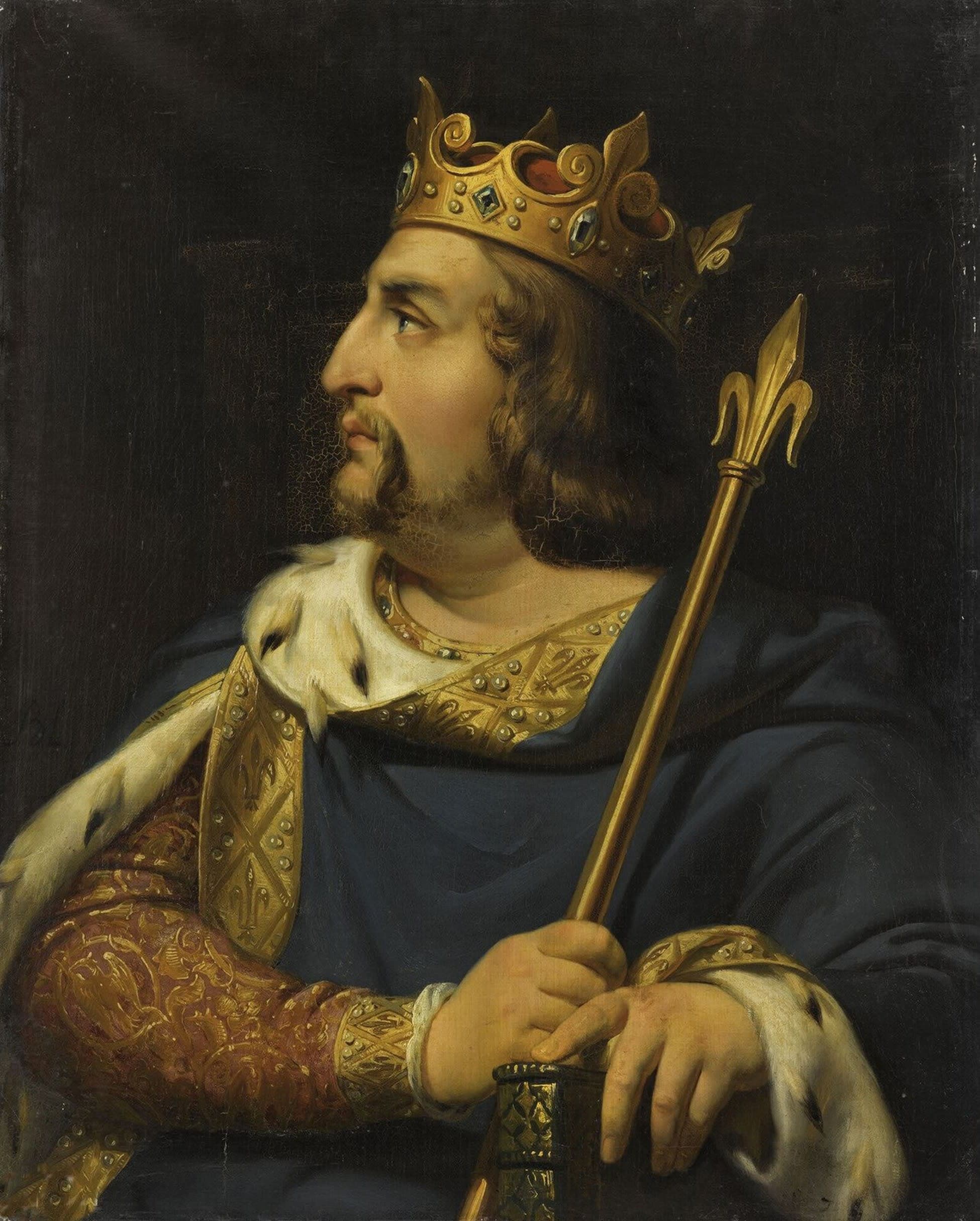
Louis VI, known as Louis the Fat, was born on December 1, 1081. He was the eldest and only one of four sons of King Philip I and his first wife, Bertha of Holland, to reach adulthood. Louis was the first Capetian to bear a name traditional to the Merovingian and Carolingian dynasties.

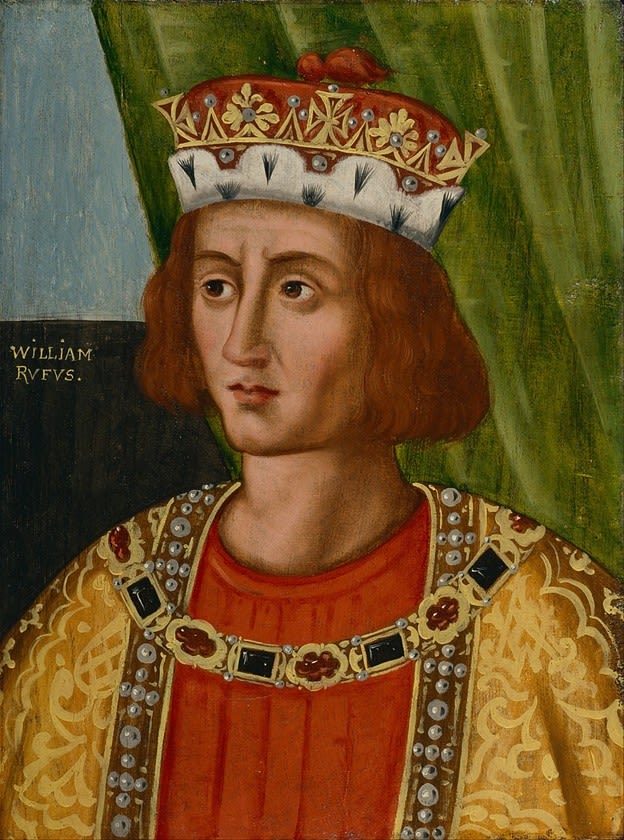
The prince was educated at the Abbey of Saint-Denis, where his fellow student and lifelong friend was the future abbot and royal adviser, Suger. In 1092, at the age of 11, Louis left the abbey and received from his father the county of Vexin including the towns of Pontoise and Mantes tasked with defending it from Norman aggression. He was knighted in 1097. Soon war broke out with King William II Rufus of England, who claimed Vexin. Thanks to the determined resistance of royal forces, the disputed territory was preserved, though chroniclers differ on how active the young prince was in battle.
Louis’s personal life was marred by conflict with his stepmother. King Philip I had divorced Louis’s mother to marry Bertrade de Montfort, who saw her stepson as an obstacle to her own sons’ advancement. Although Philip I proclaimed Louis his co-ruler in 1100, Bertrade sought to remove him. The chronicler Orderic Vitalis reports that she even tried to persuade King Henry I of England to capture and imprison Louis. When that failed, she allegedly sent assassins and later attempted to poison him, but Louis was saved by a skilled Jewish physician in 1101.

To counter Bertrade’s influence, in 1104 Louis married Lucienne de Rochefort, from one of the most powerful families in the Île-de-France. The marriage, however, was annulled by a church council in 1107 on grounds of consanguinity. The divorce provoked open war between the crown and the great Montlhéry-Rochefort family.
King Philip I died on July 29, 1108. On August 3, Louis VI was hastily crowned in the cathedral of Orléans, not in Reims, which was controlled by his opponents, including his half-brother Philip of Mantes and Count Theobald of Blois. The rushed ceremony and absence of major vassals demonstrated the weakness of royal authority at the dawn of the Capetian era.

Immediately after his accession, Louis had to fight for the very survival of royal power. His real influence extended only to the region around Paris and Orléans. In the Île-de-France, key routes were controlled by powerful barons such as the Montlhérys, Rocheforts, and Montforts, who behaved like brigands, built stone castles, and defied the crown. Historian Charles Petit-Dutaillis noted that royal authority was hemmed in by “a ring of great principalities,” while within the domain “rebel lords swarmed.”
Throughout his reign, Louis VI waged an energetic, relentless struggle against his vassals to restore order and assert royal justice. He stripped Hugh of Crécy (brother of his former wife) of his seneschal’s office, prompting a baronial alliance. In 1109, the king destroyed Puiset Castle and captured its lord, Hugh III. In 1112, Louis annexed the extinct County of Corbeil to the royal domain, provoking the anger of Count Theobald of Blois. In the ensuing decisive battle, Louis was victorious, securing Corbeil for the crown. In 1114, he besieged and seized the Rochefort castles, ending their dominance and redistributing their lands among his supporters.

In 1114, Louis secured the condemnation of Thomas of Marle by a church council for murdering the bishop of Laon, depriving him of his titles but imposing only a fine. When Thomas rebelled again in 1130, he was killed in battle during the siege of his fortress at Coucy.
Once his domain was consolidated, Louis turned to external threats chiefly Henry I Beauclerc, who had united England and Normandy in 1106. In 1109 Louis tried to recapture the strategic fortress of Gisors, but the conflict settled into a low-intensity war.
Open war erupted in 1118, when Louis led a broad coalition against Henry Beauclerc, including Henry’s nephew William Clito and Count Fulk V of Anjou. In 1119, however, Louis suffered a crushing defeat at the Battle of Brémule, narrowly escaping capture. His attempt to seek papal arbitration brought no success.

A confrontation with the Holy Roman Emperor Henry V followed in 1124. The emperor, allied with Henry Beauclerc, assembled an army to invade France. Louis VI called his vassals to arms and took from the altar of Saint-Denis the Oriflamme, the sacred battle standard. The threat proved so grave that even powerful nobles like Theobald of Blois responded to his summons. An army of some 60,000 men advanced into Lorraine, forcing Henry V unprepared for such unity to retreat. This episode is often regarded as the first manifestation of French patriotism and the origin of the tradition of raising the Oriflamme before major campaigns.
Despite his setbacks in Normandy, Louis VI extended his influence by intervening in other principalities, such as Auvergne, supporting the Bishop of Clermont. In 1127 he sought to assert control over wealthy Flanders, backing William Clito’s claim to the county. Yet opposition from the English crown and Flemish merchants led to William’s death in 1128, leaving Flanders independent.
In his final years, Louis ensured dynastic continuity: in 1129 he had his eldest son Philip the Younger crowned co-ruler. After Philip’s accidental death in 1131 (gored by a pig in Paris), Louis crowned his second son also named Louis just twelve days later, in a ceremony performed by Pope Innocent II himself.

The crowning achievement of Louis VI’s reign came in 1137, when his son Louis married Eleanor of Aquitaine, heiress to the richest and largest duchy in France. This marriage dramatically expanded the kingdom’s influence.
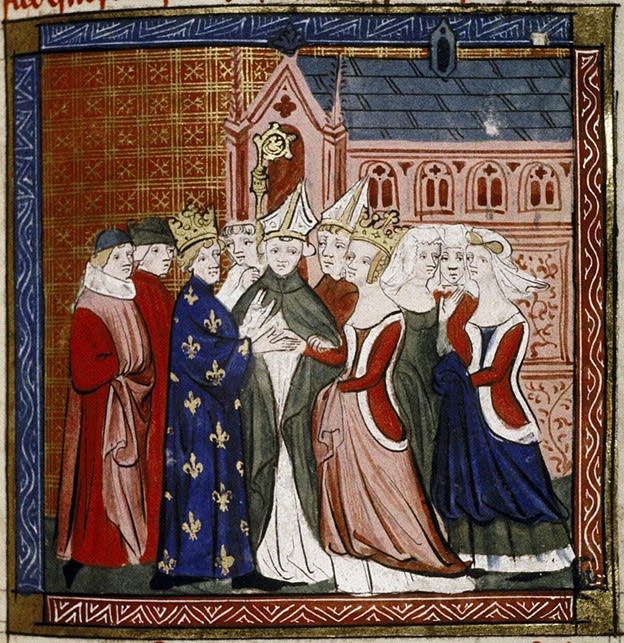

Louis VI died on August 1, 1137, at Béthisy-Saint-Pierre, suffering from obesity and dysentery.
Louis VI the Fat is considered one of the most important Capetian kings. He subdued rebellious vassals within the royal domain and greatly strengthened the authority of the monarchy. He is often regarded as the father of French centralization, having begun to build an administrative and judicial system independent of territorial princes. From his household he formed a Royal Council, the prototype of a future government.
Although chroniclers noted both his joviality, bravery, and kindness, as well as his gluttony that led to obesity, Louis VI laid the foundations that would enable his grandson, Philip II Augustus, to complete the subjugation of the great French feudal lords.


