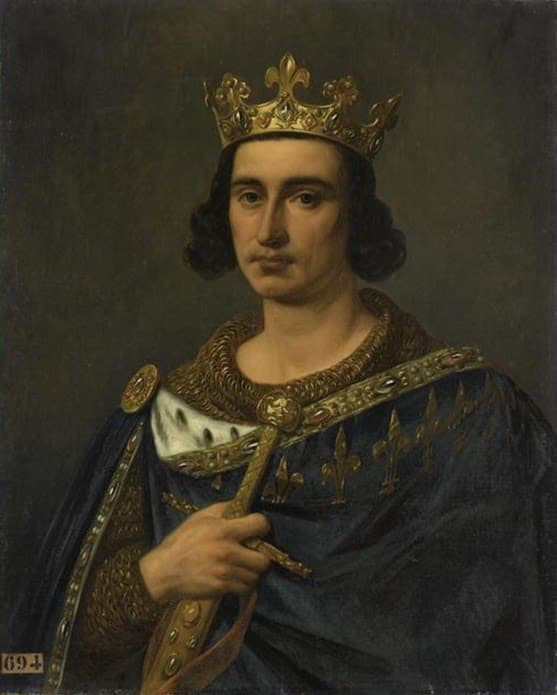

Louis IX was born in 1214 and was the son of King Louis VIII. Louis IX ascended the throne of France at the age of twelve, after the early death of his father in 1226. Thanks to the efforts of his predecessors, royal power by that time was already strong enough.
Due to the young age of the king, his mother, Blanche of Castile, became regent. Blanche was an intelligent, strong-willed and deeply religious woman; she had a great influence on her son, raising him in the spirit of Christian virtue and knightly honor. Blanche successfully governed the country during the regency, strengthening royal authority.

In 1234 Louis married Margaret of Provence, daughter of Count Raymond Berengar IV of Provence. The beginning of Louis’s independent rule did not bring significant changes in politics, since royal power was already firmly established.

In 1242 King Henry III Plantagenet of England attempted to regain the lost possessions of his ancestors in Aquitaine but suffered a crushing defeat at the Battle of Taillebourg. However, Louis, following his principles of justice, voluntarily ceded to Henry part of the territories taken back in the time of Philip II Augustus, without seeking maximum benefit from victory.
In 1244 Louis fell seriously ill and, as a sign of his faith, vowed to go on a crusade if he recovered. In September 1248 he set out with the crusading army and in the spring of 1249 captured the Egyptian city of Damietta.
However, the campaign turned out to be unsuccessful. In 1250, during the retreat to Damietta, the Saracens overtook Louis and took him prisoner. The king was released only after paying a huge sum of money and returning Damietta. In May 1250 Louis sailed from Egypt but spent another four years in Syria, waiting for new crusaders. He actively strengthened Christian fortresses such as Jaffa, Acre and Sidon, and established relations with Asian rulers. After learning about the death of his mother, the monarch returned to France after a six-year absence.
After his return, Louis IX zealously took up state affairs. He was no longer considered “the first among equals” but a full-fledged sovereign, yet he treated the rights of his vassals with respect. His reign was marked by a significant contribution to the strengthening of royal power and the reform of the judicial system.
Louis banned judicial duels and private wars in the royal domain and granted subjects the right to appeal decisions of local courts to the royal court. The main judicial body became the Paris Parliament, which included peers and legists (lawyers), whose activities significantly contributed to the strengthening of royal power.


In 1254, for the first time in the history of French legislation, he declared the principle of the presumption of innocence: “That no one shall be deprived of his right without confession of guilt and without trial.”
In 1254 the “Great Ordinance” was published, which systematized local administration, dividing the country into twenty districts headed by royal officials — bailiffs.
In 1272 a code of customary law and laws was compiled, known as the “Establishments of Saint Louis.”
According to the ordinances of 1262 and 1265, the monetary system was regulated: coins of royal minting circulated throughout France, while seignorial coins were limited to the lands of their minting.

In March 1269 Louis issued the “Pragmatic Sanction,” which strengthened the independence of the French Church from Rome, canceling financial levies in favor of the papal curia.
Louis IX actively patronized science and art, for which he was called the Pericles of medieval architecture. His time saw the construction of the cathedral in Reims and the famous Paris church of Sainte-Chapelle, where he kept relics. The king actively collected and copied books, founding the “Treasure of Charters” for storing the most important state documents. He also supported scholars such as the theologian Vincent of Beauvais, whom he commissioned to compile the universal encyclopedia “Great Mirror.”
Regarding the Jews, Louis pursued a strict policy. In 1239 he supported Pope Gregory IX in his demand to confiscate the Talmuds (a collection of legal and religious-ethical principles of Judaism) from the Jews. In 1242 in Paris, 22 cartloads of Talmuds taken from the Jews were publicly burned.


The failure of the Seventh Crusade did not weaken the king’s religious enthusiasm. In 1267 Louis IX received permission from the Pope for the Eighth Crusade. In March 1270 he went to Tunis, hoping to convert the local caliph to Christianity.
While waiting for reinforcements, an epidemic of deadly disease broke out in the crusader army. On August 3 Louis’s son John Tristan died, and on the same day the king himself fell ill. On August 25, 1270 Louis IX suddenly died at the supposed place of death, the hill of Byrsa (now within Tunis). Two days later his son, the dauphin Philip, was proclaimed the new king.

The body of Louis IX was transported by his younger brother Charles of Anjou to Sicily, and later, in May 1271, the remains were transferred and buried in Saint-Denis.
Immediately after his death, the process of his canonization began. Twenty-seven years later, in August 1297, Pope Boniface VIII by the bull “Gloria laus” proclaimed him a saint under the name of St. Louis of France. He became the first saint among French kings to be canonized by official procedure. His cult greatly strengthened the authority of the Capetian dynasty.


