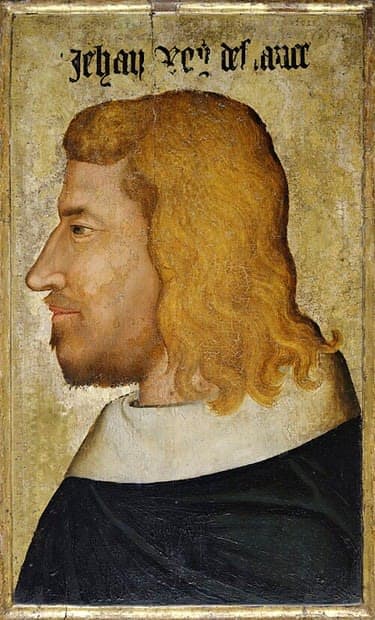

John’s father, King Philip VI, sought to strengthen the newly founded Valois dynasty. As soon as his son reached adulthood at the age of thirteen, he arranged for him a strategically important marriage. The initial plan to ally with the sister of the King of England was abandoned in favor of Bonne of Luxembourg, who was older and could bear an heir sooner. This dynastic union, concluded in 1332 in the presence of six thousand guests, secured the support of John the Blind, King of Bohemia and Count of Luxembourg. The festivities lasted for two months, and the thirteen-year-old John was knighted in Notre-Dame Cathedral.
John received the titles Duke of Normandy, Anjou, and Maine. However, governing Normandy proved difficult due to its strong ties to England and its maritime trade across the English Channel. Royal authority constantly clashed with rebellious clans such as the Tancarvilles and Harcourts. When Geoffrey d’Harcourt revolted against royal interference, many followed his example, undermining the Valois dynasty’s legitimacy and strengthening Norman sympathy toward Edward III of England.

After the death of his first wife, John married Joan of Auvergne in January 1350. Through this marriage, he became guardian to his stepson Philip of Rouvres, who would later become Duke of Burgundy. Upon ascending the throne, John placed the Duchy of Burgundy under direct royal administration, laying the groundwork for its eventual incorporation into the crown in 1361.
The main internal threat to his rule was Charles II the Bad, King of Navarre—John’s cousin and son-in-law. In 1354, Charles organized the assassination of the royal favorite, Constable Charles de la Cerda. Although John temporarily made peace with the Navarrese king, suspicions of conspiracy persisted.
In April 1356, John launched a surprise raid on the Dauphin’s castle in Rouen, arresting Charles the Bad during a feast. Four of Charles’s chief supporters were executed without trial, and Charles himself was imprisoned. This decisive yet brutal act was intended to terrify the nobility and prevent treason.
While John was fighting internal enemies, the external conflict worsened. In July 1356, the Black Prince (son of Edward III) invaded France. John the Good pursued him with a numerically superior army of heavily armed knights and caught up near Poitiers.
The French, confident of victory, rejected English offers of truce. On September 19, 1356, the Battle of Poitiers took place. Uncoordinated attacks by French knights against the disciplined English infantry and archers ended in disaster.


John II displayed personal bravery, fighting with a battle axe alongside his household knights. However, he was surrounded and captured by a young French knight in English service named Denis de Morbecque. The king, who insisted on surrendering only to “his cousin, the Prince of Wales,” ultimately handed his gauntlet to Morbecque. John and his younger son Philip were taken to Bordeaux and then sent to England.

In England, John was treated as a royal guest and allowed to maintain his courtly lifestyle, while France plunged into chaos. Only on May 8, 1360, was the Treaty of Brétigny signed. Edward III renounced his claim to the French crown in exchange for an enormous ransom of 3 million écus and full sovereignty over vast territories, including Guienne and Poitou.
Leaving his son Louis of Anjou as a hostage in Calais, John returned to France to raise the ransom. To do so, he imposed new taxes, took loans, and in 1360 introduced the first gold coin, called the franc (literally “free”).

However, in July 1363, Louis escaped from captivity. Shocked by what he saw as a stain on royal honor, John II declared that he would voluntarily return to England as a prisoner in his son’s place, citing his duty to uphold “honest intentions and honor.”
John the Good was warmly received in London, but a few months after his arrival, in April 1364, he fell ill with an “unknown disease” and died in the Savoy Palace. His body was brought back to France and buried in the royal necropolis of Saint-Denis Abbey.
Although prone to anger and impulsive violence, John II the Good was remembered as a warrior-king, whose personal courage at Poitiers and devotion to knightly honor—even at the expense of the state—became a symbol of the chivalric spirit of his age.


