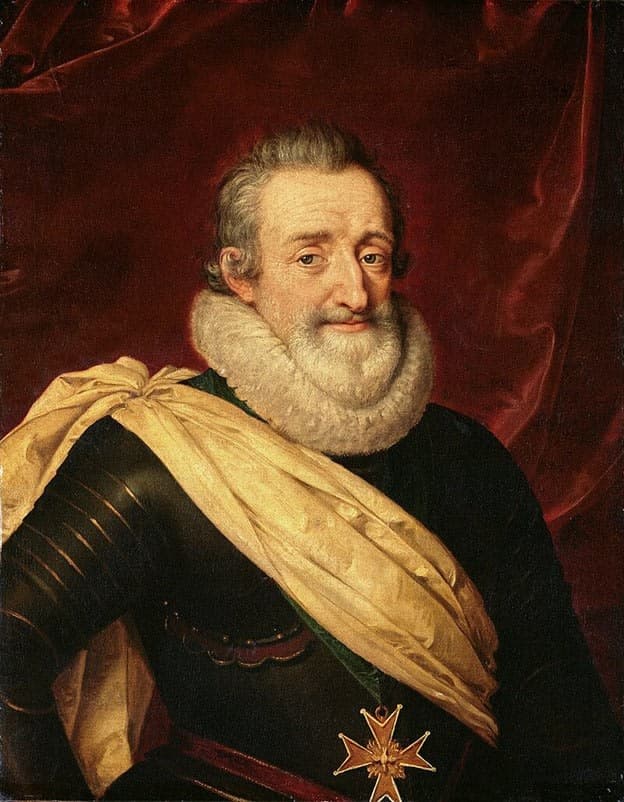

Henry IV was born in 1553 in Pau, in the castle of his grandfather. According to legend, immediately after birth his lips were rubbed with garlic and moistened with wine to protect him from illness. His mother, Jeanne d’Albret, a staunch Calvinist, raised him in the Protestant faith, though he was baptized as a Catholic.
From 1561, Henry lived at the French court, where his religion became a source of family conflict. During the First War of Religion, he stayed in the neutral castle of Renée of France. After his father’s death, Henry remained at court as a guarantor of peace between France and Navarre. In 1568, he took part in his first military campaign the Third War of Religion, serving under Admiral Gaspard II de Coligny.

In 1572, after his mother’s death, Henry became King of Navarre. Soon after, a political marriage was arranged between him and Marguerite de Valois, sister of King Charles IX. The wedding, held on August 18, 1572, was orchestrated by Catherine de’ Medici and turned into a deadly trap.

Just a few days later, on August 24, 1572, the St. Bartholomew’s Day Massacre began in Paris. Henry narrowly escaped death by renouncing Protestantism and outwardly converting to Catholicism.
Forced to remain at the French court for three years, he befriended the king’s brother, Francis, Duke of Alençon. In 1576, Henry escaped, rejoined his followers, and reconverted to Protestantism.
In 1584, the death of the childless Duke of Anjou made Henry of Navarre, as a direct male descendant of Louis IX, the rightful heir to the French throne. However, under pressure from the Guise family, King Henry III outlawed Protestantism, sparking the War of the Three Henrys.
Henry of Navarre proved a brilliant commander. In 1587, he defeated the royal army at the Battle of Coutras, and the assassination of Henry, Duke of Guise, in 1588 brought him closer to Henry III. On April 30, 1589, the two kings signed a treaty of alliance.


On August 2, 1589, after Henry III was assassinated by the fanatic Jacques Clément, Henry of Navarre was proclaimed King of France Henry IV.
However, three-quarters of the kingdom, supported by the Catholic League, refused to recognize a Protestant king. Weakened, Henry lifted the siege of Paris, but triumphed soon after in two key battles: Arques (September 29, 1589) and Ivry (March 14, 1590). At Ivry, leading his troops personally, he achieved a decisive victory that allowed him to blockade Paris.

Exhausted by war and short of funds, Henry took a pragmatic step. On July 25, 1593, in the Basilica of Saint-Denis, he converted to Catholicism — the moment immortalized by his legendary phrase: “Paris is well worth a Mass.”
He was crowned on February 27, 1594, in Chartres Cathedral (breaking the Reims tradition), and entered Paris triumphantly on March 22, 1594. On September 17, 1595, Pope Clement VIII granted him absolution, reconciling much of the Catholic nobility.
In 1595, Henry IV formally declared war on Spain, which had supported the League. The conflict dragged on until April 30, 1598, when Henry signed the Edict of Nantes, restoring religious freedom to Huguenots, granting them civil rights and the right to hold fortified towns. This ended decades of religious strife. Soon after, the Peace of Vervins (May 2, 1598) ended the war with Spain, securing France’s peace and stability.


After years of chaos, Henry IV aided by brilliant ministers such as the Duke of Sully and Barthélemy de Laffemas — rebuilt France’s economy and state institutions. Known as “Good King Henry” (le bon roi Henri), he prioritized agriculture and famously declared that he wanted every peasant to have “a chicken in the pot on Sundays.”
He founded the Gobelin tapestry manufactory, encouraged silk production, and initiated construction of the Briare Canal, the first navigable canal in France.

In 1607, Henry IV officially annexed Navarre and Béarn to the French crown, completing the centuries-long process of unifying France under one monarch. He also commissioned major urban projects the Grand Gallery of the Louvre and new Parisian squares, including the Place Royale (now Place des Vosges).

Henry supported Samuel de Champlain’s expedition, which laid the foundations for French colonization in Canada.
Having no heir with Marguerite de Valois, he annulled their marriage in 1599 and married Marie de’ Medici in December 1600. The birth of their son, Louis (the future Louis XIII), in 1601 secured the Bourbon line.
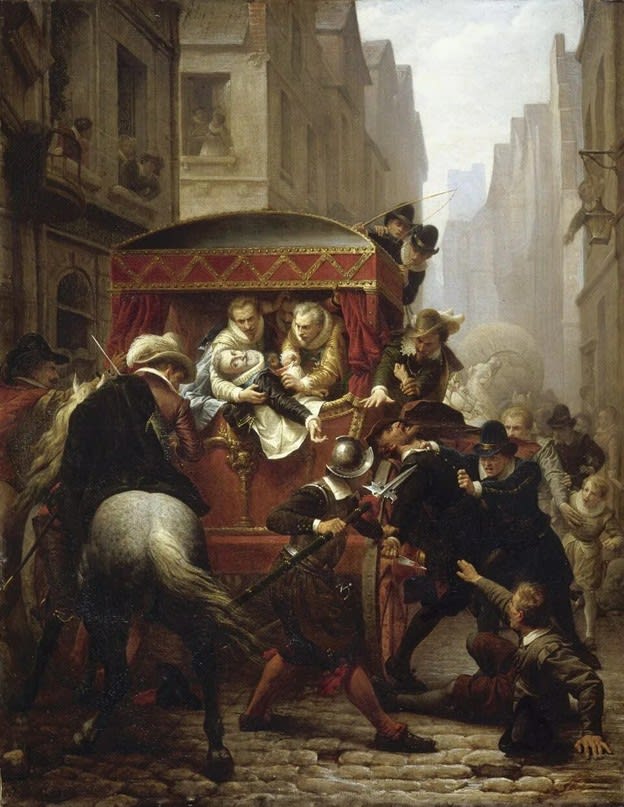
The end of Henry’s reign was shadowed by renewed tensions with the Habsburgs and a series of assassination attempts at least nineteen in total. On May 14, 1610, while traveling through Paris, Henry’s carriage was blocked on Rue de la Ferronnerie, where he was stabbed twice by the fanatic François Ravaillac. One blow pierced his lung and aorta, killing him instantly.
He was succeeded by his eight-year-old son, Louis XIII, under the regency of Marie de’ Medici. Henry IV’s reign left a deep mark on French memory — as the era of reconciliation, prosperity, and unity, and he remains an idealized symbol of a king who healed and rebuilt France.


