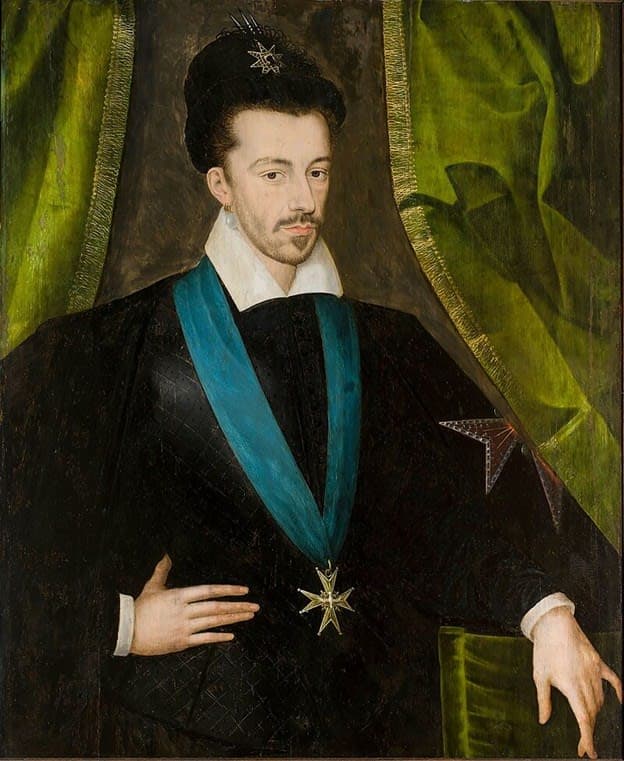

Henry III was born in 1551. As a young prince, he received an exceptional education under the guidance of François Carnavale and the famous translator of Aristotle, Bishop Jacques Amyot. Henry was not only highly educated but also intellectually sharp. He spoke Italian fluently (often using it in conversation with his mother, Catherine de’ Medici), read Machiavelli in the original, took lessons in rhetoric, and excelled in fencing and dancing. His charm and refined manners made him magnetic at court.

Henry’s personal style, however, sharply contrasted with French courtly traditions and later caused a cultural shock in Poland. The Venetian ambassador Moresini in 1573 described Henry’s “feminine elegance,” his fondness for jewelry, and his habit of wearing double pearl earrings and ornate clothing. These peculiarities, coupled with his attachment to handsome young favorites, fueled rumors of homosexuality and earned him the derisive nickname “the Prince of Sodom.”
Henry briefly went through a phase of interest in Protestantism, calling himself “the little Protestant” and even attempting to convert his younger sister, Marguerite. His mother, however who loved Henry above all her children swiftly ended this experiment, determined to secure him a Catholic crown. Within three years she turned him into a seemingly devout Catholic, though this did little to improve his relationship with his brother King Charles IX, who viewed Henry as a potential rival.

Catherine actively sought “a crown” for her beloved son. When in 1572, Sigismund II Augustus, the last king of Poland from the Jagiellonian dynasty, died, Henry was put forward as a candidate for the Polish throne.
The St. Bartholomew’s Day Massacre (1572) had shocked the Polish nobility, who distrusted Henry. French diplomacy had to work tirelessly to convince the electoral Sejm that Henry was not responsible for the slaughter. In May 1573, Henry won the election — but at the cost of major concessions.
His envoys swore to uphold the Henrician Articles, which guaranteed noble privileges and the elective nature of the monarchy, as well as the Pacta Conventa, which bound the king to repay debts, support Polish youth’s education in France, and build a navy.
At his coronation in Kraków on February 21, 1574, Protestant leader Jan Firlej, Marshal of the Crown, interrupted the ceremony, demanding Henry sign guarantees for religious freedoms: “Swear it, king, you promised!” (Jurabis, rex, promisisti). Henry was forced to comply.


Henry’s short reign in Poland was a mutual cultural shock. The Poles were appalled by his effeminate manners and indifference to governance, while Henry, who did not speak Polish and spent his nights gambling and feasting, grew deeply homesick.
On June 14, 1574, he learned of his brother Charles IX’s death and the vacant French throne. Overcome by ambition, he resolved to flee. In the night of June 19, 1574, Henry of Valois secretly escaped from Wawel Castle, without notifying the Senate. Pursuers were sent after him, but he managed to bribe his way across the border.

Poland gave him until June 1575 to return; after his absence, he was formally deposed.
Returning to France amid the Religious Wars, Henry was crowned on February 11, 1575, and two days later married Louise of Lorraine. Lacking funds for war, he granted freedom of worship to the Huguenots, enraging the ultra-Catholic League, led by the powerful Henry, Duke of Guise.

In 1584, Henry’s younger brother Francis, Duke of Anjou, died. As Henry III had no children, the lawful heir became Henry of Navarre, leader of the Huguenots an outcome intolerable to the League, which was backed by Philip II of Spain.
In 1585, France plunged into the War of the Three Henrys, involving Henry III, Henry of Navarre, and Henry of Guise.
In May 1588, Paris, inflamed by the League, rose in rebellion against the king. Henry III fled the capital, while Guise entered Paris in triumph, hailed as a savior and potential monarch.
Desperate, the king decided to eliminate his rival. On December 23, 1588, during the Estates-General at Blois, Henry of Guise was assassinated by royal guards. The next day, his brother, Cardinal Louis of Lorraine, was also executed.


The murders turned Catholic opinion against the king. Pope Sixtus V excommunicated him, and Henry was forced to ally with his former enemy, Henry of Navarre. Together, the two Henrys marched to lay siege to Paris.
On the night of August 1, 1589, at Saint-Cloud, a fanatical Dominican monk, Jacques Clément, managed to gain access to the king.

Pretending to deliver confidential papers, Clément stabbed Henry in the abdomen with a dagger. The wounded king initially seemed to recover but soon realized he was dying. Surrounded by witnesses, he proclaimed Henry of Navarre his heir. Henry III died at 3 a.m. on August 2, 1589.
With Henry III’s death, the Valois dynasty came to an end. His successor was Henry IV, the first king of the House of Bourbon.
Later, Henry III’s remains were transferred to Saint-Denis Basilica. Curiously, the transfer was delayed for years — for it was prophesied that Henry IV would die a week after his predecessor’s reburial. The prophecy proved true: Henry IV was assassinated in 1610, shortly after the remains of Henry III were moved to the royal necropolis.


