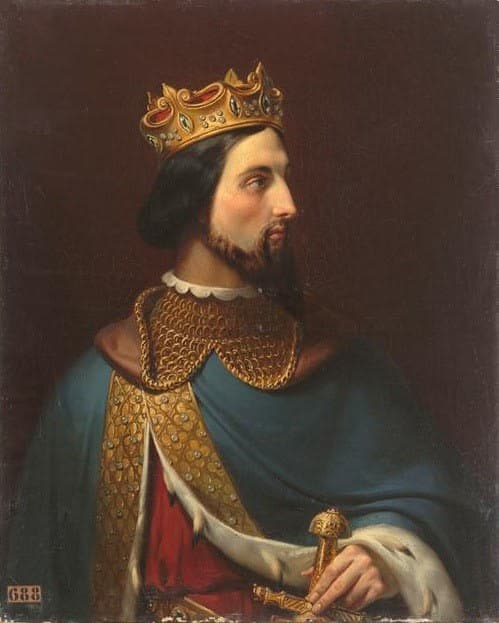

Henry I was the second son of King Robert II the Pious and his third wife, Constance of Arles. He was born around 1009–1010. For a long time, he was not considered the main heir to the throne. At the age of eight, in 1016, he became the nominal Duke of Burgundy a compromise that satisfied both King Robert, who wished to incorporate Burgundy into the royal domain, and the local nobility, who were struggling to preserve their autonomy.

Henry’s elder brother, Hugh Magnus, was crowned co-ruler in 1017 but died eight years later. Queen Constance’s favorite was her third son, Robert, whom she actively promoted as heir. King Robert II had to overcome fierce opposition from his wife and part of the nobility to secure Henry’s succession. Finally, on May 14, 1027, Henry was crowned in Reims.
The intrigues of Queen Constance continued. It is believed that under her influence, in 1030 Henry and his younger brother Robert rebelled against their father. They fled to Burgundy and allied with Count Renaud of Nevers but soon reconciled with the king.

After Robert II’s death on July 20, 1031, Queen Constance openly fought to place her favorite son Robert on the throne. She was supported by the powerful Odo II of Blois, whose lands surrounded the royal domain. Henry, on the other hand, was backed by Robert the Devil, Duke of Normandy, and Fulk Nerra, Count of Anjou.
At the beginning of the war, Henry was defeated and fled to Normandy. Duke Robert welcomed him with honor and provided him with troops. With the Norman army, Henry returned to Paris, where he reached a peace agreement with his brother: Robert renounced his claim to the crown but received the Duchy of Burgundy in return. Soon afterward, Queen Constance died in exile.
Henry’s position improved thanks to the intervention of Emperor Conrad II of the Holy Roman Empire. In 1032, King Rudolph III of Burgundy died without heirs, and both Odo II of Blois and the emperor laid claim to his inheritance. This made Conrad II and Henry I natural allies. In 1034, the emperor’s invasion of Champagne forced Odo II to abandon his ambitions.


Henry I won the war for the throne, but at the cost of major concessions to his vassals. He lost Burgundy, ceded the strategically important southern part of the Vexin to the Duke of Normandy, and left the vast possessions of the House of Blois untouched. As a result, Henry I could only be “first among equals” among his nominal vassals.

After the death of Robert the Devil in 1035, Normandy fell into feudal anarchy. Henry initially took advantage of this situation, supporting the young Duke William (the future William the Conqueror) against rebellious barons. In 1047, Henry helped William defeat the rebels at the Battle of Val-ès-Dunes.
However, relations worsened sharply in 1052 when William married the daughter of the Count of Flanders, creating a potentially dangerous alliance for the French crown. Henry I broke the alliance and began supporting rebels in Upper Normandy, forming a coalition with Count Geoffrey Martel of Anjou. In 1053, William defeated part of the royal army, and in 1054 he crushed another royal force at the Battle of Mortemer. In 1057, Henry again invaded Normandy, but his rearguard was defeated. Until his death, Henry I unsuccessfully tried to drive William out, ultimately dying during the siege of the Norman fortress of Thimert.
For the first twenty years of his reign, Henry was an ally of the emperors of the Holy Roman Empire. But in 1051, he married Anna of Kiev, daughter of Grand Prince Yaroslav the Wise of Kievan Rus’, thus joining the anti-German alliance system. His relations with Emperor Henry III became strained, especially after a dispute over the relics of Saint Denis, which Regensburg claimed to possess. Henry I personally traveled to Bavaria to prove that the Regensburg relics were fake. In 1056, at a personal meeting, Henry I even accused Emperor Henry III of violating treaties, highlighting the growing tension between France and the Holy Roman Empire.


During Henry I’s reign, the barons of the Île-de-France grew increasingly powerful, building stone castles and waging private wars that made trade routes unsafe. After a series of early failures, the king spent the last decade of his reign doing little to curb his vassals or intervene in the growing struggle of cities for communal rights.
Henry’s only significant success was the continuation of the Capetian tradition of securing succession during the monarch’s lifetime: he had his eldest son Philip crowned as co-ruler. The ceremony took place on May 23, 1059, in Reims, in the presence of all the princes of France except the Duke of Normandy. Philip was only seven years old at the time. Henry I died the following year.


