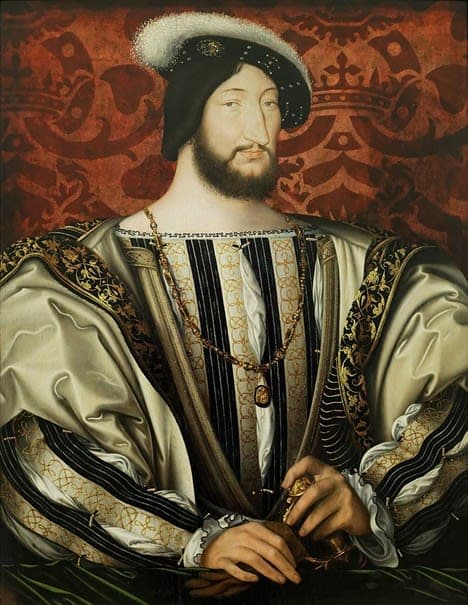

Francis I was born in 1494, and before reaching the age of two, he lost his father. His mother, the energetic and educated Louise of Savoy, raised him together with his sister Marguerite of Navarre in her castle at Cognac, and later at the royal castle of Amboise. This secluded upbringing, full of maternal affection and admiration from his peers, made Francis cheerful, carefree, and somewhat self-centered. His chief passions were hunting and horseback riding.

In 1506, he was betrothed to Claude of France, daughter of King Louis XII and heiress to the Duchy of Brittany. Upon the death of Louis XII on January 1, 1515, Francis his cousin and son-in-law ascended the French throne.
Following in the footsteps of his predecessors, Francis I immediately began preparing for the conquest of the Duchy of Milan, to which he laid dynastic claims.
He renewed alliances with England, particularly with Henry VIII, and concluded treaties with Venice and Charles of Habsburg (the future Emperor Charles V).
The young king performed an extraordinary military feat—crossing the Argentière Pass in the Alps by hand-carrying his artillery and blasting through rock to clear the way.
On September 14, 1515, his 30,000-strong army met the Swiss mercenaries at the Battle of Marignano, the “Battle of Giants.” The encounter ended in a brilliant French victory and the conquest of Milan.


The campaign made Francis I a hero and earned him the title “Caesar, conqueror of the Swiss.” In 1516, he signed a “Perpetual Peace” with the Swiss, gaining the right to hire their troops for high pay.
His Italian success marked the dawn of the French Renaissance. Inspired by the Italian courts, Francis invited Leonardo da Vinci to France and housed him at Clos Lucé, near Amboise. He also patronized Andrea del Sarto and Raphael.

In Bologna (1515), Francis met Pope Leo X and signed a Concordat, which abolished the Pragmatic Sanction of Charles VII and granted the king the right to appoint bishops.
Francis also formed an alliance with Charles of Austria, who had promised to marry a French princess. But after the death of Emperor Maximilian I, both Francis and Charles competed for the imperial crown; Charles V was elected in 1519.
The rivalry between the Valois (France) and Habsburg (Spain and the Empire) became the dominant axis of European politics in the sixteenth century.
The First War (1521–1526) broke out over claims to Milan and Burgundy. Despite early success, the French were defeated at Bicocca (1522). The war was worsened by the betrayal of Constable Bourbon, who defected to Charles V. The climax came at the Battle of Pavia (February 24, 1525), where Francis was wounded, captured, and taken to Madrid.

His captivity ended with the Treaty of Madrid (1526), under which he ceded Burgundy, Artois, Flanders, and Naples, while his two eldest sons were sent to Spain as hostages.
The Second War (1526–1529) began when Francis, upon his release, repudiated the treaty. He formed the Holy League to “liberate Italy” but was again defeated. The conflict ended with the “Ladies’ Peace” of Cambrai (1529), in which Francis kept Burgundy but renounced his Italian claims and paid a massive ransom.


Seeking to weaken Charles V, Francis I made a historic alliance with the Ottoman Sultan Suleiman the Magnificent in 1535 a defensive and offensive pact that secured France commercial privileges throughout the Ottoman Empire.

The Third War (1535–1538) saw the French occupy Savoy and Piedmont, though without decisive victory. It ended with the Truce of Nice (1538), soon broken when Charles V refused to grant Milan to Francis’s son.
The Fourth War (1541–1544) erupted after the murder of French agents. Francis mobilized five armies, and the Turkish fleet under Hayreddin Barbarossa captured Nice. Despite a brilliant victory at Ceresole (1544), Francis was forced to sign the Treaty of Crépy on September 18, 1544, restoring the status quo between the rivals.

The reign of Francis I marked the strengthening of royal absolutism in France. He adopted the principle “Si veut le roi, si veut la loi” (“What the king wills, the law wills”).
He created the office of royal governors, who wielded wide authority in the provinces. The Parliament lost political significance, its seats becoming purchasable.
Francis I, however, founded the College of the Three Languages (Collège des Trois Langues) in 1530 for the study of Greek, Latin, and Hebrew challenging the scholastic dominance of the Sorbonne.
To finance wars and court extravagance, taxes soared. He established state annuities (rentes) in 1522, introduced a state lottery (1539), expanded the navy, and encouraged industry.
In religion, Francis I was inconsistent. At first, he supported humanist reformers, but after the “Affair of the Placards” (1534), when anti-Catholic pamphlets appeared in Paris he began harsh persecution of Protestants, authorizing executions of heretics and massacres of the Waldensians.
Francis I died on March 31, 1547, and was buried in Saint-Denis Abbey. He left behind not only a centralized French state but also a rich cultural legacy, ushering in the full bloom of the French Renaissance.



