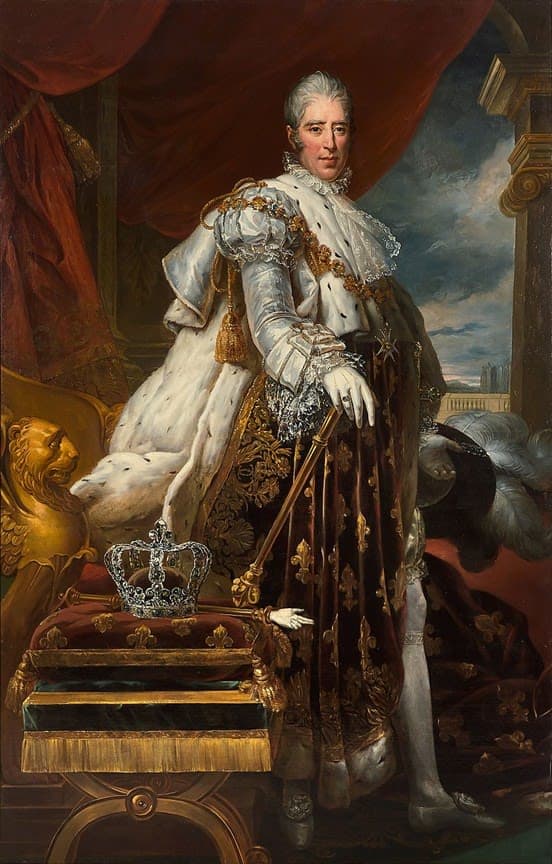

Charles X was born in 1757 at Versailles, the younger brother of Louis XVI and Louis XVIII. From birth until his accession, he held the title Count of Artois. Unlike his elder brothers, who were slow and indecisive, Charles was handsome, energetic, and passionate, earning a reputation as a charming courtier and notorious lady’s man. His lifelong companion was Yolande de Polastron, Duchess of Polignac, to whom he was deeply devoted.
Charles was a fierce opponent of democracy and of any concessions to the Third Estate. His rigid royalism made him deeply unpopular, even among moderate monarchists. In early 1789, his denunciations of the revolutionary National Assembly were so extreme that Louis XVI reportedly called him “more royalist than the king himself” (plus royaliste que le roi), a phrase that became proverbial.
After the storming of the Bastille in 1789, Louis XVI urged Charles to leave France, fearing that his extremism would endanger the monarchy. Politically, this also ensured that, if the royal family perished, Charles could continue the Bourbon line for he had two sons.


After the execution of Louis XVI in 1793 and the death of the young Louis XVII in 1795, Charles’s elder brother Louis XVIII proclaimed himself king in exile. Charles, as his heir, became the de facto leader of the royalist cause.
Following the death of Madame de Polastron in 1803, the Count of Artois, who was then living in Great Britain, underwent a transformation from a libertine into a devout Catholic, aligning himself with ultramontane conservatism the belief in papal supremacy and strict clerical authority.
When the Bourbon Restoration occurred in 1814, Charles, now bearing the title Monsieur, was initially reluctant to return to France. He regarded his brother Louis XVIII as a “traitor to the crown” for accepting a constitution and granting amnesty to “regicides.”
In 1820, tragedy struck when his beloved younger son, the Duke of Berry, was assassinated. This murder seemed to threaten the extinction of the senior Bourbon line, as Charles’s elder son was childless. However, a few months later, the Duke’s widow gave birth to a posthumous son, Henri, Duke of Bordeaux, nicknamed “the miracle child.” Charles devoted himself to raising his grandson in the strict tradition of Bourbon royalism.

Upon Louis XVIII’s death on September 16, 1824, Charles ascended the throne. Unlike his brother, he sought to emphasize the sacred and traditional character of monarchy, being anointed at Reims Cathedral on May 29, 1825 — the last French king ever crowned there. The opulent medieval-style coronation, including the ritual “healing of scrofula,” drew criticism for its archaism. During the ceremony, Charles swore to uphold “the laws of the realm and the Constitutional Charter,” but by placing the Charter second, he revealed his priorities.

Charles X’s reputation as an enemy of civil liberties and a reactionary monarch was well known, though many admired his strength of will and personal discipline. He retained the ultra-royalist ministry of Jean-Baptiste de Villèle, whose government passed several highly controversial laws: A compensation bill granting nearly 988 million francs to émigrés dispossessed during the Revolution alarming small landowners who feared property redistribution. A Law Against Sacrilege, prescribing the death penalty for blasphemy, which outraged liberal and anticlerical circles.
Despite his politics, Charles was a patron of the arts. Under his reign, the Egyptian Department of the Louvre was established under Jean-François Champollion, and France’s intellectual and artistic life thrived.

In foreign policy, Charles sought to restore France’s prestige, maintaining friendly ties with Russia and considering colonial expansion at the expense of the Ottoman Empire.
In August 1829, he appointed Prince Jules de Polignac, an uncompromising ultra-royalist and close confidant, as Prime Minister a disastrous decision that alienated moderates.
Facing a liberal majority in parliament, the Polignac cabinet provoked confrontation. On March 17, 1830, the Chamber of Deputies issued the famous “Address of the 221,” a declaration of no confidence in the government.
Ignoring warnings, on July 25, 1830, Charles X and his ministers signed the July Ordinances of Polignac, flagrantly violating the Constitutional Charter by:Dissolving the newly elected Chamber of Deputies, Suspending freedom of the press, Reducing the electorate through property qualifications.
The publication of these decrees on July 26 sparked an immediate uprising in Paris the July Revolution of 1830, which toppled the Polignac ministry and the Bourbon monarchy itself.


On August 2, Charles X abdicated in favor of his ten-year-old grandson, Henri, Count of Chambord, naming the Duke of Orléans, Louis-Philippe, as regent. However, the liberal Chamber of Deputies refused to recognize the child’s claim and instead proclaimed Louis-Philippe I “King of the French,” establishing a constitutional monarchy and ending the senior Bourbon line’s rule.
Charles X went once more into exile first to Great Britain, then to the Austrian Empire. He steadfastly regarded only his grandson, the Count of Chambord, as France’s rightful monarch.
Charles X died of cholera on November 6, 1836, in Gorizia (then part of the Austrian Empire, now Slovenia). He was buried in the Church of the Annunciation in Kostanjevica, beside other exiled Bourbons.
His death marked the end of the ultra-royalist dream of restoring the Old Regime in France and the final collapse of divine-right monarchy in its traditional Bourbon form.


