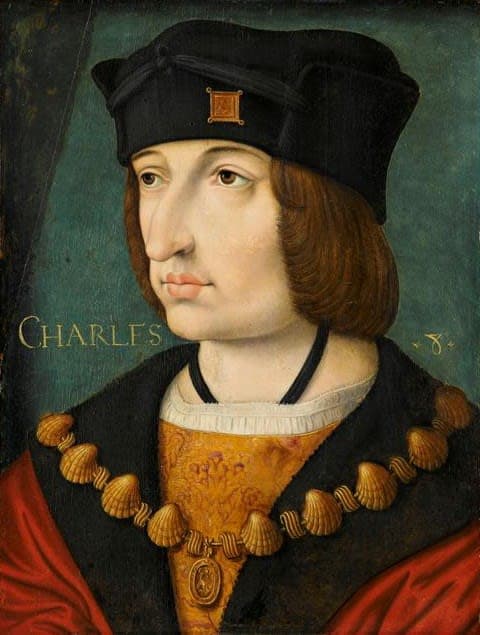

Charles VIII ascended the French throne on August 30, 1483, at the age of thirteen, becoming the only surviving son of Louis XI and Charlotte of Savoy.
Due to the king’s fragile health and congenital deformities such as a large head, bowed legs, and, according to some accounts, six toes on one foot his father had entrusted the regency to his elder sister, Anne of Beaujeu, whom Louis XI once called “the least foolish woman in France.” Anne, together with her husband Pierre II of Bourbon, governed the kingdom until 1491.

At the beginning of Charles VIII’s reign, the government led by Anne of Beaujeu convened the Estates General of 1484, which adopted a program of moderate reforms. However, these reforms were never implemented, and the Estates General would not be summoned again for a long time.
The question of Charles’s marriage was crucial for consolidating royal power. Initially, in 1482, a marriage was arranged between Charles and Margaret of Austria, daughter of Emperor Maximilian I of the Holy Roman Empire. As her dowry, France was to receive parts of Artois and Burgundy. Margaret was raised at the French court in anticipation of the wedding.

However, in 1488, Francis II, Duke of Brittany, died, leaving his eleven-year-old daughter Anne of Brittany as sole heir. Seeking to preserve Breton independence, Anne was married by proxy to Maximilian I in 1490. The French regarded this marriage as a hostile act.
To prevent Brittany’s separation, the regent Anne of Beaujeu launched the so-called “Mad War” (Guerre Folle) against the Duke of Orléans and the Duke of Brittany. Eventually, Brittany was surrounded. French troops besieged Rennes, where the fourteen-year-old Anne resided. Charles VIII personally sought her hand in marriage, and in December 1491, the wedding took place at the Castle of Langeais.
This union confirmed by Pope Innocent VIII in 1492 brought Brittany into permanent union with France. The former fiancée, Margaret of Austria, was sent back to her father.

Charles VIII managed to pacify neighboring powers angered by the Breton marriage: he paid Henry VII of England, returned Margaret’s dowry territories (Artois, Franche-Comté, and Charolais) to Maximilian I, and ceded Roussillon to Ferdinand II of Aragon.
Freed from internal and border issues, Charles turned to his greatest ambition the conquest of the Kingdom of Naples, to which he laid certain dynastic claims. A passionate admirer of chivalric ideals, he dreamed of emulating the knights of old.
In August 1494, Charles crossed the Alps at the head of a large army. His advance through Italy was triumphant he entered Naples “without a single lance being struck,” as the population, weary of their previous rulers, welcomed him as a liberator.


Crowned King of Naples, Jerusalem, and Emperor of the East, Charles spent two months indulging in lavish festivities a fatal mistake. A powerful League of Venice soon formed against France, uniting Pope Alexander VI, Venice, and even his former ally Lodovico Sforza of Milan.
Charles hurriedly retreated north. On July 6, 1495, his forces clashed with the League’s army at the Battle of Fornovo. The French failed to achieve a decisive victory and withdrew to France, losing all their Italian conquests.

The Italian expedition criticized by contemporaries as undertaken “without sense or money” brought France no territorial gains and marked the beginning of the long Italian Wars.
On April 7, 1498, Charles VIII died in Amboise in a tragic accident: entering a low doorway, he struck his head on the lintel, suffered a fatal brain injury, and died nine hours later.
Since all three sons born to Charles and Anne of Brittany had died in infancy, the crown, under the Salic Law, passed to his cousin Louis XII, Duke of Orléans.


