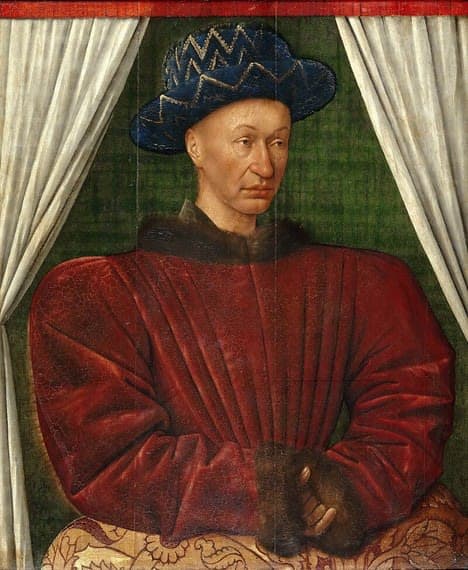
Charles VII was the fifth son of Charles VI the Mad and Isabeau of Bavaria. Although he had four elder brothers, their early deaths in youth made Charles heir to the throne and holder of the title of Dauphin. His path to the crown was one of the most arduous in the history of France.
When in May 1418 the Burgundians seized Paris, the fifteen-year-old Dauphin was forced to flee the capital. The following year he attempted to reconcile with the head of the Burgundians, John the Fearless. Their first meeting in July 1419 produced no results. The second meeting took place on 10 September 1419 on the bridge at Montereau. However, the Dauphin’s men, including Tanguy du Châtel, treacherously attacked the duke and killed him. The degree of Charles’s own involvement in this murder remains unknown, but this act darkened his reputation for life and became the reason for his fear of bridges.


The murder of John the Fearless had catastrophic consequences. The new Duke of Burgundy concluded an alliance with England, and Charles’s parents, Charles VI and Isabeau of Bavaria, in 1421 deprived him of his rights to the throne, declaring him an illegitimate child. Insulted and fearing for his life, Charles fled to southern France and found protection with the powerful Yolande of Aragon, whose daughter, Marie of Anjou, he married.

After the death of Charles VI in 1422, the question of succession remained unresolved. Under the Treaty of Troyes, the throne passed to the minor Henry VI of England. Charles, having no opportunity to make a decisive attempt to expel the English, controlled only the lands south of the Loire. His residence became the town of Bourges, and his opponents contemptuously nicknamed him the “King of Bourges.”
By 1429 the position of Charles’s supporters had become critical; Orléans, the last stronghold of French forces in the north, had been under siege for many months. It was at this moment that Joan of Arc appeared in his life. The girl, claiming that she had been given a divine mission, arrived in Chinon on 10 March 1429.
Charles decided to test her by hiding among the crowd, but Joan unerringly picked him out, saying, “God has granted you a happy life, dear Dauphin!” This event gave Charles the confidence he so desperately needed.
Joan of Arc not only lifted the siege of Orléans, but, inspiring the French troops, managed to lead Charles through English-occupied lands to his coronation at Reims, which took place on 17 July 1429.


Although Joan of Arc was later captured by the Burgundians and sold to the English, Charles did nothing to save her, and in 1431 she was burned at the stake in Rouen.
Despite Joan’s martyr’s death, her exploits and successes laid the foundation for Charles’s ultimate triumph. In 1435 he signed the Treaty of Arras, by which Burgundy came over to the side of France in the war with England.
In the following two decades, French troops liberated practically all the territory of France, leaving the English only the port of Calais.
In 1438 Charles ratified the “Pragmatic Sanction,” which proclaimed the primacy of a council over the papacy, laying the foundations for the freedom of the Gallican Church.
Charles also created the first standing army, including the gendarmerie, and in 1432 founded the University of Poitiers.
His policies contributed to the economic prosperity of the kingdom.

The later years of Charles VII’s reign were overshadowed by the hostility of his heir, Louis, who demanded more power and organized plots. In 1456 Louis fled under the protection of the Duke of Burgundy.
In the last months of his life Charles was tormented by the obsessive idea that he would be poisoned on his son’s orders. In July 1461, because of a tumor, he could no longer take food and died of starvation on 22 July 1461; he was buried at Saint-Denis.
Charles VII, despite his indecision and inaction at the beginning of his reign, undoubtedly left France in a better state than he had found it: for the first time since the Capetians, the country was united under the authority of a single monarch.


